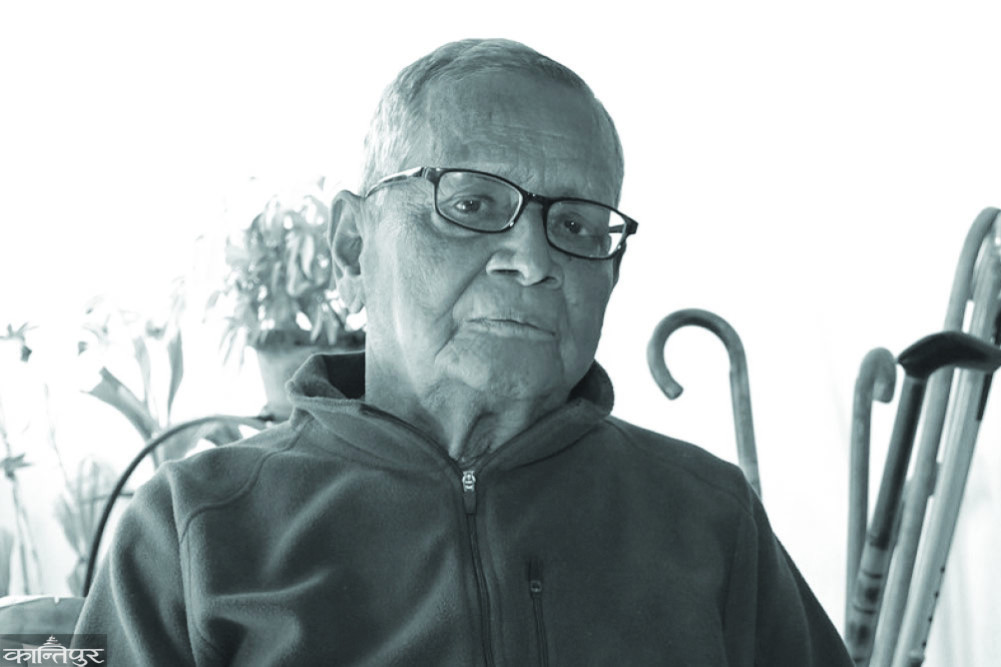
Dr. Pandey used to say – When a person is completely affected by myopia, he cannot see beyond the bridge of his nose. When a person has myopia, even reading and writing are useless.
We use Google Cloud Translation Services. Google requires we provide the following disclaimer relating to use of this service:
This service may contain translations powered by Google. Google disclaims all warranties related to the translations, expressed or implied, including any warranties of accuracy, reliability, and any implied warranties of merchantability, fitness for a particular purpose, and noninfringement.
Dr. Devendra Raj Pandey will no longer be seen among us. His identity as a prominent civic figure of Nepal has been established. A prominent activist of civil society and a person of self-reliance, Dr. Pandey is famous for his consciousness.
I was introduced to Dr. Pandey in 2036 BS. That was the year of the student movement. King Birendra had announced a referendum between the non-party Panchayat system and the multi-party democratic system to pacify the movement.
When that announcement was made, Dr. Pandey was working in the Ministry of Finance. He had stood in favor of the multi-party democratic system. At that time, the government formed under the leadership of Surya Bahadur Thapa had pressured him to open the government treasury in favor of the non-party Panchayat. After that, he started campaigning for the multi-party side. He used to say in clear words that the establishment of a multi-party democratic system was indispensable for development. After he entered the political arena as an intellectual activist, there was a huge stir in the country's intellectual society. However, the multi-party system was defeated by a small number of votes in the referendum.
In the period after the referendum, I established a close relationship with Dr. Pandey. At that time, I was the editor of Deshantar Weekly. The first interview I had with Dr. Pandey became very popular. In that interview, Dr. Pandey had said - We are between two prosperous countries, like a hut between two palaces. Dr. Pandey had given a symbolic example of India and China, which are moving rapidly on the path of development.
In the following days, he started appearing in meetings and ceremonies as a representative of civil society. Less than a decade after the referendum, a national people's movement for democracy took place in the country. BP Koirala was alive during the referendum. The national people's movement of 2046 BS was carried out by the Nepali Congress and the communist parties under the universal leadership of 'Iron Man' Ganeshman Singh.
After the victory of the multi-party faction in the People's Movement, an interim government was formed under the leadership of the acting president of the Nepali Congress, Krishna Prasad Bhattarai. Dr. Pandey became the Finance Minister of that government. After becoming the Finance Minister, he visited some districts in the east and west. I was with him at that time.
Dr. Pandey used to say – When a person is completely affected by myopia, he cannot see beyond the bridge of his nose. After becoming myopia, even what a person reads and writes is of no use. It is not that a degree is needed to know and understand. We have conscience. We have the power to reason. That is the difference between us and animals. However, that conscience is not being used here. Without conscience, autonomy is lost. No one has the feeling that I am a free being. And, this trend has become a single umbrella. Even animals have the sensitivity to know what is safe for them and where there is danger. Here, they do not even know what is right for them.
Dr. During my meeting with Pandey, I used to jot down his thoughts in my diary. I have tried to present the essence of his thoughts from those notes and more than half a dozen interviews I conducted with him.
In disputes about policies, principles, this project, that project, Dr. Pandey did not trust any side. He did not trust those who supported it, nor did he trust those who opposed it. He said imperialism, he said expansionism, he said it would harm the country. Someone said, ‘No, this is amazing.’ He said – even when Nepal’s economy is growing, there will be an economic growth of three to four percent. That too will be done through taxes, remittances, finance, construction. There is nothing in the productive sector. Agriculture has almost disappeared. There is nothing special in the factories. Unemployment has disappeared. How has this kind of economy been so affected, tell me? From the youth to the elderly in Kathmandu, there is ‘purchasing power’. Restaurants have opened everywhere, resorts have opened. Weekends have been called, they have jumped. I am not saying not to do that. Youth should have fun. But, the question is where did the money come from? More than half of the economy here is underground. Contractors who do big projects cannot work for ten years. They keep extending the deadline. How many years have they been building the road to Sankhu? How many years have they been building the road to Nuwakot? The contract has been given to those who are called middlemen. Where has all the money gone? It has been spent on building here. Motors worth three crores have been installed. Look at the state power. When I was the Finance Minister and Kisunji was the Prime Minister, we used to ride the same motor as during the Panchayat period.
If a big project is completed in three years instead of twenty years, it starts giving a 'return' to the society. It has a 'cumulative effect'. But no one is interested in it.
While talking about development, Dr. Pandey once said – All the houses around Singha Durbar have been built in the name of construction. Police buildings have been built equally. It was impossible to talk about the army. The one who gives the contract for the construction work will benefit, the one who receives it will also benefit. Let the money you and I have paid in taxes go to waste.
Sometimes such a situation arises, the state, the National Bank can intervene through ‘monetary policy’. However, there is no point in saying, ‘keep money in this bank, keep money in that bank’ without any policy.
In his opinion, the economy should be dynamic. Only when the economy is dynamic, production increases. People’s income increases. They keep saving. They invest that savings in the bank. The bank gives loans to be productive. From that, citizens get more jobs. From that, people get more income. This is the process.
He used to say that ‘neo-liberal policy’ would encourage an open market. He used to say – This policy was brought by America and Britain in the late 1970s and 1980s to ensure economic growth. The World Bank and IMF sold that idea to countries like ours. But, we are neither liberals nor socialists. We are nothing. We have made some achievements in the name of liberalism. Perhaps that should have been done.
For example, we privatized. That too is a work under the ‘liberal economy policy’. According to that, the government, the state, does not run industries. The state’s job is to create an environment for investment. It is not to make rules and laws against ‘corrupt taxes’. ‘Corrupt taxes’ are a tax system that discourages investment. And ‘regulation’ is also to be minimized. The objective is to allow the private sector to work to increase profits without any hindrance. When they increase profits, people get jobs. Investment increases. When investment increases, the economic growth rate increases. Whether you believe it or not, that is the principle of privatization. But, what happened here in the name of privatization? Suppose, I am the state. I ran a sugar factory. I gave it to you after you said I shouldn't do it. This is what happened.
Is there any industry running in the country now? Will industries be closed in the name of privatization? Look at the Janakpur cigarette factory, the Gaindakot paper factory, the leather shoe factory, the agricultural implement factory. What happened? Even if there is no industry, privatization is done? Doesn't privatization mean transferring from public ownership to private ownership? What industry? If 50 percent of the economy is underground, what is the GDP? GDP does not 'capture' it.
Dr. Pandey used to say - our economy is running entirely on remittances. Now remittances have started decreasing, and the pressure on the economy has started increasing. If the money coming from there was actually going to be invested in the productive sector, other avenues would have opened even if the young manpower had gone abroad. What is it that young people working in agriculture have to plow their entire lives? But, there was no other option for them. The main thing is that remittances have subsidized unproductive work.
Whatever foreign goods can be ordered, there is a lot of it. Remittances have subsidized all of these. To some extent, they have also done real estate transactions. They have also done the financial sector linked to it. However, there was no investment in work that would have a long-term positive impact on the economy. The same remittances had sustained the economy. As they decreased, there was no alternative. The economy should be 'diversified'. The base area of the economy should be expanded.
Whether it is a big project or a small project, every project is called a 'feasibility study'. That is, a feasibility study is carried out. What is feasibility? Can that project be technically carried out? Is it economically 'viable'? That is, it is said. I don't know if any study has been done. How are the works of building a view tower, bringing a train, and building an airport in Nijgadh going on?
I'm not saying that they won't be built. But, will the return on investment be worth it? Similarly, a project is started with an investment of ten rupees, but a hundred rupees are spent. At most, there is a DPR here. That means money for a 'feasibility study' will come. How many don't even say DPR. Has any study been done to build a view tower? Just look at the old bus park in Kathmandu. Has a 'feasibility study' been done to see why it will be built, what will it be built? Leave that aside. Has any study been done to see how much the underground water in Kathmandu can support the apartment buildings that have been built? Earlier, I said it was a shortsightedness, it is in every field.