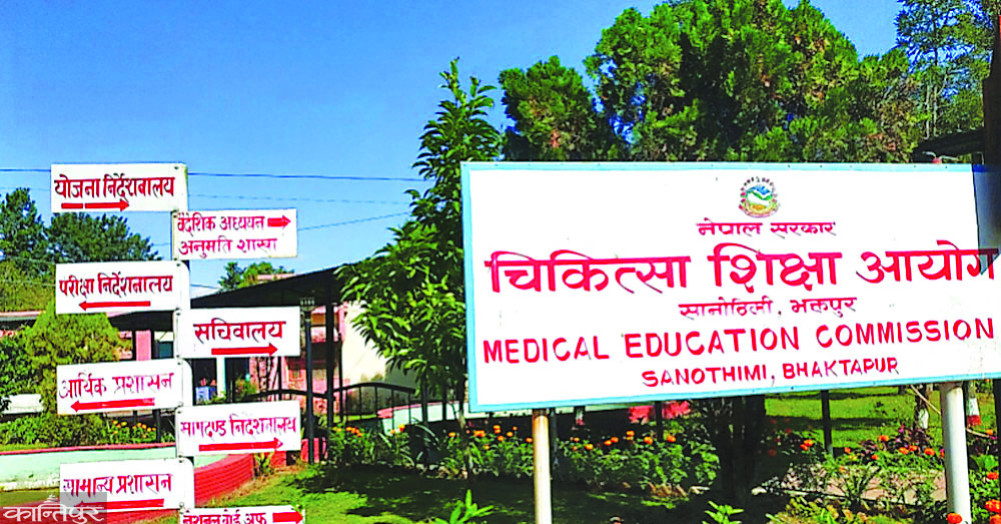
While neighboring countries are developing medical education by strengthening regulatory bodies that were born later than Nepal, it is sad that in Nepal, the existence of the Act and Commission, which was achieved through decades of struggle, is in crisis.
We use Google Cloud Translation Services. Google requires we provide the following disclaimer relating to use of this service:
This service may contain translations powered by Google. Google disclaims all warranties related to the translations, expressed or implied, including any warranties of accuracy, reliability, and any implied warranties of merchantability, fitness for a particular purpose, and noninfringement.
The essence of medical education and health services
Medical education and health services are purely service-oriented sectors. Even in developed capitalist countries, these sectors are mostly run under government ownership or non-profit trusts so that the quality of services does not deteriorate due to commercial interests. Although the National Medical Education Act, 2075 BS has drawn a roadmap to make medical education completely non-profit from 2085 BS, no concrete homework and interest is shown by the current government and the concerned bodies for its implementation. Ironically, there is still a large number of private medical, dental and nursing colleges in Nepal that do not even meet the minimum standards of the government.
Past situation and the advent of the Medical Education Act
Before the Act came into effect, this sector was made a means of commercial profit due to the lack of effective regulation. Colleges that did not even meet the physical infrastructure and patient pressure opened in cities in droves, relying on access and power. Fee bargaining and unhealthy competition flourished in the name of 'medical tourism'. The number of seats was increased by showing artificial human resources during inspections. This created a situation where manpower with little practical knowledge was produced, the quality deteriorated, and the produced manpower concentrated in the cities to raise investment instead of going to rural areas. When scholarships were cut and paid quotas were increased in government colleges as well, qualified but poor students were deprived of opportunities.
To end this situation and ensure equitable access, the Medical Education Act, 2075 BS, was passed after a few decades of struggle based on the report of a task force of experts, and the Medical Education Commission was formed. Despite political and external interference, the commission brought about major improvements in medical education by introducing a unified entrance examination, merit-based admission, a transparent admission system, and scientific fee determination. This led to a decrease in the number of students going to study abroad, and the provision of 75 percent free seats in government colleges provided opportunities to talented students. In addition, the quality of health services also improved.
Interrelationship between scholarships and rural health services
There is a rule that doctors and health workers who have studied on government scholarships must serve in remote and rural areas for two years. Currently, Nepal's rural health system relies on these scholarship recipients. If this scholarship quota is reduced, rural hospitals and primary health centers will definitely be without doctors within a few years. However, it is worrying from a public health perspective that the current government's policies and measures seem to be aimed at increasing the number of seats in private colleges and reducing government investment, rather than encouraging scholarships.
Attack on the Commission's leadership and institutional autonomy
Serious doubts have recently been raised about the autonomy of the Medical Education Commission, which is considered the backbone of reforms in the medical sector. Prioritizing a person with a specific agenda and conflict of interest from the leadership level before the application for a prestigious position like the Vice-Chairman of the Commission is against established values and norms. The attempt to hand over the leadership of the institution with the precondition of significantly increasing the number of paid seats and cutting scholarships, while disregarding the rules and transparent criteria of the selection process, has raised serious questions about the credibility and impartiality of the Commission.
The cycle of poor quality and the game in public health
The quality of both medical education and health services is certain to collapse if the number of seats is increased suddenly without taking into account physical infrastructure and adequate standards. On the one hand, the attraction of foreign students will be zero after the standard of education has deteriorated, while on the other hand, Nepali health personnel will not be recognized in the international market. As a result, the immature dream of the state to gain economic benefits by exporting skilled personnel abroad will be shattered, and there will be a huge flood of unskilled and unemployed personnel even within the country. This will ultimately lead to a big game in the health of the common Nepalese.
On the other hand, due to the low investment of the state in the health sector, from primary health centers to large government hospitals, there is a compulsion to meet the expenses from internal sources. Municipal hospitals and basic health centers have not yet been constructed at many local levels, due to which even government services are becoming expensive and inaccessible for the general public. This is a direct violation of the constitutional and fundamental right of citizens to live a healthy life.
Remittance economy and citizen neglect
Nepal's economy is based on remittances from parents and youth who sweat in the Gulf countries and taxes from the general public. However, it is a mockery of social justice that the same citizens and the children, parents and families of Nepalis who contribute to remittances do not receive quality education and health services, and that the state tries to avoid it as a 'non-rewarding sector'. Changing policies under the influence of vested interests without seriously studying market demand and quality will increase extreme labor exploitation and the abundance of unskilled manpower in the medical sector, which will not be accepted even by the international market.
Conclusion
Citizens do not expect overnight miraculous changes from the government, but rather are looking for policy honesty and minimum accountability to the people. While neighboring countries are developing medical education by strengthening regulatory bodies that were born later than Nepal, it is sad that the existence of the Act and Commission obtained through decades of struggle in Nepal is in crisis. It is now the shared responsibility of a conscious civil society to protect the Act and the Commission, while remaining vigilant against such games that threaten public health and the future of deserving students.