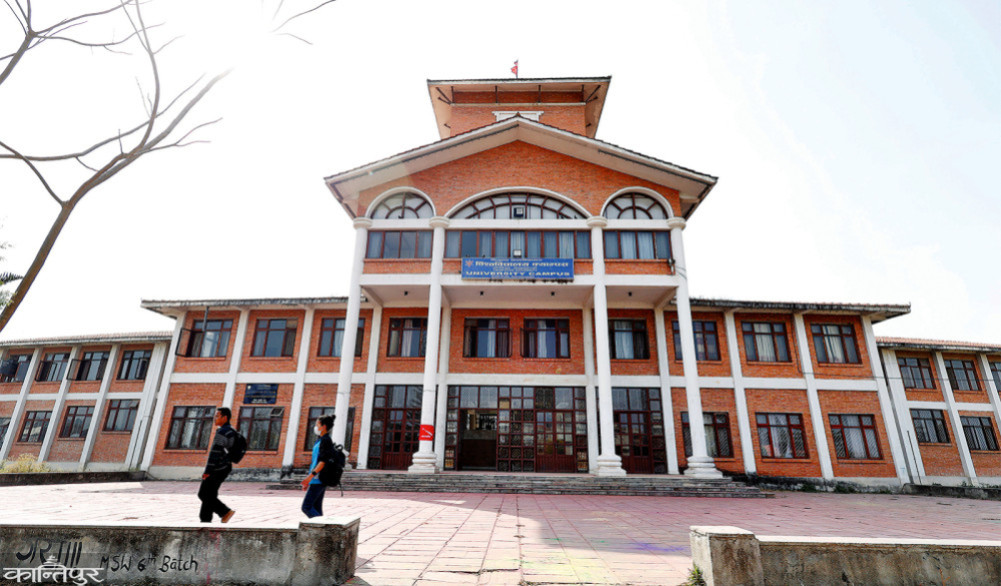
The government's push to implement 10 percent scholarships in universities has sent a positive message. It can be expected to boost the university's educational and academic activities.
We use Google Cloud Translation Services. Google requires we provide the following disclaimer relating to use of this service:
This service may contain translations powered by Google. Google disclaims all warranties related to the translations, expressed or implied, including any warranties of accuracy, reliability, and any implied warranties of merchantability, fitness for a particular purpose, and noninfringement.
Equitable access to education has become a challenging issue. The number of lower and lower middle class families is significant and such access has become weak due to remote geography. Economic, social, political, cultural and traditional reasons are also responsible for this. There is a tendency for school-age children to not enroll and to drop out of classes. The situation is similar at the university level.
Due to financial burdens and other factors, many students choose employment. Those who go for foreign employment avoid studying. Due to the uncertainty of employment, university education has also started losing its appeal. In such a context, creative measures were needed to attract and retain students to universities. At this time, the government's insistence on implementing 10 percent scholarship in universities has given a positive message. This can be expected to disrupt the educational and academic activities of the university.
Prime Minister and Chancellor Balendra Shah held a group discussion with the vice-chancellors of seven universities, including Tribhuvan University, at the Prime Minister's Office Singha Durbar on Tuesday. During that meeting, he directed the universities and their subordinate campuses to strictly implement the 10 percent free scholarship. Earlier, even when the vice-chancellors were appointed, Education Minister and Pro-Chancellor Sasmit Pokharel had directed the implementation of the scholarship-related system.
The government's insistence on implementing the 10 percent scholarship in universities has sent a positive message. This can be expected to disrupt the academic and academic activities of the university. In the context of the uncertainty of employment, university education has also started losing its appeal. Such a creative solution was needed. Following the directive, Tribhuvan, Agriculture and Forestry, Pokhara, Purbanchal, Madhyapaschim, Sudurpaschim and Rajarshi Janak Universities have issued circulars to their subordinate campuses to implement the 10 percent scholarship. Purbanchal, Pokhara, Agriculture and Forestry, Sudurpaschim and Madhyapaschim Universities have also issued separate notices on Monday and Tuesday and issued instructions to ensure scholarships in their campuses. Now, the full implementation of the directive is awaited.
Last year, 672,000 students were enrolled in higher education in Nepal's universities and campuses. If 10 percent scholarships are implemented, about 67,000 students will receive facilities in higher education. If around this number of scholarships can be provided every year and they complete their studies, a significant achievement will be achieved in terms of expanding access to education. Another notable aspect of such scholarships is its target group.
Because, campuses will have to provide scholarships to meritorious, disadvantaged and targeted students of 10 percent of the total student enrollment. This will allow students from families of weaker sections of the society to access higher education. It will make the classroom inclusive. Students from many regions and geographies gather in university classes. The presence of students from the strong to the weak classes and communities in the classroom will help to increase interaction between all parties, increase respect, increase tolerance and expand knowledge about various aspects of society.
The more students pursue higher education, the more the students, families, society and the state will benefit. If the number of those pursuing higher education increases, all these parties will receive educational and academic nourishment. As educational access increases mainly for lower class families and their studies are completed, it will increase their confidence. Such confidence also helps in educational, economic, social and political upliftment. It increases the possibility of development. Therefore, scholarships are also a matter of social justice for Nepali society.
There has been discrimination in the opportunity for education or quality education in Nepali society for a long time. This has ultimately created discrimination in the opportunities obtained through education. As a result, only one class has established dominance in the policy-making and decision-making process of the state. It has not been able to increase the equal attachment to the state in all classes and communities of society. Therefore, the scholarship program that is being made mandatory in the university can contribute to increasing the attachment to the state not only of the concerned individual and family but also of the community and geography.
There is currently no uniformity in the provision of scholarships. Some universities have provisions related to scholarships in their statutes. Some have made provisions in this regard by making rules through the Senate and Executive Council. Similarly, some have mentioned the provision of providing scholarships to 10 percent of the admitted students as a condition of granting affiliation. Universities may have their own methods and procedures, but there should be no confusion and deception regarding the implementation of the scholarship program. Its method should be made transparent.
The experience of medical education can be useful here. There, students who receive scholarships in private and public medical colleges are selected during the integrated entrance examination. A similar or more sophisticated method can be adopted here too. On the other hand, the provision of scholarships to certain students should not impose an additional financial burden on others. Students who have received scholarships should not be subjected to unnecessary mental harassment or forced to pay fees during the academic program or during exams. Therefore, strong monitoring should be carried out at all stages from the distribution of scholarships to implementation.