Article by Krishna Prasad BhusalIt is almost impossible to treat and destroy wild birds. Therefore, measures must be taken to prevent bird flu from spreading to domestic birds and mammals. Infected or dead birds must be safely collected and properly managed.
We use Google Cloud Translation Services. Google requires we provide the following disclaimer relating to use of this service:
This service may contain translations powered by Google. Google disclaims all warranties related to the translations, expressed or implied, including any warranties of accuracy, reliability, and any implied warranties of merchantability, fitness for a particular purpose, and noninfringement.
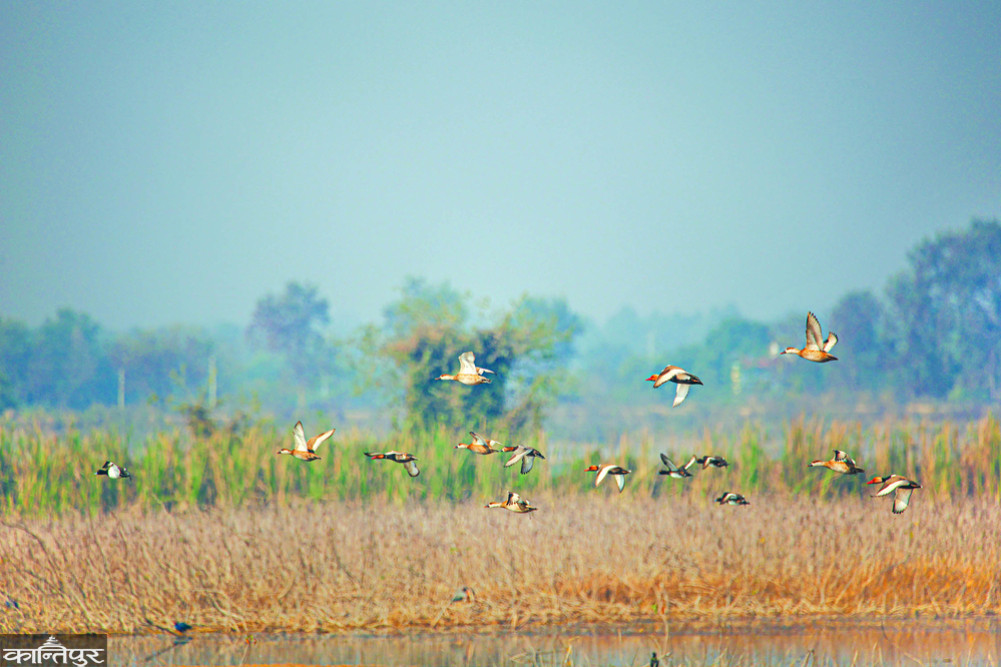
Thousands of birds of more than 150 species come to Nepal to escape the winter cold - from Russia, China, Mongolia, Europe, Korea and the Tibetan region . About 50 species of migratory birds travel through Nepal to India, Pakistan, Sri Lanka and Africa .
The journey and arrival of migratory birds are not only interesting, adventurous and ecologically beautiful and beneficial, but they can also be a means of carrying viruses that can pose a risk to human health . Mainly migratory waterfowl, especially various species of ducks, storks and birds of prey, are considered the main natural reservoirs and carriers of avian influenza (bird flu) viruses . The main breeding grounds of waterfowl (Siberia in the Northern Hemisphere, northern Europe, Alaska and the wetlands of Canada) are the natural origin and reservoir areas of these viruses .
As winter begins, these birds migrate south, carrying different types and forms of the virus to new geographic areas. The virus then spreads to other wild birds in the local environment and in some cases to wild mammals. The virus can spread to domestic chickens, ducks and other birds through infected wild birds and the environment they contaminate. Humans who come into direct contact with such infected birds or their contaminated environment are also at risk of contracting the avian influenza virus.
The avian influenza (H5N1) infection that has spread in Nepal since last Chaitra has now severely affected 11 districts. News has been made public that vultures, falcons, hawks and other birds at the Central Zoo in Kathmandu, as well as some carnivorous mammals, have also been infected and some have died. Although hundreds of house crows have been reported to have died, we do not have sufficient data on how many other wild birds have been affected.
Although reports of sporadic illness and death of migratory ducks that have come to Nepal in the winter have been received from various areas, there has been no adequate study, testing, and monitoring and prevention of possible infections. As a result, it can be easily assumed that the infection may have spread widely among domestic chickens, ducks, and house crows before the ducks returned to their habitat. Chickens and other birds infected with avian influenza may not have been identified and safely managed in time, and may have been thrown out in the open or not properly destroyed in some places. Such a situation has increased the risk to human health. There is a strong possibility that birds such as vultures, crows, and eagles that eat the dead birds and other animals may also be infected and spread the virus further.
Therefore, avian influenza infection is not only a matter related to public health, infectious disease control or animal health. For its effective prevention and control, integrated and active participation of bird researchers, organizations working in bird conservation, relevant government agencies, poultry and duck farmers and farmers, animal health workers and public health workers is necessary. Although cooperation based on the ‘One Health’ concept that looks at human, animal and environmental health in an integrated manner has been envisaged for the effective prevention and control of avian influenza, it has not been effectively implemented in Nepal.
Although migratory ducks, which are potential carriers of avian influenza, mainly rely on wetlands, they also use surrounding agricultural lands in search of food, so farmers need to be aware of the potential risk of spreading the infection. Our focus is only on the destruction and control of poultry and related materials after an outbreak. In the first stage, bird researchers and ornithologists should find basic scientific information on the monitoring, migration, distribution, ecology and behavior of wild birds. If infected birds are found anywhere in a sick or dead state, they should immediately inform the relevant agencies and play a supporting role in testing. Such information is of great help in monitoring the potential spread of the disease, identifying high-risk bird species, assessing their susceptibility, and adopting necessary prevention and control measures in a timely manner.
Although migratory ducks, which are potential carriers of avian influenza, mainly rely on wetlands, they also use surrounding agricultural lands in search of food, so farmers need to be aware of the potential risk of spreading the infection. It is especially important to adopt safety measures to prevent domesticated ducks and chickens from having direct contact with wild birds.
Similarly, poultry farmers and businessmen should pay special attention to the safe management and scientific destruction of chickens or other birds that have died due to disease while protecting themselves. When dead infected or potentially infected birds are thrown into the open, there is a risk of the infection spreading to other carnivores and birds such as vultures and humans. Jatayu restaurants, which are operated with the aim of providing safe food to protect endangered vultures, are also high-risk areas for avian influenza. Because different species of vultures eat civets collectively in the same place and crows and eagles also participate, there is a risk of the infection spreading to multiple species at once. In 2019, three samples of rare dungar vultures rescued sick in the Jatayu restaurant area in Kawasoti, Nawalparasi, were found to be infected with avian influenza. Therefore, it is imperative to adopt strict biosecurity measures and effective disease surveillance measures in Jatayu restaurants, which have proven to be a milestone in vulture conservation.
During the illegal trade and transportation of birds, there is a high possibility of direct or indirect contact between wild and domestic birds and humans. Such contact increases the risk of spreading avian influenza and other infectious diseases, so the illegal trade and transportation of birds must be controlled. The risk of infection and spread of this disease is also high in zoos. Especially in small zoos, parks and wildlife rescue centers operated at the local level in community forests and other areas across the country, the risk of infection spreading is even higher as there is close contact between different species of birds, other wildlife and humans. Therefore, regular disease surveillance, strict adherence to biosecurity measures, timely testing of infected or suspicious animals and birds, safe management, and effective disease control programs are essential in such places.
Although wild birds are naturally infected with the avian influenza virus, they are generally not as susceptible to the disease as domesticated, zoo, or rescue birds and other wildlife. Therefore, since even wild birds that do not show any symptoms of the disease can spread the infection, strict safety measures should be adopted to prevent direct or indirect contact between wild birds and domestic animals. In addition, it is necessary to adopt high vigilance as birds such as house crows, which have adapted to rapid urbanization and live close to humans, may increase the risk of infection.
It is almost impossible to treat and destroy wild birds in groups. Therefore, measures should be taken to prevent the virus from spreading to domesticated birds and mammals. And, there should be safe collection and proper management of infected or dead birds. Especially during winter, regular monitoring and testing of migratory birds in wetland areas, proper management of habitats, and focus on preventing the spread of the virus to other animals should be emphasized