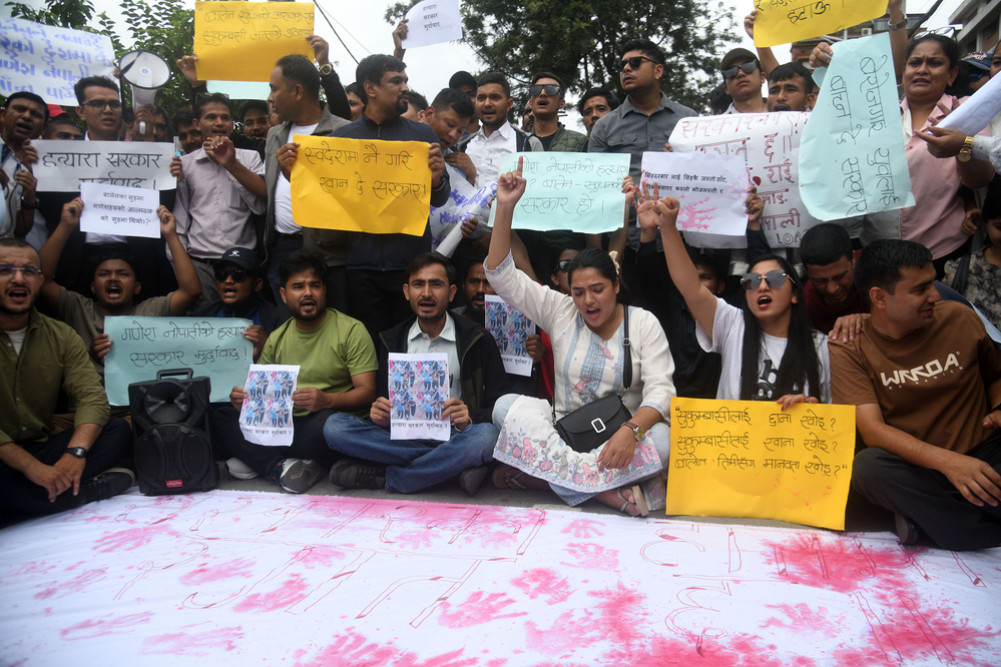
Ganesh's self-immolation is not an incident of 'not getting service'. It is a sign of a crisis in the state-society balance. The state is not capable of reform but is motivated by oppression. And, society is also not able to constantly monitor.
We use Google Cloud Translation Services. Google requires we provide the following disclaimer relating to use of this service:
This service may contain translations powered by Google. Google disclaims all warranties related to the translations, expressed or implied, including any warranties of accuracy, reliability, and any implied warranties of merchantability, fitness for a particular purpose, and noninfringement.
Ganesh Nepali from Mugu attempted self-immolation in front of the Passport Department in Tripureshwor. He died during treatment. After that, the question of who owns the state and for whom is it raised before the Nepali society. This question should be answered by the society, not the state. After all, if a Nepali youth is ultimately forced to choose the path of ending his life, who are the citizens of this country? What is the social, economic and political answer to this question? Ganesh Nepali has been deprived of living in this country as a citizen under the leadership of those who came to power who said that we will transform in five years, achieve an economic growth rate of 7 percent and create an economy worth 100 billion US dollars and end all kinds of problems.
Dear readers, your question may be – what is politics? And, for whom is it? Running a state is politics. When a citizen commits self-immolation in front of the state, in the final dialogue with the state, what is the issue if it is not political? I will say at the outset that the President of the main opposition party, Congress, Gagan Thapa, forgot his responsibility when he made the statement that ‘this is not a political issue’. Ganesh Nepali’s self-immolation is definitely not a political issue. But history will demand a political answer to this incident. That too less from the ruling party and more from the opposition. Here, the Nepali Congress led by Gagan has completely failed. As a leader, Gagan Thapa will appear innocent in the pages of history.
This incident also raises another question—hasn’t the pain caused by Ganesh’s death also stopped society from moving forward? After such an accident, we pause for a moment, mourn, get angry, comment on social media, write harsh words, and then return to our daily routines. But the problem remains. When pain and events disappear from the news, even though it seems like society is moving forward, we are losing inside. Our sensitivity, trust, and patience are shattered. Society does not move forward with the loud streets and concrete buildings that are being built by the multiplicity of 'development'. The consciousness and quality of life of a society are not measured by roads and buildings. It is measured by how trustworthy the relationship between citizens and the state is. If the situation of losing citizens at the doorstep of the state becomes normal, the language of development may be grand, but the lives of citizens are small.
When we try to understand this incident by limiting it to personal impulses or private pain, we run away from the real question. The reason for this is not only in the psychology of the individual. It also lies in the economic, social, political, and institutional environment that shapes that psychology.
From here, the historical question begins— Why is the relationship between the state and citizens so ugly and weak in Nepal? The answer to this is not just in the current government or any one office. The answer to this lies in the history of state-building and the culture it created. From the Rana regime to the Panchayat, the state was largely a structure for managing its ‘subjects’ – controlling rather than serving, ordering rather than being accountable. After 2046, the language of the citizen became stronger, the words of rights increased, and the practice of democracy began. But the change in culture did not go hand in hand with the language of the institution. After 2062/63, the state took a new form on the path of republicanism and federalism, but the old administrative habits and vision towards the citizen remained the same in many places. We have changed the ‘frame’ of rights, but the culture has not changed. Here, the citizen still has to be ‘graceful’, request, and bow down. Those who came to power, saying that they will change all this, have once again shown their true face through Ganesh.
This is where the concept of ‘statelessness’ by writer, philosopher and political activist Edward Said (1935–2003) comes in handy. Especially in its figurative sense. When Said writes about exile and alienation, he does not limit statelessness to the state of not having a paper citizenship. He also shows the feeling of being ‘out of touch’. Where a person is physically present in a place, but his life is not included in the language of the state. A person may have a citizenship certificate, but he is ‘invisible’ in the systems of the state. His pain is in the file but not heard. His rights are in the rules and laws, but not in practice. Many citizens in Nepal experience such ‘inner alienation’. The role of the opposition in a democratic society is sought as much as the state's attention and readiness are needed to change the practices here, where the capital does not recognize it even though it comes to the capital, the law gives authority but the office does not give time, the language of the state says 'service' but experience feels like 'punishment'. Democracy is not a calculation of points in parliament. It is the structure of society and a common agreement of all of us. The government is only the police. But every action of it is approved by the society. The opposition party should be at the forefront of that society.
Ganesh's death has given the society and the common citizen a feeling of defeat. Such a feeling prevents society from moving forward and becoming egalitarian. Because it pushes citizens in two directions. First, despair and self-doubt. The conclusion that 'I can't do anything' separates citizens from public life. Second, distrust and harshness. The conclusion that ‘rules don’t work, access is needed’ teaches citizens to seek relationships, not rules. Both directions reduce the possibility of institutional reform. A frustrated citizen does not question. A citizen whose faith has been shaken will not stand up for his rights. And the state is not forced to reform itself. From here, the path for society to move forward becomes narrow. But the truth is that the parties of yesterday and their leaders are the ones who brought this country to this kind of crisis. Whatever is happening today is the result of the trampling of the basic values of society and the state by yesterday. But that said, in an unbroken state, the government cannot divide time into yesterday and today. Therefore, the state cannot use yesterday as a mirror of its behavior because it was bad.
Economists Daron Acemoglu and James A. Robinson, in his book ‘The Narrow Corridor: States, Societies, and the Fate of Liberty, 2019’, explains this situation from another angle. According to their argument, freedom, security, and prosperity are possible only when the state is sufficiently capable and society is organized. And, when both keep each other in check and balance. If the state is weak, services are not provided, rules and regulations are not enforced, and intermediaries and informal power increase. If the state becomes too powerful, citizens’ rights and society’s oversight of the state are weakened. The voice of civil society becomes muffled. To stay in the middle path (narrow corridor), both the state and society need a continuous ‘race’. Which they have called the ‘Red Queen Effect’.
This The symbolic vocabulary is taken from the famous English writer and mathematician Lewis Carroll's work 'Through the Looking-Glass'. In the story, the 'Red Queen' tells 'Alice' - 'You must run as fast as you can to stay in one place.' This saying refers to a situation where stability is possible only through continuous effort.
Economists Acemoglu and Robinson use this metaphor in their book to argue that in order to maintain freedom, society must continuously increase its social activism, organizational capacity, and collective power. Because, the capacity of the state increases over time. If society is stagnant and stops at the same level, the increasing capacity of the state becomes relatively powerful. And, that can ultimately increase the pressure on freedom. Therefore, preserving freedom is not a movement and a one-time achievement. It is an exercise in continuous running, constant vigilance.
The problem in Nepal is seen in the continuation of this dilemma. The capacity of the state (service, justice and implementation) is weak. Society is also tired. We question on impulse. We change power in a short period of time through agitation and sabotage. But we cannot move forward on the path of reform by making sustainable institutional demands. As a result, the state oppresses the citizens forever by showing arrogance. What happened this time is also not new.
Ganesh's self-immolation incident is not an incident of 'not getting service'. It is a sign of a crisis in the state-society balance. The state is not capable of reform but is excited about repression. And, society is also not able to continuously warn. Incidents happen, voices are raised, but there is no dialogue and sustainable efforts for reform. This cycle gives the citizen the feeling of 'I am alone'. As Edward Said said, this feeling is alienation from the state. The relationship with the state on the paper of citizenship but not in practice. Such a feeling sometimes weakens the individual from within. Society becomes tougher from the outside. And when society is tougher, we easily dismiss the other victim as ‘weak’. Whereas, the structure that creates the problem remains safe.
History also teaches us another lesson. That is, when the citizen-state relationship deteriorates, the weak always have to pay the price. During the Rana regime, the weak bore the burden of taxes and labor. In the Panchayat, citizens experienced the limits of political expression. During the conflict, amidst the violence, the citizens of villages and settlements carried double fears. Now violence comes in different forms. Procedural violence, violence of uncertainty, violence that takes away time and respect. This violence does not show ‘blood’, but it is tiring. Citizens are hurt the most where the state considers their time and respect a ‘small thing’. As such injuries accumulate in history, both a big explosion or a big depression are possible. Which Nepali society has only recently experienced. The
question is not ‘who is to blame’. The main question is ‘what is being changed’. The issue that needs to be changed is concrete – keeping citizens at the center of the service process. Seeing citizens as ‘life’, not ‘files’. Ensuring employment, creating an environment for respectful labor, and making everyone feel the state through justice. These tasks do not seem like big national goals, but these are the basis for making the goal meaningful. The hope given by the language of ‘7 percent growth rate’ and ‘100 billion US dollar economy’ has now to be sought. Before the citizens conclude that the assurance was false, the current Finance Minister Swarnim Wagle should explain why the economy is in shambles. He is not only the Finance Minister of the current government. He is also a person who claims to be a democrat educated and initiated in the liberal world. He may have political compulsions, but he also has personal responsibilities towards this society.
The role of society must also be redefined in a drastic way. Saying that ‘society must respond’ does not mean abdicating the state from responsibility. It means that society must transform its demands from emotion into discipline. It is not enough to show anger for a few days after an incident. Sustained pressure and vigilance are needed. There is a need for measurable demands for service reform, continuous insistence on transparency, and a social consensus that rejects the ‘access’ culture. As soon as society gets tired and gives up, the inertia of the state wins. And, if the state continues to disappoint the citizens, the fatigue of society will increase further . The way to break this cycle is continuous, calm but firm demand . Not impulse, but institutional pressure and vigilance are needed .
The question of whether Ganesh's death has blocked the way for society to move forward can also be answered in this way . This incident is a test of our collective consciousness . It becomes an obstacle for society, if we forget it by making it just a moment of mourning . It creates more despair and harshness in the common people . But if we consider it as a mirror and raise concrete demands for improvements in the state's service culture, if society continues that demand and the state also considers the 'ability to listen to citizens' questions' as its strength, it will not stop . It will push forward by shaking .
Ultimately, the answer to the question of who owns the state is not in any one party, any one government or any one declaration . The answer lies in the respect, service, equal treatment, and reality of society that citizens receive. If the state creates a situation where citizens are intimidated at its doorstep, citizens start feeling stateless within their own country. And, when this feeling increases, the path for society to move forward also narrows. Because trust is needed to move forward. Ganesh's death has reminded us of this harsh truth.