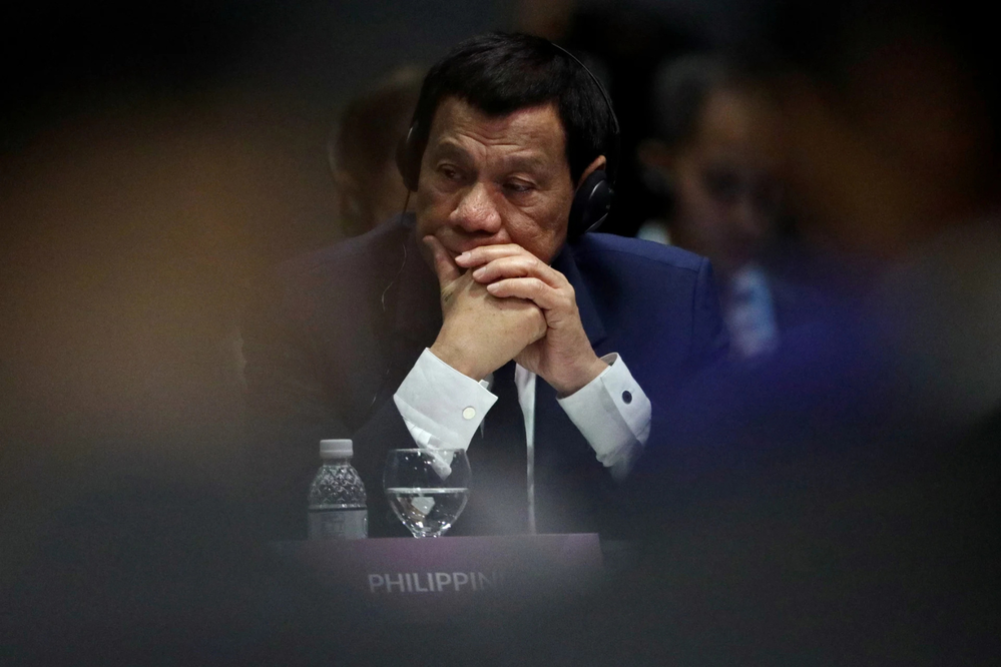
The credit for the rise of characters like Duterte goes to social media. They succeeded in uniting the crowd with the help of algorithms. As a result, even if they made any anarchic statements in public, society did not protest or defend the statement. But the ‘heroes’ who emerged in this way ultimately led to the crisis that society faced.
We use Google Cloud Translation Services. Google requires we provide the following disclaimer relating to use of this service:
This service may contain translations powered by Google. Google disclaims all warranties related to the translations, expressed or implied, including any warranties of accuracy, reliability, and any implied warranties of merchantability, fitness for a particular purpose, and noninfringement.
Before becoming president of the Philippines in 2016, Rodrigo Duterte was the mayor of Davao City for about 22 years. During that time, he is accused of running the ‘Davao Death Squad’. According to Human Rights Watch and the Philippine Commission on Human Rights, the squad killed about 1,400 civilians. Street children, petty criminals, and drug traffickers were eliminated on suspicion of drug cartels. Duterte won the presidential election in 2016.
Some aspects of Duterte’s rise to the presidency are noteworthy. He cleverly used social media to rise to power. According to Peter Pomerantsev’s book ‘This Is Not Propaganda’, Duterte used to call himself a political outsider. In other words, even though the Marcos and Aquino families ruled the Philippines for decades, he was not from that family. He used the extrajudicial killings he committed when he was mayor as campaign material for the presidential election. One of his associates created Facebook groups in various cities across the country. They were made into a place for discussion in the local language. In about 6 months, each group had about 100,000 members. After that, its admins started posting some crime incident every day. The incident was true, but the admins would add topics like ‘that criminal is a drug dealer’.
Maria Ressa and her online magazine ‘Rappler’ also supported Duterte in the election. Rappler itself organized the presidential dialogue on Facebook, in which Duterte also participated. However, Duterte's relationship with Rappler began to deteriorate after Duterte whistled at a female TV reporter. Rappler began reporting on Duterte's extrajudicial killings. Duterte's supporters immediately launched hashtag campaigns of 'Unfollow Rappler' and 'Unfollow Maria Resa'.
Duterte never blamed himself for the extrajudicial killings he committed. Instead, he defended them. When he was mayor, he criticized and disobeyed the central government. Duterte never blamed himself for the extrajudicial killings he committed. Instead, he defended them. As mayor, he criticized and disobeyed the central government. He pressured the center to allow local administrators to operate autonomously rather than under the center. Duterte would publicly speak out against his opponents.
After becoming president, he started the ‘War on Drugs’. According to the report of the ‘Armed Conflict Location and Event Data Project’, by the end of Duterte’s term (2022), the Duterte administration’s own report stated that 6,252 people had been killed. But according to other human rights organizations cited by the International Criminal Court (ICC), 30,000 civilians had been killed. Most of those killed were poor people in urban areas.
In Nepal, a situation has been seen where a person’s popularity increases based on the popularity created through social media and gets elected based on that. The popularity of Balendra Shah, who was elected as the mayor of Kathmandu Metropolitan City in the 2079 local elections, has expanded mainly through virtual means such as social media. The groups and pages on social media supporting him played a role in establishing that ‘old parties and leaders are corrupt’. They were largely successful.
He gave numerous interviews before the election, but since then he has made social media his main medium of communication. When the police stopped his wife's car for questioning, he went so far as to say 'Singha Durbar will be burned' on Facebook. He wrote statuses insulting various countries, contrary to diplomatic etiquette. From burying dissenters in pieces to calling all new and old leaders thieves, he did everything on social media. While he was mayor, he chased away sidewalk traders and attacked squatters. He also fought with the federal government. In fact, even before he became mayor, when news of his misuse of the flag was made, supporters launched an 'unfollow online news' campaign.
After the Gen-G movement, he joined the Rashtriya Swayamsevak Sangh (RSS) before the 21 Falgun elections. The message spread on social media that he had done a lot of good work in Kathmandu and that he would build the country in the same way. The wave of social media reached every village. Ultimately, the Rashtriya Swayamsevak Sangh (RSS) and Shah won an encouraging victory.
After becoming the Prime Minister, Shah's initial goal was to attack the squatters. He had created state terror on the squatters, arguing that it would protect them from floods. But the squatters, who he had placed in holding centers with poor management, ended up suffering from floods and inundation.
Overall, the problems of society cannot be solved by the miraculous rise of any one person. Simon Johnson, James A. Robinson, and Daron Acemoglu, who won the Nobel Prize in Economics in 2024, say that for society to progress, it is necessary to develop institutions. A society that emphasizes institutional development remains strong and such a society can make rapid progress. Hugo Chavez's rise in Venezuela was also a miraculous character. While in power, he also held unlimited power in his hands. There was little emphasis on institutional development. With his end, Venezuela eventually fell into a deep crisis.
There is no doubt that the rise of the above-mentioned characters was due to the weakness of institutions. Shoshana Zuboff said in her famous book ‘The Age of Surveillance Capitalism’, ‘If you have not paid for a product, you are a product.’ Zuboff made this statement to clarify the ‘manipulation’ of people by social media.
The rise of the characters discussed here, including Duterte, is different from that of traditional leaders, which is credited to social media. They succeeded in uniting the crowd with the help of algorithms. As a result, even if they made any anarchic statements in public, society did not oppose or defend those statements. But we should not forget that the 'hero' who has emerged in this way will ultimately lead the society to a crisis. Society will not progress with the emergence of a single miraculous character. All institutions have their own role to play in that. Therefore, society should always emphasize on strengthening institutions.