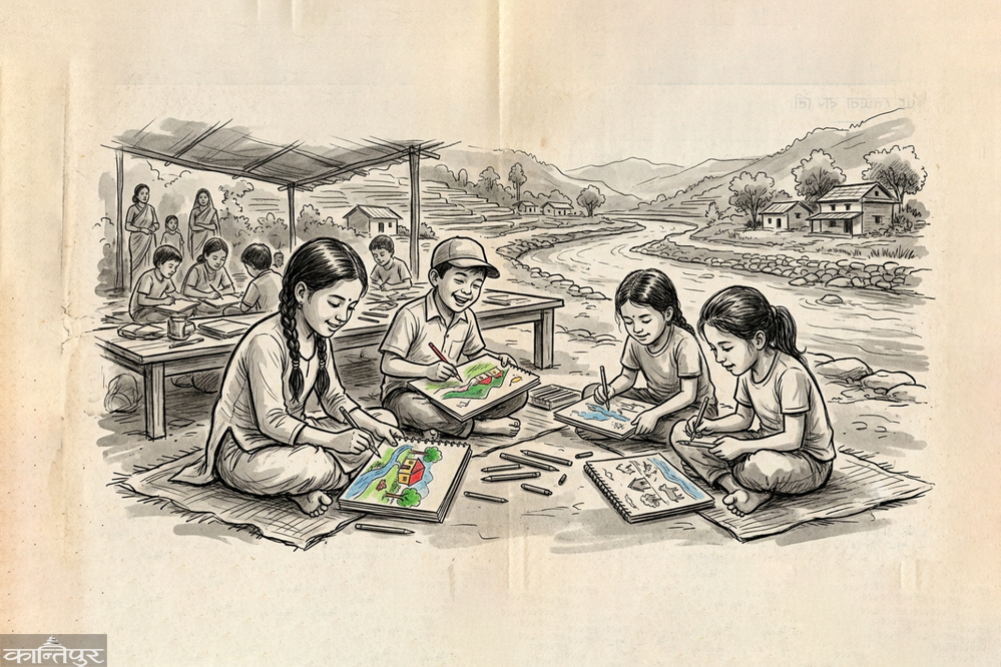
Children may not speak the technical language of politics, but they have developed a political awareness. They see public problems, worry about them, and even find solutions in their imagination. The idea that children are isolated from politics is not consistent with reality.
We use Google Cloud Translation Services. Google requires we provide the following disclaimer relating to use of this service:
This service may contain translations powered by Google. Google disclaims all warranties related to the translations, expressed or implied, including any warranties of accuracy, reliability, and any implied warranties of merchantability, fitness for a particular purpose, and noninfringement.
Many of us believe that politics is an adult affair. We have a common perception that children are too young to understand issues like government, elections, democracy, public policy, or citizenship. That is why formal civic education in schools often begins only after adolescence. Before that, childhood is seen as a period of play, learning, and developing the foundations for lifelong learning.
A new perspective on childhood: active social actors
However, over the past three decades, childhood studies and research in various fields have seriously challenged this view. A growing number of scholars are now viewing children not as passive recipients of knowledge from adults, but as active social actors who understand, interpret, and form opinions about society based on their own experiences. They begin to think about rights, justice, inequality, responsibility, and the public good long before they are old enough to vote. Their political thinking may not be expressed in the language of adults, but its essence and meaning are political.
The intellectual foundation of this new approach is believed to have begun with the book ‘Constructing and Reconstructing Childhood’ published in 1990 by Alison James and Alan Prout. They interpreted childhood as not only a stage of biological development but also a cultural and social experience constructed by society. Their argument was that children are not just ‘future citizens’, but also members of society today, whose ideas and experiences should be taken seriously.
This idea was further developed by William Corsaro through his famous concept of ‘interpretive reproduction’. According to him, children do not accept adult values and culture at face value. They interpret, reconstruct and give new meaning to them through their own experiences in play, friends, family and school. Therefore, childhood is not only a preparation for becoming future citizens, but also an active stage in the development of civic consciousness.
In his book ‘The Anthropology of Childhood’, anthropologist David Lancey studies different societies around the world and shows that childhood experiences are not the same everywhere. In many societies, children play important roles in the family, community, and production processes from an early age, which undermines the idea that children are inherently socially passive.
Utler’s research: Exploring politics through pictures
Amidst this intellectual debate, Norwegian researcher Stine Johansen Utler conducted a very interesting research. Her study ‘If I Were Prime Minister’: Political Awareness in Young Children’s Pictures’, recently published (2026) in the ‘Journal of Childhood, Education and Society’, raises a simple but profound question – can young children also think politically?
To find the answer to this question, she asked about 200 Norwegian children aged 6 to 9 just one question: “If you were prime minister for a day, what would you decide?” The most interesting aspect of the study was its methodology. Typically, researchers interview children or fill out questionnaires. But Utler didn’t do that. She asked the children to express their answers through pictures.
Developmental psychology research has long shown that young children can express more complex ideas through pictures than words. For them, pictures are not just art – they are also an expression of thoughts, feelings, values and imagination. So Utler used pictures as an alternative research tool to understand children’s political thinking.
Long before they are old enough to vote, children are already thinking about justice, equality, responsibility, leadership, and the common good. The idea that children are separate from politics is not realistic. The results of the research were surprising. Some of the children imagined that if they became prime minister, they would enjoy eating ice cream, buy lots of toys, build a huge amusement park or have a day off every day. These answers reflect that they are still children.
However, most of the drawings went far beyond personal desires. Some drew drawings of helping the poor. Some drew plans to house the homeless. Some imagined ending war.
Some drew drawings of cleaning rivers, some of planting trees, some of stopping bullying in schools, some of improving hospitals, some of caring for the elderly, and some of protecting animals. The most interesting thing was that many of the children thought about the question ‘What does society need?’ before asking the question ‘What do I need?’ .
Review of Politics: Power or Common Good?
From this point, the study draws an important conclusion – children may not speak the technical language of politics, but they have developed political awareness. Children see public problems, worry about them and even find solutions in their imagination.
This challenges the traditional view of politics. If political awareness is measured only by knowledge of elections, parliament, political parties or the constitution, then young children certainly seem politically ignorant. However, if politics is a collective reflection on how to make society better, then children's thinking seems surprisingly mature.
This is why Utler's study has opened a new door to looking at the relationship between politics and childhood. It urges us to see children not only as 'citizens of tomorrow', but as citizens who are starting to understand public life from their own perspective.
The most important contribution of Utler's study is in redefining politics. Traditional political science has often measured political awareness in terms of knowledge about elections, the constitution, political parties, or government structures. So children aged 6 to 9 are naturally seen as ‘politically ignorant’. But Utler’s question was different. What exactly is politics? Is politics just about elections and government, or is it also about collective thinking about how people live together, how justice is established, how common problems are solved, and how society can be made better? The children’s drawings strongly supported the second answer.
They did not portray politics as an exercise of power, authority, or control. Instead, they saw politics as a means of caring, cooperation, equality, and the common good. In many of the drawings, ‘the prime minister was not a leader who gave orders, but a person who helped.’ Here he was building houses for the poor, here he was cleaning rivers, here he was stopping wars, here he was making schools safer. This shows that the children were understanding leadership as a responsibility rather than a display of power.
This finding is also in line with the ideas of the famous political philosopher Hannah Arendt. According to Arendt, politics is essentially a process of building a shared world, where people learn to coexist with each other. The children's drawings also convey this message. Their political imagination seems to focus on compassion, cooperation and the public good rather than ideological competition.
Another interesting aspect of the research was that not all children thought in the same way. While some prioritized their own desires, many thought about society as a whole. Some expressed particular concern for the plight of the poor, the elderly, the sick or the homeless. This shows another dimension of political maturity. Political awareness is not just about knowing the facts about government, but also developing the understanding that your decisions affect the lives of other people. Even some 6-year-olds presented a surprising view that the purpose of government is not just to fulfill personal desires, but to solve common problems.
The study also found some interesting trends between girls' and boys' drawings. Girls tended to draw more drawings related to equality, justice, environmental protection, peace, and social welfare, while boys' drawings showed slightly more personal achievement, power, or adventure. The researcher did not interpret these findings as permanent or biological differences. Instead, she suggested that messages about leadership, power, and care from family, school, media, and social culture may begin to have an impact in childhood. Boys also drew pictures of deep human emotions, while many girls also expressed personal desires. So these findings should be understood as social trends, not as hard distinctions.
Beyond the Textbook: The Role of Everyday Life and School
Utler's study is not a one-off study. This provides new evidence for decades of academic findings about children’s political socialization. In his book ‘The Making of Citizens’, communication expert David Buckingham argues that children start learning about politics long before they read political science textbooks. They hear conversations at home about elections, corruption, inflation, unemployment, public services, environmental problems or international events. Even if parents think they are not listening, children are already forming their own ideas about government, justice, fairness and leadership. Politics is learned not only from textbooks, but also from everyday life.
In this context, schools are also important places for political learning. Although many schools claim to be ‘politically neutral’, they are practicing democracy every day. Who gets to speak in the classroom? Are different views respected or not? Are the rules fair or not? Are all students given equal opportunities or not? It is through these experiences that children learn the true meaning of democracy. The ‘International Civic and Citizenship Education Study’ conducted by Judith Torney-Purta and her colleagues has also reached the same conclusion. Schools based on discussion, participation and mutual respect prepare more active and responsible citizens in the future. Democracy is learned by experiencing democratic relations rather than by memorizing articles of the constitution.
Article 12 of the United Nations Convention on the Rights of the Child has also institutionalized this approach. It gives children the right to express their views freely on matters that affect them. Roger Hart’s famous book ‘The Ladder of Child Participation’ also makes it clear that meaningful participation is not just about formally asking for opinions, but also about giving children’s views real weight in the decision-making process. This idea was also put forward by educator John Dewey. According to him, democracy is not just a subject learned from textbooks, but a practice experienced in everyday school life. When children experience respect, participation, dialogue and shared decision-making in the classroom, they build the foundation to become responsible and active citizens in the future.
All these thoughts are equally relevant for Nepal. Even though Nepalese children are not old enough to vote, politics is not far from their lives. Elections, protests, bandhs, inflation, natural disasters, foreign employment, the state of public schools, local government decisions or environmental crises directly affect their daily lives. They see these events, listen to discussions at home and form their own understanding. Therefore, the idea that they are isolated from politics does not match reality.
Utler's study sends a clear message to schools in Nepal - civic education should be embedded in the school culture from the elementary level. It is not necessary to make young children memorize the constitution. What is essential is that they are encouraged to question, discuss, listen to others, respect different opinions, collaborate, and think about the problems of their community. Before teaching democracy, schools themselves must be democratic.
This study also has an important message for parents. Many parents think that politics is an inappropriate subject for children. It is necessary to protect children from partisan bitterness or hatred. However, that does not mean keeping them away from all public issues in society. When children ask, ‘Why is someone poor?’, ‘Why is the river dirty?’, ‘Why does no one get the opportunity to go to school?’ – these questions are the initial lessons of democratic education. Instead of ignoring them, we should be able to transform them into age-appropriate dialogue.
Perhaps the most interesting message of this study is also for politicians. In adult politics, power, competition, and ideology are often discussed. But in the Norwegian children's drawings, the focus of politics was not on power, but on people and society. They did not dream of eliminating or banning the opposition – they dreamed of ending hunger, cleaning rivers, saving animals, and stopping conflict. Of course, public policy is not that simple. Running a government is much more complicated than drawing a picture. But it reminds us of the fundamental truth that the ultimate goal of political decisions is to make people's lives better.
Utler's study also proves that children start thinking about justice, equality, responsibility, leadership, and the common good long before they reach voting age. They imagine clean rivers without reading environmental policy, dream of good schools without understanding public administration, and want a peaceful world without reading international relations.
For a world worried about the future of democracy today, this study has a simple but profound message: democracy does not start with voting, it starts in childhood. When we encourage children to question, imagine, collaborate, and think about the common good, the foundation for responsible citizenship begins to be laid.