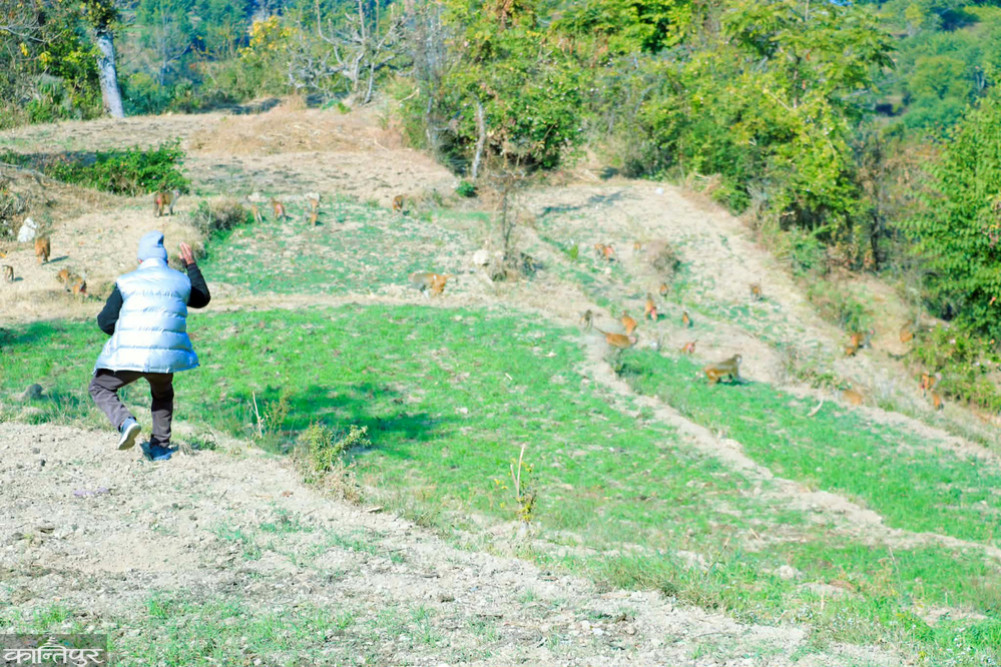
What are our monkeys looking for? Are monkeys attracted to crops in search of specific foods that contain certain nutrients, or is it because of their opportunistic habit of eating whatever they find when they are hungry? Special studies are needed on the diet and crop selection of monkeys in Nepal.
We use Google Cloud Translation Services. Google requires we provide the following disclaimer relating to use of this service:
This service may contain translations powered by Google. Google disclaims all warranties related to the translations, expressed or implied, including any warranties of accuracy, reliability, and any implied warranties of merchantability, fitness for a particular purpose, and noninfringement.
The monkey menace has become the sole pain and frustration of thousands of farmers in Nepal for years. This issue has now risen from the gossip of the village to the country's highest house. There is a need for effective steps to manage this concern by transforming it into an organized, science-based and sustainable policy.
In this context, Laligurans Municipality in Tehrathum has come up with a plan to stop monkeys by planting fruit trees in the forest. However, it is time to seriously answer the question of whether this plan will actually solve the problem or make it worse.
Similarly, the easy argument that 'the forest is gone, so monkeys are coming to the settlements' is not supported by Nepal's own data. In the past three decades, Nepal's forest area has increased by about 0.6 percent annually, mainly due to the success of the community forestry program. It reduced deforestation rates from 1.31 percent in 1975 to 0.01 percent by 2013. However, research on the monkey problem has shown that these newly planted and regenerated forests are highly fragmented. And, the practice of removing species that monkeys feed on as pests during community forest management has led to a single species dominating, leaving little natural food source for wildlife.
Studies on monkeys have shown that they can get used to the same sound deterrent within a few days. Therefore, instead of repeating the same sound, the AI-camera system to be installed in Nepal should use different sounds, time intervals and, if necessary, even light or laser signals, automatically changing them. Another study on the same program found that 48.6 percent of Nepal's native forests were lost between 1930 and 2014, while overall tree planting was increasing. This is because the species planted were chosen for their commercial value for timber, not for their biodiversity or food availability. Experts who studied the program have clearly stated that the forest program forced monkeys to invade agricultural land, because the monkeys have turned to it as an alternative source of food when they cannot find enough food in the forest.
Similarly, the agricultural buffer zone between forests and settlements is disappearing. As rural families move to cities and abroad for employment, the area of barren land is increasing, and productive farmland is decreasing. This means that the edge of the forest has now reached the settlements. A detailed study on community forest areas says that although this regeneration has indeed increased biodiversity, it seems that the forest restoration itself may have increased conflict even though it is ecologically successful by reducing the distance between human settlements and wildlife habitats. Therefore, the cultivation planted on the forest-farm edge and Fruit trees do not restore the lost natural forest diversity, but rather create a new feeding ground in the very place where the conflict is most intense.
But there remains a deep scientific question that no one in Nepal has seriously studied. What are our monkeys really looking for? Are they drawn to crops in search of specific foods with certain nutrients (such as sugar, fat or protein) or are they just opportunistic eaters who are hungry and eat whatever they can find? The diet of Nepal's monkeys and their crop-choice patterns need to be studied separately.
The most neglected aspect of ape-human conflict is the mental health of humans. And we must speak out about this. In Nepal, the discussion on this topic focuses almost entirely on the economic damage to crops, but no one asks about the mental health of humans who have been living in fear in their own homes and fields for years.
Thousands of farmers in Nepal have been carrying this pain alone for years. And, not giving this issue space in policy making is an injustice in itself. Nepal should not lag behind in terms of technology either. A study conducted in Taiwan to prevent crop damage caused by monkeys has developed a system that uses AI-powered cameras (object recognition systems) to automatically chase away monkeys with lasers or other non-harmful means as soon as they are seen, which has shown more effective results than traditional methods.
Similar machine-learning-based camera systems are being tested in India and other countries to automatically recognize various species of monkeys, wild boars, elephants, etc., and send immediate alert messages to farmers' mobile phones and emit different sound or light signals according to the species. Nepal can also install such AI-powered cameras and sensors on the forest-farm border to alert farmers in time and start a system to automatically chase away monkeys.
However, an important caveat is necessary here, which is related to the intelligence of the monkeys. The same study conducted on monkeys has shown that these monkeys get used to the same type of sound deterrent within a few days and then the measure becomes ineffective. Therefore, rather than repeating the same sound for two to three months, any AI-camera system installed in Nepal should automatically change it by mixing different types of sounds, at different times and intervals, and if possible, even non-sound signals such as light or lasers.
Let us discuss some points about the long-term solution to the monkey-human conflict –
1. Focusing on the nutritional ecology of Nepal’s monkeys, an intergovernmental scientific task force comprising the Department of National Parks and Wildlife Conservation, Department of Forests, Ministry of Agriculture, Forestry and Environment, Institute of Forestry Studies of Tribhuvan University and associated think tanks will be formed to answer the question of whether they are seeking specific nutrients. Involve postgraduate students from Tribhuvan University, Kathmandu University and Agriculture and Forestry University through research grants.
2. Immediately stop the cultivation of fruits on forest edges as a sole measure, and instead, direct it towards enrichment of local species within the forest, away from the farm edges, guided by the results of research on the budget. This model can be developed in collaboration with community forest user groups.
3. Enact and strictly enforce a national ban on feeding in temples, tourist sites and known feeding centers. This is because this has been the most persistent factor of conflict in all the countries studied.
4. Make a state-level conflict mapping survey mandatory, following the model already used in Gandaki Province. And, allocate budget for any new intervention only on that basis.
5. Amend the National Parks and Wildlife Conservation Act to give local governments clear, legally defined conflict management powers.
6. Conduct sterilization as a pilot program not at the national level, but only in three to five identified conflict-centered districts, with scientific monitoring for at least three years.
7. Encourage cash crops that monkeys do not like, such as ginger, turmeric, and chili, with easy loans and technical assistance, for fields directly connected to the forest edge.
8. Introduce a practical compensation and crop insurance scheme for ongoing crop damage, so that the situation of risk being concentrated in only a few families ends.
9. Install AI-powered cameras and sensors on a pilot basis at the forest-farm border, which can identify monkeys and send an immediate alert to the farmer's mobile phone, automatically activating a deterrent signal. Keeping in mind the learning capacity of monkeys, adopt a technology that changes the same system to different sounds, time intervals and, if possible, non-sound signals every two to three months.
10. Establish farmers' mental and social health as a formal part of conflict response. Provide coping strategies training through local health posts, stigma-reduction outreach and create a formal coordination mechanism between the Ministry of Health and Population and wildlife agencies.
11. Introduce a long-term program to make smallholder farming sustainable through irrigation investment, market access and land consolidation incentives, because barren land has ultimately become the new habitat of monkeys.
12. Track ecological, economic and psychological/social outcomes simultaneously. Institutionalize a national human-wildlife conflict monitoring system so that future policies can be based on evidence, not speculation.
13. Promote forest use so that there is human movement in the forest, so that monkeys move further away from human settlements to make their homes.
14. In the process of conserving community forests, grazing was first stopped, which led to the growth of bushes in the forest, which reduced the food for monkeys. Therefore, animal husbandry, which is the backbone of rural livelihoods, came into crisis. The policies and rules according to community forests led to fragmentation of grazing areas. Now, under the Rural Livelihood Renaissance Campaign, grazing will be managed in many community forest clusters. This can also create rural employment.
15. Establish forest-based enterprises and introduce and implement programs to increase the availability of wood-based products in the market. This will increase the use of products based on our own raw materials. And, with proper management of the forest, monkey management will also go hand in hand.