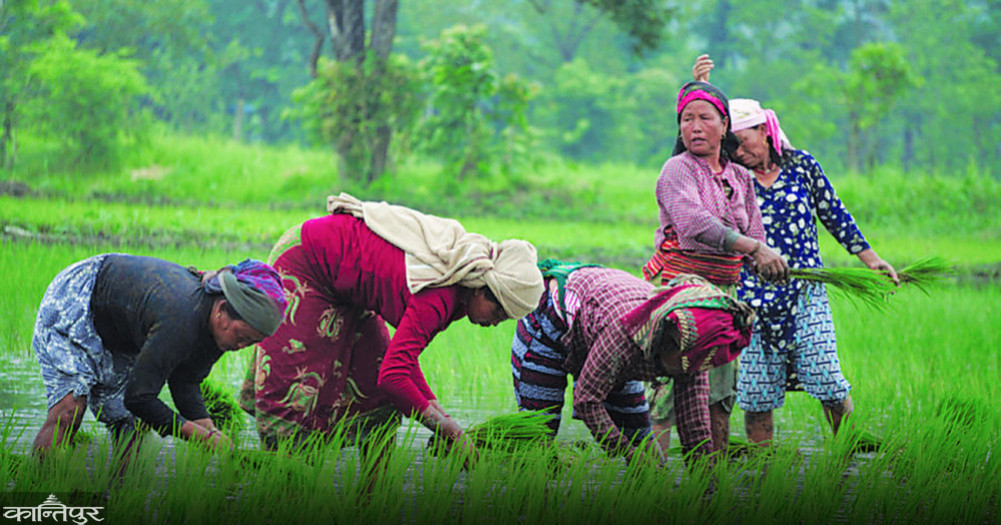
With the use of chemical fertilizers in the name of modern agriculture, the soil has become unusable, that is, the soil is on the verge of death. Chemical fertilizers have destroyed our biodiversity, the cycle of biodiversity required for agricultural crops has been broken. Modernity has not taken care of the life of the soil.
We use Google Cloud Translation Services. Google requires we provide the following disclaimer relating to use of this service:
This service may contain translations powered by Google. Google disclaims all warranties related to the translations, expressed or implied, including any warranties of accuracy, reliability, and any implied warranties of merchantability, fitness for a particular purpose, and noninfringement.
A lot of money in chemical fertilizers
Out of the 51.14 billion rupees allocated for agriculture in the budget this year, 28 billion rupees have been earmarked for chemical fertilizer subsidies. Chemical fertilizer subsidies account for 54.74 percent of the total agriculture budget. There is a shortage of fertilizers every year. However, such a huge amount goes to chemical fertilizers every year. Farmers would not have access to any other subsidies except chemical fertilizers. In Nepal, production-based subsidies, small farmer subsidies, and transportation subsidies are necessary, but all of these have been neglected.
The process of chemical fertilizer subsidies has been going on not only by this government, but by previous governments for a long time. Is this process right? Is this the right path for us? First of all, what is the service that farmers will get from the ministry? Let's discuss. 54 percent of the amount went to fertilizers. How much goes to employees? How much to vehicles and horses? And, what support do farmers actually get? There can be only one answer to this – farmers do not get any support from the current government’s approach. It can also be said that the budget should be increased for this. But why increase the budget? Is the appropriate way for us to purchase more chemical fertilizers? This path cannot be discussed only from an economic perspective. The most important issue that needs to be discussed is the environmental and humanitarian crisis. In our context, social and cultural analysis should be done more.
The impact of chemical fertilizers
It is not enough to discuss the fact that money has been wasted since we started importing chemical fertilizers. The first question is the environmental aspect. After the use of chemical fertilizers in the name of modern agriculture, the soil has reached a state where it can no longer function. Chemical fertilizers have destroyed our biodiversity. The conclusion of a discussion held in Khanikhola Rural Municipality of Kavre was – now frogs and grasshoppers are no longer available. According to farmers, the biological diversity or cycle required for agricultural crops has been broken by the use of chemical fertilizers. The soil of the fields of Hariwan Municipality in Madhesh Province has become like sand. That is, the soil is becoming sandy. A farmer from Hariwan was saying, ‘When will the soil stop working and this will become a graveyard.’
A study conducted by the federal laboratory found that the soil in Madhesh Province has only 1.94 percent organic matter instead of the required 5 percent. Although the soil in the hills is relatively good, the quality of the soil in the hills has started to deteriorate and there is only 2.59 percent organic matter. This means that the soil is on the verge of death. Modernity has never taken care of the life of the soil. Farmers in Madhesh are saying that the day when the soil will die is not far away. The main reason is the increasing use of chemical fertilizers.
The impact of chemical fertilizers applied to the land has destroyed the biodiversity of our rivers. The way that fish and shrimp used to be found in the rivers, today they are no longer found. Because chemical fertilizers from the fields eventually reach the rivers. A study conducted in the Narayani River in Nawalparasi has shown that the diversity of fish has decreased. Some fish have disappeared, some are in the process of disappearing. Why did this happen? In the discussion, the Bote, Majhi, and Musahar communities said in one voice, ‘There are many reasons. One of them is chemical fertilizers, which are also destroying the diversity of the rivers. The environmental services provided by rivers are weakening. Chemical fertilizers are also raping rivers. The use of chemical fertilizers is putting the entire ecological cycle in danger.’
Chemical fertilizers and human crisis
Not only soil health, but also human health has been put in a huge crisis – modern agriculture using so-called chemical fertilizers. In Gandaki Rural Municipality of Gorkha, more than 15 people in a single ward have been diagnosed with cancer. In Hariwan Municipality, more than 20 people in a single ward have been diagnosed with cancer. These are diseases that can be seen by counting them.
The world is on the slogan of rapid economic development. Nepal is very much affected by this slogan. No matter what, how or through which process, producing more and becoming rich has become our basic belief. Women are especially in danger due to the increasing use of chemical fertilizers. Nepali agriculture has been feminized. Men feel that their ‘respect has been lost’ when they are involved in agriculture. That is why women are more involved in agriculture. And, the problem has also fallen on women. If this process is to be continued without questioning, Nepal’s large female population may become unhealthy and sick.
The use of chemical fertilizers has also broken social relations. And, it has made farmers dependent on the market. There was a community of fertilizers, seeds and armaparam in the society, there was exchange, it was a custom to take fertilizers from home and go to the farmer . When the market brought fertilizers, the community-cultural and social relations of the farmers were reduced . And, every household came to be connected with the market . Along with external fertilizers and seeds, knowledge also reached the farmers' homes through the market. The farmers were made unconscious . When and what to plant ? How to plant ? These issues did not become a matter of the farmers' sovereignty . In this sense, economic, political, social, cultural and community relations were disrupted . The farmer now became alone even though he was in the middle of the community . Now community relations are being displaced and the market is throwing dice with the farmers . Farmers need to survive through mutual community relations, but they are in trouble because of their relationship with the market .
Not chemical fertilizers, but community fertilizer-bank
Fertilizer is needed for farming . And it is not enough to just shout ‘no chemical fertilizers’. Now we must think about alternatives to chemical fertilizers without delay. The first thing that is needed politically is a commitment not to import chemical fertilizers. Then the way will open. Every local government should advance the concept of a community fertilizer bank. In the Nepali context, a community fertilizer bank means producing organic fertilizers at the community level. How much fertilizer does the local government need? First of all, this data should be obtained. This task is not difficult. After the data is available, work should be done in four dimensions for fertilizer production. The first is – producing fertilizer through community forest groups. Community forest groups are connected to the forest. They select fertilizer producers from within them and train and subsidize the selected human resources. The subsidy can be given based on the location, situation, and amount of fertilizer. If about 25,000 community forests in Nepal are involved in this process, it will also contribute to fertilizer production, and the scope of community forests will also expand. Secondly, fertilizer production can be a great way to attract youth to agriculture. We have discussed startups, but have not worked on them. If the startup concept is linked to fertilizer production and youth are involved in fertilizer production, it can not only create fertilizer production, but also create employment.
If this process is carried out by training our youth who earn 25-30 thousand in Arabia and Qatar, then the number of youth going abroad will also decrease. Such units should be small, so that unnecessary environmental pollution does not occur in the transportation of fertilizer. An environment should be created where fertilizer is produced, where it is consumed. Youth should be given the opportunity to participate as individuals, communities, groups and public companies. Grants and training can attract youth. This will become a production sector for which producers do not have to go looking for a market. In collaboration with the local government or through subsidies, farmers buy fertilizer at the place of production and it is also cheaper for the farmer. They do not have to bear the burden of fertilizer. Another producer is agricultural cooperatives. The main purpose of cooperatives is to facilitate farmers in production, marketing and agricultural services. If the interested people within the cooperative are trained efficiently and go into the fertilizer production process, the cooperative can make a great contribution.
Similarly, women's groups have been formed all over Nepal. They have not found any specific work. They can be trained and qualified. They can be involved in fertilizer production through subsidies. In that case, women's income and contribution will also increase. And, their status in production will also increase. For this, cooperatives, community forest groups, youth, and women's groups should be prepared. And, the government should also create an environment for preparation. If we go into this process of fertilizer production, the life of the soil and human life will move in the direction of improving at the same time. If we can save the money to buy fertilizer for a year, we can achieve a lot. Nepal can become self-sufficient in fertilizer within a maximum of 5 years. The local government should be accepted as the most responsible and important force in this process. The fertilizer required for urban areas and roof cultivation can be produced in agreement with the neighboring rural municipalities.
An agreement can be reached in advance with the local governments of Nuwakot, Kavre, Dhading, and Sindhupalchowk regarding the fertilizer required for the Kathmandu Valley. The local governments of Nuwakot, Kavre, Dhading, and Sindhupalchowk will produce it and the Kathmandu Metropolitan City will buy it. Each urban metropolitan city can make an agreement around itself. The fertilizer bank is basically the management of the fertilizer required by its municipality or metropolitan city itself. This can be done in collaboration between the metropolitan city and the rural municipality. The provincial and federal governments should support the local governments with an open mind from a financial perspective.
The illusion of rapid economic development and chemical fertilizers
This is a topic we need to discuss – the world is now under the slogan of rapid economic development. A country like ours is very much affected by this slogan. Whatever, however, and by whatever process, producing more and becoming rich has become our basic belief today. Chemical fertilizers have been introduced around this slogan of rapid economic development, saying that production should be increased. However, this slogan is leading us into a very big crisis – production is not increasing. How can production increase when the life of the soil is weakening? It is only increasing environmental damage. It is putting the relationship between nature and man in trouble. It is turning man into a unit that exploits nature.
It is no longer a matter of rapid economic development, but we should make the slogan of balanced economic development in harmony with nature our main mantra. Our development should proceed in a pattern of production in harmony with nature. If we are to proceed in this pattern, agricultural education should also change. I once asked the students of Rampur in a discussion on food sovereignty held on Rampur campus – How much education is given on ecological agriculture, biodiversity-based agriculture, and nature-friendly agriculture? The students answered in unison, ‘Four-five days in four years are taught. The rest is taught on other things.’
This means that our agricultural education system does not teach much about how to produce fertilizer. Agricultural education is based on rapid development and high production. Therefore, the slogan of rapid economic development and agricultural education must be restructured into biodiversity-based agriculture, balanced development, and nature-friendly agriculture.