The state must learn to see citizens not simply as 'problems', 'trespassers', 'violators', 'protesters', or 'facts', but as people carrying complex social realities.
We use Google Cloud Translation Services. Google requires we provide the following disclaimer relating to use of this service:
This service may contain translations powered by Google. Google disclaims all warranties related to the translations, expressed or implied, including any warranties of accuracy, reliability, and any implied warranties of merchantability, fitness for a particular purpose, and noninfringement.
In a democracy, having a state and experiencing a state are different matters. Citizens should not only be able to see the state, but also feel it. Looking at the contemporary situation in Nepal, citizens have been able to experience the existence of a state, but in the form of fear and terror. Shouldn't the first reason why citizens remember the state be trust, not fear? Shouldn't the feeling of the state's presence be through sensitivity, justice, and a sense of protection, not through harshness, punishment, and control?
The evaluation of any democratic state is not based solely on how many laws it has made, how many roads it has built, or how much revenue it has collected. Rather, its character is also determined by how it treats its weakest, poorest, and most vulnerable citizens. The constitution gives the state the right to govern, but the basis for citizens to accept that rule is the justice, humane behavior, and sensitivity shown by the state.
Looking at the current state of governance, it is felt that the state is becoming harsher towards its own citizens. Why do the citizens who elect their representatives and bring them to power become victims of the state's harshness and insensitivity? This question is not just a criticism of a government, party, or leader. This question is related to the character of the state. Because governments have changed, prime ministers have changed, ministers have changed, local governments have changed, but the nature of complaints that citizens make to the state has not changed much. The government changes, but why does the language of the government remain the same? Why do those who raised their voices in the suffering of citizens when they were in opposition start defending the state after coming to power? Why do those who call criticism the beauty of democracy start understanding criticism as a conspiracy, exaggeration or obstruction after coming to power?
The Constitution of Nepal has expressed its commitment to social justice, human rights, inclusiveness, democracy and a socialist-oriented state. Looking at the fundamental rights, directive principles of the state and the obligations of the state, it is clear from the spirit of the constitution that the state is not just a mechanism for implementing laws, but also a protector of civil rights. The constitution has given the state the authority not to rule over citizens, but to make their lives comfortable and respectable.
But to achieve all these objectives, the state needs to be sensitive. Being sensitive does not mean showing mercy to its citizens, citizens are never the object of mercy. The state should be able to imagine how its policy, law and decision will affect someone's life. This is the identity of a sensitive state. At every stage of decision-making, asking the question ‘Who will be affected the most?’ is sensitivity. Asking the question whether a policy or law has burdened someone with inequality and injustice is sensitivity. When the government comes to the media or social media and speaks, speaking thoughtfully is sensitivity.
The insensitivity of the state is not always visible only in lathi-charge. Sometimes it is in a file. It is in the budget. It is in the decision of the Council of Ministers. It is in amending the law. It is in silence. And, many times it is hidden in a single sentence – ‘We have done nothing wrong.’
The first reaction of the state after an unpleasant incident also shows its character. A sensitive state can show solidarity with the victim at the beginning. It can say ‘We will investigate’, ‘If there is weakness in the state bodies, we will correct it’. Apologizing is not just admitting guilt, but is a normal moral behavior. But in our public life, the opposite is often seen. The first reaction of the state after an incident is not self-criticism, but self-defense. There seems to be a rush to prove the government innocent before giving justice to the victim.
After the Gen-G movement, the state had an opportunity to self-criticize about the shortcomings that occurred during the movement and the distrust that arose among the citizens. A sentence like ‘We may have committed some shortcomings too, we will review them’ could have won the hearts of many citizens. But KP Sharma Oli’s public statements never showed such humility. Instead, the tendency to look for the center of blame outside was strong, blaming invisible forces was placed on them.
The recent tragic self-immolation and subsequent death of Ganesh Nepali also posed a serious question to the state. The question here is not just about the death of one person. The question is – how does the state understand such an incident? Does he see it as just a personal decision? Or does it also raise some questions about the relationship between society and the state?
But here too, there was a tendency to blame, the federal government also started blaming the local government, the ruling party parliaments started pointing to mental health as the cause of death, all parties seemed to be trying to evade their responsibility. After all, what can we expect from a person who makes irresponsible statements like ‘It is not your fault to be born poor, but it is your fault to die poor’?
The deceased was not just a Nepali citizen. He was also a Dalit. He was also poor. He was also a resident of the remote Mugu district, unseen by Kathmandu. He was a member of an economically, socially and geographically backward community. He was an innocent citizen who was forced to self-immolate after being unable to pay a fine of a thousand rupees, how can we not see the state or the government as the culprit in this? Isn't this the same federal government that is introducing a system of higher fines to regulate road discipline in a country where those who cannot pay a fine of a thousand rupees should not consider the financial reality of the citizen while determining the penalty? If the penalty itself becomes an unbearable financial burden for low-income citizens, does it provide equal justice or unequal suffering? A citizen's life ended due to not being able to pay one thousand rupees. In a society with such a social reality, shouldn't the state also consider income inequality, poverty, and economic capacity while determining the size of the fine?
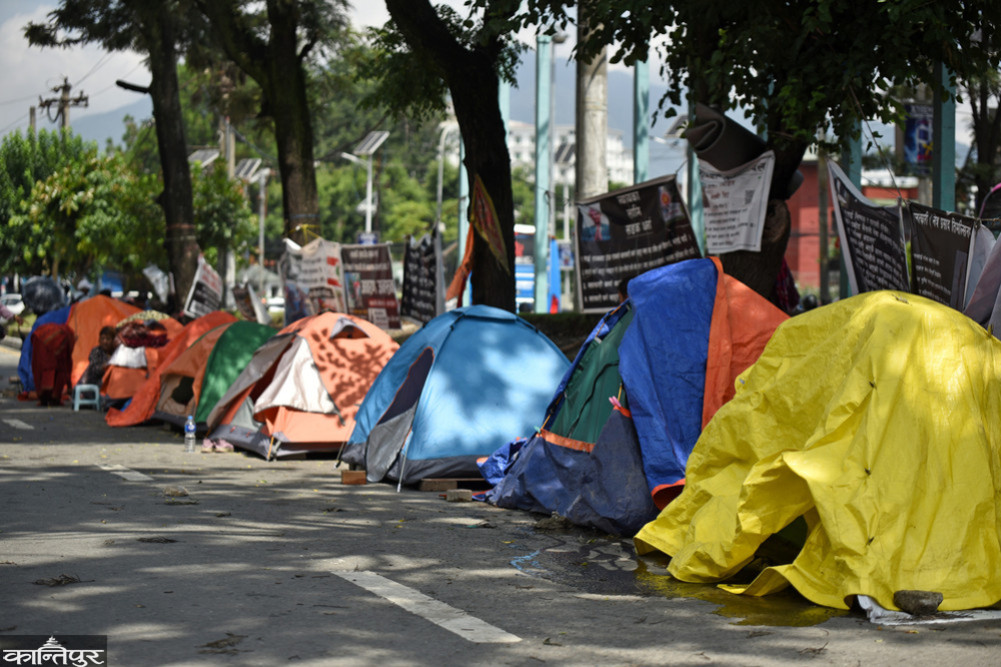
Let's look at the question of the squatters. The state, without any prior preparation, declared them 'encroachments' at first sight and displaced them, and now their situation is well known. They are being asked to leave the holding center after promising 25 thousand. The squatters are once again in trouble after water entered the holding center in Kirtipur. How does a sensitive state treat its citizens like this? While the state was demolishing the houses of the squatters, did it even try to find an answer to the question of whether there were pregnant women, new mothers, people with disabilities, senior citizens, school-going children, people without citizenship, single women, daily wage workers, etc.? Should the government's preparations regarding the management of the squatters be considered sensitive or insensitive?
The government also has a unique psychology. The same incident, pain, and perspective on citizens changes when it is outside and inside power. When in the opposition, incidents of suicide and displacement of squatters are seen as a symbol of the extreme failure of the state, but after coming to power, the same incident starts to be limited to personal decisions, legal processes, or administrative matters. Ravi Lamichhane, who used to say, "I will come to beat my chest" if a bulldozer was used in the squatter settlement before the elections, remained silent when the same bulldozer was used during his own government. He did not give any public response on the day the dozer was running, nor could he stop his own government. The self-immolation of entrepreneur Prem Prasad Acharya was presented by the then mayor of Kathmandu Metropolitan City, Balen Shah, as an extreme failure of the state, while Ganesh Nepali is silent when he self-immolates.
Another mirror of the state's sensitivity is its law enforcement agencies. Be it the Nepal Police or the City Police, in recent years their behavior has made citizens feel more harsh than the rules. Be it the incident of abuse against a woman who makes a living by selling kafal in Surkhet or the humiliating treatment shown to a sidewalk vendor in Kathmandu or the scenes of workers selling panipuri throwing all their livelihood items on the street or the incidents of using force targeting unarmed and minor protesters during the Gen-G movement, raise a serious question: have the state's security agencies lost their sensitivity? Has 'Police are my friends' become limited to just slogans? Do the police make citizens feel safe or scared?
While the state is enforcing the law, another question should be asked, why were people forced to set up shops on that sidewalk? Did they come there for the pleasure of doing illegal business or did they come there due to lack of employment, poverty and the compulsion to earn a living? If the policy is limited to only clearing the sidewalk and no alternative livelihood plans are made, then such a policy may be legal, but it is not sensitive. Is the state's objective to eliminate poverty or to remove the poor from public view? This question should be asked by every citizen of the state.
The state's compassion is not only visible in its decisions, but also in its language. In a democracy, the language of power should be a language of restraint, sensitivity and respect. But in recent days, words indicating threats, retaliation and the use of force have been increasing in the expressions of people in public positions. The use of expressions like ‘beating’, ‘breaking legs’, ‘spitting’, ‘beating’ in public by ministers and MPs or the Prime Minister challenging the Constitutional Commission in the style of ‘what if we interrogate for 5 hours, we will interrogate for 5 years’ is not a sign of democratic culture. The state already has legal power. When it is repeatedly demonstrated through threatening language, it exposes the autocratic character of the state.
Why does power change people? However, this question is not new. Many studies in psychology and political science have shown that people’s decision-making style can change after gaining power. This is where the question arises of whether we should make the state only a legal state or a moral state. A legal state enforces rules. A moral state also takes humanity into account while implementing rules. This is also the concept of a welfare state. A welfare state does not see citizens as just tax payers or administrative files. It places the right of every citizen to live a dignified life at the center of governance. The constitution's vision of a socialist-oriented state does not mean that the state will distribute everything, but that the state will see even the weakest citizens in the distribution of development, justice, and opportunities.
Citizens have not asked the state for a miracle. They have not sought a government that does not make mistakes. What they have sought is for the state to see them as human beings. To admit when mistakes are made. To understand social reality when making policies. To keep humanity at the center when implementing laws. To consider the situation of the weakest citizens when making decisions. Isn't this also the need for a healthy democracy?
Change of power is a normal process of democracy. But changing the character of the state is an even greater need. The social justice, inclusiveness, and welfare state envisioned by the constitution should not be just words on paper, but should become a culture of governance. The state must learn to see citizens not just as ‘problems’, ‘intruders’, ‘violators’, ‘movers’ or ‘facts’, but as people with complex social realities. The state often views citizens through only one identity. Dalits, women, people with disabilities, the poor, squatters, workers, Madhesis, indigenous peoples, senior citizens – they think that these are all separate categories. But in real life, a person lives with many of these identities. A woman can be Dalit, poor, disabled, pregnant or stateless. If the state views citizens only through one ‘label’, it is a sign that it does not understand social reality.
A sensitive state understands this complexity. An insensitive state makes decisions by attaching a single label. Therefore, every decision made by the state, every rule made, needs to be made and implemented with sensitivity and keeping in mind social reality. The greatness of a state is measured not by how strict the laws it makes, but by how respectfully it treats its weakest citizens.
The state may not have feelings, but the state must have compassion. Because, a power without compassion may ultimately appear powerful, but it can never be just. And, power without justice is not a sign of democracy, but only of governance. Compassion is not an optional quality of governance, but should become the main basis of good governance. A state without compassion can develop, but cannot build trust. A state without compassion can make laws, but cannot provide a sense of justice. A state without compassion may have power, but its moral legitimacy gradually weakens. It is easy to sing in favor of the poor, but it is difficult to govern in favor of the poor. Therefore, 'Garibko Chameli' should not be limited to election songs, raps or slogans but should also be seen in the state's behavior.