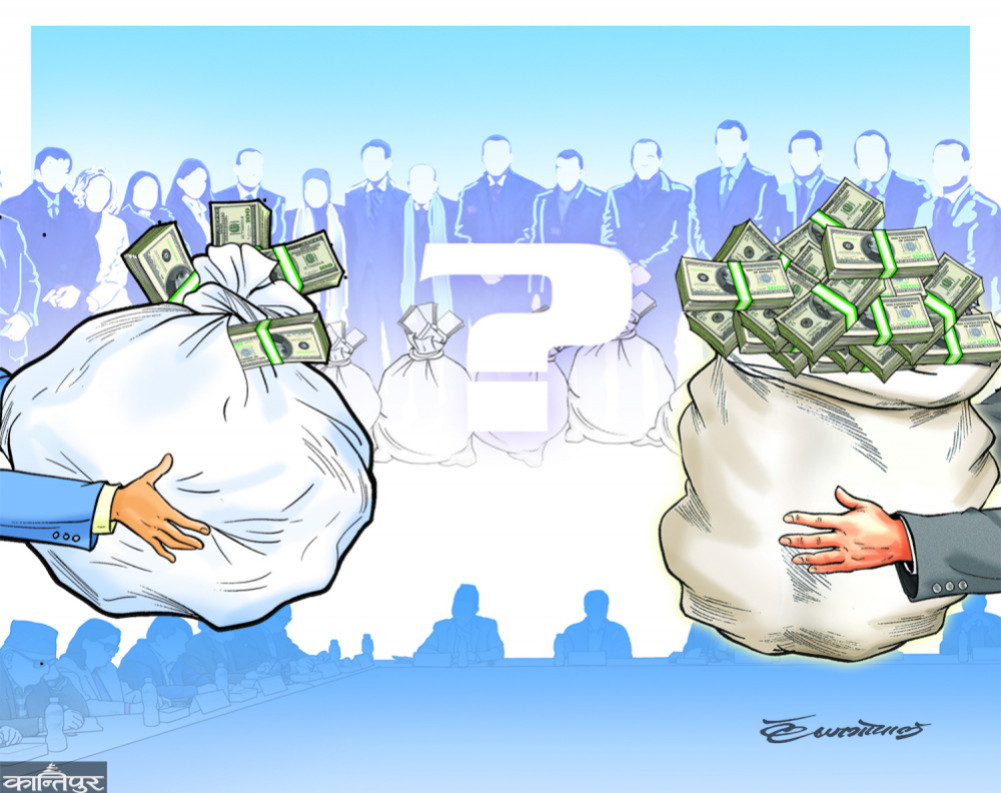
Countries with weak economic capacity try to assure foreign investors for foreign investment. For that, they also seek to sign investment agreements with various countries.
We use Google Cloud Translation Services. Google requires we provide the following disclaimer relating to use of this service:
This service may contain translations powered by Google. Google disclaims all warranties related to the translations, expressed or implied, including any warranties of accuracy, reliability, and any implied warranties of merchantability, fitness for a particular purpose, and noninfringement.
The expansion of foreign investment is also seen to contribute to increasing exports in various rapidly developing countries. However, it is not so easy to reap benefits from these two sources that increase a country's income. Nepal is an example of this.
Nepal's share of exports in international trade is less than 10 percent. The share of foreign investment in the economy is only around 0.2 percent. It is common practice to sign bilateral investment agreements (BIA) and free trade agreements (FTA) to increase investment and trade. In some cases, such agreements are made at our own initiative, and in others, at the interest of other countries. At present, both of these agreements have been proposed by our northern neighbor, China. Nepal should move forward with such agreements only after ensuring its own interests through adequate homework.
Countries with weak economic capacity try to assure external investors for foreign investment. For that, they seek to sign investment agreements with various countries. They make proposals. On the other hand, various countries also seek to invest in other countries and make proposals. In that process, investment security, protection, and promotion are sought. In countries with weak economic, social, and political conditions, good governance, political commitment, and social acceptance and positive sentiment towards investment are also weak, so additional assurances are sought.
The inability to create an investment-friendly environment in Nepal is often attributed to complex legal provisions, insecurity, and instability.The inability to create an investment-friendly environment in Nepal is often attributed to complex legal provisions, insecurity, and instability. Due to such obstacles, foreign investment is only 0.2 percent of GDP, whereas in Cambodia, which joined the World Trade Organization at the same time, such investment has reached nearly 10 percent.
With the aim of increasing investment, Nepal has already signed investment agreements with France, Germany, the United Kingdom, Mauritius, Qatar, Finland, and India. However, significant investment has not materialized. Therefore, we should adopt a strategy of signing investment agreements with as many countries as possible, assuring the security of investments, and increasing economic dynamism in the country. We should move forward with such agreements by considering what our potentials are, which sectors we can benefit from, and in which sectors investment would bring us broad benefits such as job creation.
An agreement with our rapidly developing neighbor China could indeed be beneficial for us. However, considering Nepal's needs and the cordial Nepal–China relationship, such an agreement could be useful in principle. Nevertheless, the provisions of the agreement will clarify many issues. Such matters also depend on Nepal's own homework.
A 2021 report published by the World Bank states: the more foreign investment there is, the more it increases exports. We can view this issue in connection with the free trade agreement (FTA) proposed by China. The inflow of investment, increased production, and facilitation of exports are complementary issues. Even if foreign investment comes or not, it is natural to expect that domestic products should have easy access to foreign markets. A free trade agreement would help Nepalese products reach China more easily.
But we are not currently in a position to compete with China in production and trade. China's trade volume is large. Nepal cannot benefit from an agreement based on equal facilities. Rather, it could create a situation where only China benefits. Alternatively, Nepal can identify goods that are already being exported to China and other potential exportable goods and take the initiative to secure facilities for them.
Before signing a free trade agreement (FTA) with China, Nepal's experience and practice with India can also be applied to the Nepal–China context. India has provided duty-free market access to almost all Nepalese products. Nepal, however, imposes customs duties and other charges on all but primary agricultural products. If similar provisions can be included in an agreement with China, Nepal could benefit. If a simple, clear, stable, and predictable policy can be formulated, and if agreements can be made with various countries that ensure the interests of both Nepal and investors, both investment and exports can be boosted.
The proposals for BIA and FTA from China are an opportunity for us. Considering the current situation of a strong government, they have come at an appropriate and timely moment. However, to make this encouraging and to ensure results, government homework is essential. Whether it is China or any other country, the main thing we need to keep in mind is our own maximum interest.
Therefore, we must prepare a strong framework that serves our interests. In this process, we must consult with all stakeholders. Based on the framework prepared as a common conclusion, we can present our position to different countries and clarify how flexible we will be regarding their concerns. This will contribute to making agreements and achieving results.