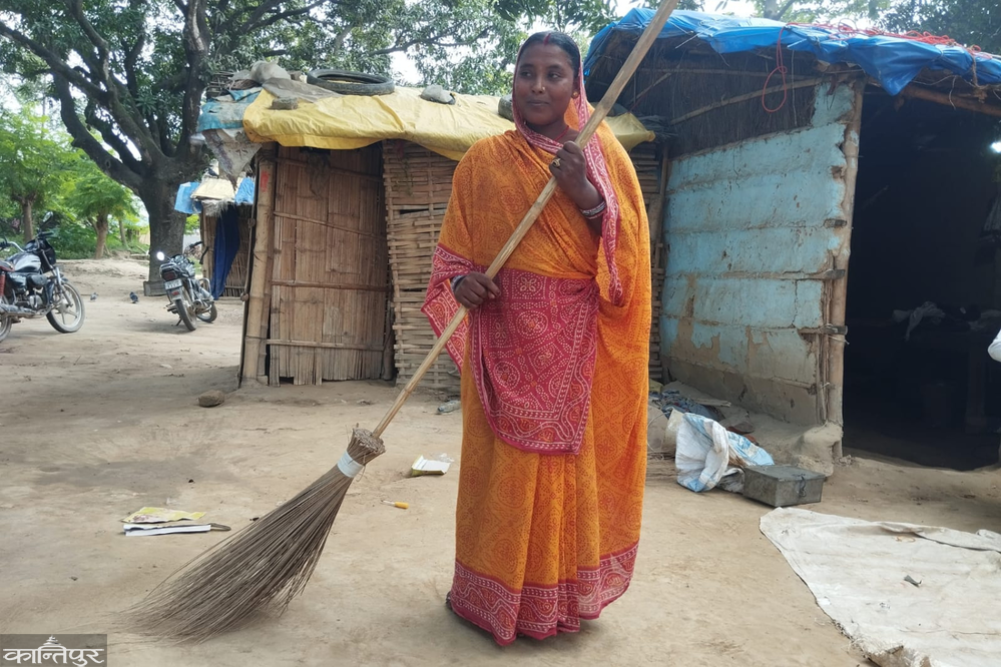
When the market awakens in the morning, people see clean streets, but they do not see Umarawati. She is present in the scene of the street, but not in memory. It is as if she, too, is just another part of the street—like an electric pole or a rest platform. But if one looks closely, it becomes clear—the hands that make the market livable again every morning are hers.
We use Google Cloud Translation Services. Google requires we provide the following disclaimer relating to use of this service:
This service may contain translations powered by Google. Google disclaims all warranties related to the translations, expressed or implied, including any warranties of accuracy, reliability, and any implied warranties of merchantability, fitness for a particular purpose, and noninfringement.
Umarawati wakes up very early in the morning. But it feels as if she rises not from sleep, but from the filth of the market. There is a broom in her hand. At first glance, you wouldn’t think Umarawati is a municipal employee. It seems as if the morning light has entrusted her with her work and moved on. The broom in her hand moves ahead of her, and she follows behind. Dust, leaves, pieces of plastic, and the neglect of the entire night all gather in one place. There is no haste in her gait, but neither is there laziness. A person who has been sweeping the same road for years remembers not only the potholes in the street, but also when the doors of which houses open and where the first leaf falls from which tree.
The color of labor is on her face. Sunburned skin, a sari faded by dust, a forehead damp with sweat—these all together form her identity. But when the subject of her son comes up, her voice changes. The hand holding the broom seems to pause in midair for a moment. “Let him study,” is all she says. There is no grand speech in that word “study,” but there is a light a mother has preserved in her heart for her child for years. She has few complaints about her own work. Her only complaint is this: may this work not become her child’s fate.
When the market wakes up in the morning, people see clean streets, but they do not see Umarawati. She is present in the scene of the street, but not in memory. As if she, too, is just another part of the street, like an electric pole, a drain, or a rest platform. But if you look closely, you see—it is those very hands that make the market habitable again every morning. She sweeps the street with her broom, but never sweeps away her dreams. She does not know how to let them fly away with the dust. She keeps them quietly in her heart, waiting for another morning. When we leave our homes in the morning, the street is clean. We take that cleanliness for granted. But the street does not become clean by itself.
In Simraungadh Municipality of Bara, there is an old pond, Isra. Once, that pond managed the water of a prosperous kingdom; now it preserves the face of history. It still carries the memory of the Simraungadh kingdom. In a small house by the edge of that pond lives 36-year-old Umarawati Devi. For almost a decade, she has been a sanitation worker for the municipality. The ruins of history and the labor of the present live together on the same path. The pond is a memory of the old kingdom; the broom is a test of today’s state.
In the Madhes, the heat begins to seep into the body before the sun even rises. The cold of the winter fog, however, rushes straight to the bones. But they have never let the seasons be a reason to stop working. In the heat, the broom tries to sweep away dust; in the cold, fog.Her son, Dilip Malik, studies in grade eight. He does not reject his mother’s work, but he does not see his future in it: “There is no respect for this job. I won’t pick up a broom.” In this sentence of a teenager, there is not only personal desire, but also the history of a family bound to the same labor for generations. And, there is also the aspiration to break free from that history. But aspirations alone do not change history. It is not enough for only the family to dream. Sometimes, the state must also dream.
Four districts east of Bara, in Siraha, you meet Sikindar Halkhor. He, too, is a sanitation worker in Siraha Municipality. He was previously a security guard at a local bank. After losing that job, he chose cleaning work. He said a sentence you won’t find in any government report: “No other path was visible.” Now, all three of his sons have entered the same profession. Here, a difficult question arises.
In the Madhes, the heat begins to seep into the body before the sun even rises. The cold of the winter fog, however, rushes straight to the bones. But they have never let the seasons be a reason to stop working. In the heat, the broom tries to sweep away dust; in the cold, fog. Sometimes it feels as if they are not sweeping the street, but the weather itself. There is no proclamation in their movements, no slogan. There is only a continuity that makes the municipality habitable again every morning.
Umarawati and Sikindar are two different stories. But their struggle is with the same society. Umarawati dreams that her children will not have to pick up the broom. For her, resistance means getting her children out of an occupation tied to the same caste for generations. She does not reject her own labor, but she does not want her labor to become her children’s destiny. This is a silent rebellion—not to throw away the broom, but to break the hereditary succession of the broom.
Sikindar’s story comes from the opposite direction. This profession is not his aspiration, but the result of a lack of alternatives. Rather, he demands respect, security, and equal treatment while remaining in this profession. His resistance is not to leave the profession, but to change its dignity. There appears to be a contradiction between these two stories, but in reality, both stand against the same structure. One mother is searching for a different future for her children. One father is fighting to dignify the present. One wants to stop the cycle of inheritance; the other wants to make that inheritance a matter of dignity, not humiliation. Even though Umarawati and Sikindar’s paths seem different, their struggle will remain the same.
If Umarawati were walking alone, she would be just one person. But when another broom rises on the other side of the street, and then another beyond that, Umarawati suddenly becomes Umarawatis. One name is shared among many hands. After that, no sanitation worker is seen working on the street. It feels as if the morning itself has split into many pieces and set out to awaken the market.
For Umarawati to become Umarawatis is not just a grammatical change. It is also a change in sociology. When we hear the story of one person, we feel compassion. When we see many Umarawatis, we begin to see the structure. There is not just one mother’s dream. There is the shared aspiration of hundreds of mothers. There is not just one broom, but a history of labor. And then it becomes clear: the city and market do not rest on the shoulders of a single Umarawati, but stand on the invisible labor of countless Umarawatis.
The question of the Umarawatis, who are at the very bottom of the social structure, is not about the broom. The question is about the future. When will a broom sweep away the narratives that crawl in the subconscious alleys of social structure? The first question: what will be the future of the children of the Umarawatis? If their greatest dream in life is that their children do not have to do this work, has the state been able to provide them with another path through education, skills, and opportunity? Shouldn’t a citizen’s profession be determined by choice, not by birth? The second question: when will the people who do this work receive respect? Words of thanks are not enough for the labor that keeps the city clean. Respect means a safe workplace, protective equipment, regular health checkups, timely and fair wages, social security, and a place for workers’ voices in decision-making processes.
The third question: why does this work remain the fate of only one community? The day public sanitation work is not the identity of any caste, but a respected public service, and the day both Dalits and non-Dalits can do this work with equal dignity, that is the day society will have improved not only its sanitation, but also its consciousness. The mark of a civilized society is not the shine of its streets, but its perspective on labor. The broom makes the filth of society’s boundaries, limitations, and weaknesses plainly visible.
In most municipalities of Nepal, sanitation workers are on daily wages, contracts, or hired through contractors. They regularly clean streets, drains, garbage, and public spaces. But in many places, they do not have enough protective equipment. Even basic safety measures like gloves, boots, masks, regular health checkups, and occupational insurance are incomplete. Complaints about not receiving salaries on time are heard repeatedly. This means the problem is not only individual, but also institutional.
We often consider sanitation an environmental issue. But sanitation is a matter of labor, and of dignity. Clean streets are essential for public health. But why is the health of those who clean the streets not a matter of public concern? Municipalities allocate budgets for waste management. But why is the safety of those who work directly with waste not a priority?
We want clean cities and markets. But do we also want safe sanitation workers? The quality of democracy is also measured by how the state treats those at the grassroots who wield the broom. This question is rarely asked: Do you feel you have to do this work because of your caste? When you are sick, does the city remember you, or only the garbage? Why, even in democracy, are some communities still forced to live as the most essential, yet most invisible, workers of society?
Sanitation workers do not usually make the news. They only become news when they take to the streets in protest. When they stand on the street protesting unpaid wages, when the municipality sends bulldozers to remove their settlements from public land, or when the city stinks because garbage is not collected, only then do cameras turn toward them. And even then, not to understand their lives, but to explain why the city became dirty. Why is their presence only noticed in their absence? What would happen in the city if they did not work for a single day?
The irony is that on the day the city looks exceptionally clean, the credit is usually given to the mayor’s efficiency. But the names of the hands that made that cleanliness possible are never mentioned. Credit for success goes up, while risk and humiliation fall down. There is perhaps no clearer example than this of how credit is distributed unequally in democracy. This is where the test of the media begins.
The question is for each of us citizens as well. We do not know the name of the person who sweeps the street in front of our own house, but we are the first to complain if the city is not clean. We produce garbage, but do not want to look at the people who work with garbage. A democracy matures when citizens not only consume services, but also learn to respect the labor that makes those services possible. The true stature of a city is measured not only by how clean its streets are, but by how safe, respected, and hopeful the people who clean those streets are.
Sometimes it feels as if the biggest mirror of a city is the broom. Because it not only shows what is on the street, but also what society has hidden. The broom cleans the street, but who cleans the hand that holds the broom? The Umarawatis do not have the leisure to ask this question. They are bent over the street. A person who is bent over sees many things, but very few people see them. Perhaps the broom of the Umarawatis was born to sweep our vision before it sweeps the street.
The broom of the Umarawatis cleans the street every morning. But perhaps the real work of that broom is not just to sweep the street. It is also trying to sweep away the dust that has settled on our vision. As long as the hands that clean remain unsafe, the city’s cleanliness is incomplete. As long as labor is tied to caste, democracy too remains incomplete.
The foundation of “cleanliness and good governance” rests on the skills, safety, and dignity of the invisible workforce in the sanitation sector. If even one of these three is weak, the claim of a clean municipality remains incomplete.
A country is not built by the “team” of any ruler. In reality, it is these very people who wake up first in the morning and are the last to tire at night who build the country. These invisible workers, who drag their own lives to make others’ lives easier, are the nation builders. Learning to see them is perhaps learning to understand democracy more deeply.