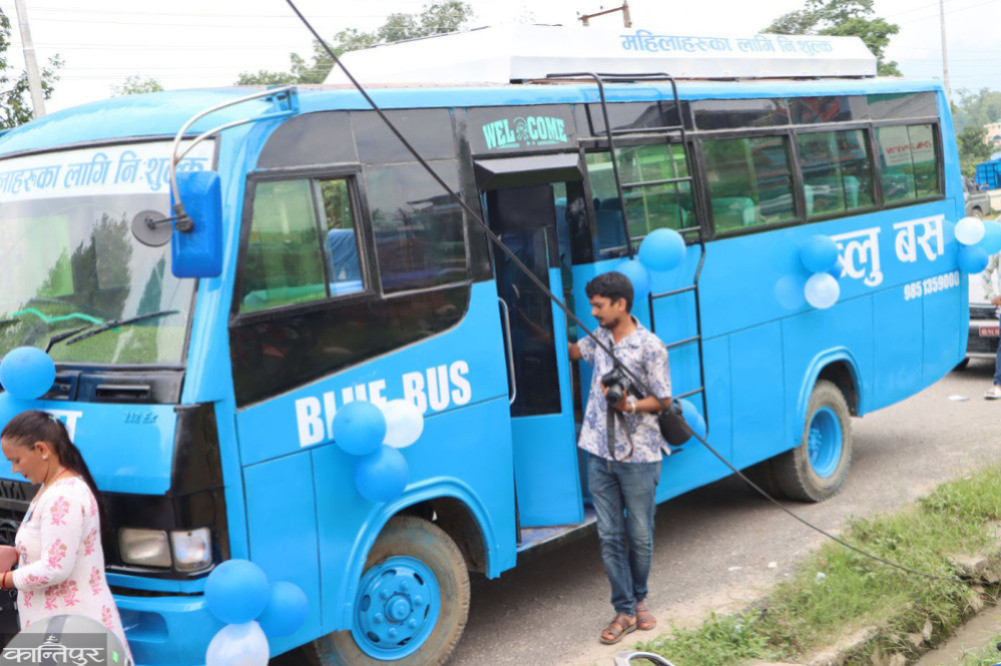
Should we create an environment where women can confidently use public transportation, or introduce a populist program where only a certain number of women receive free services?
We use Google Cloud Translation Services. Google requires we provide the following disclaimer relating to use of this service:
This service may contain translations powered by Google. Google disclaims all warranties related to the translations, expressed or implied, including any warranties of accuracy, reliability, and any implied warranties of merchantability, fitness for a particular purpose, and noninfringement.
The government has introduced various programs for women's empowerment, safety, health, employment, and economic self-reliance. It has also announced the operation of a free 'Blue Bus' service in Kathmandu for safe and convenient public transportation for women.
Meanwhile, at the local level, Bardibas Municipality introduced a plan to provide fifty thousand rupees as an incentive to couples from the Musahar community to reduce child marriage. Later, it also announced a policy to give fifty-one thousand rupees to daughters who marry after reaching the age of 20.
Globally, it is a fact that women are comparatively in weaker positions than men in various aspects. In Nepal, there are obstacles to the development of girls, adolescents, and women. Problems such as malnutrition and lack of nutritious food, limited access to health services, insufficient information about adolescence and menstruation, child marriage and its health consequences, as well as incidents of sexual and gender-based violence, occur daily.
Similarly, barriers to women's social development include patriarchal mindsets and social structures, various customs, unequal access to education, domestic violence and social insecurity, and low participation of women in decision-making processes. Limited employment opportunities, lack of access to property and economic resources, and limited access to loans and financial services for entrepreneurship have also made it difficult for women to live independently. The lack of information, access, and opportunities regarding various state-provided opportunities has certainly affected women's self-confidence and leadership development.
It is perhaps with these and other diverse challenges in mind that the government has been introducing various programs and plans targeting women. However, it is uncertain whether these plans are actual demands of women or concepts devised by those in leadership positions. Recently, the government announced the operation of a free blue bus service for women.
Incidents of abuse against women in public transportation continue to make daily headlines. Individuals with bad intentions, sexual predators, and mentally disturbed people continue to harass women and girls alone or in secluded places. Abuse occurs in transportation, public spaces, workplaces, streets, and digital platforms. If women have to carry the constant fear of falling victim to sexual or criminal abuse, it is hard to say that this will not hinder the development of their independent, critical, and fearless consciousness.
So, what should the state do to protect women from violence and abuse perpetrated by a section of society? Free transportation for women, women's schools, women's colleges, separate offices for women? Or similar measures? This question is being raised with considerable seriousness in today's context.
There is a belief that women are the embodiment of care and service, and therefore it is the responsibility of men or the state as a whole to ensure their safety and protection. Our patriarchal family structure imposes the responsibility and compulsion of monitoring women around the clock.
There are also men in society who feel it is their duty to protect their wives, sisters, or mothers. These habits or practices have arisen from our upbringing, education, and the responsibilities assigned by society. As a result, women may develop a sense of helplessness, while men may live with an additional burden of responsibility.
Do women need separate protection? The countless issues and problems faced by women have already been mentioned above. Should we encourage them with financial incentives or invest in raising awareness? This is a matter worth considering. Policies of protection and safeguarding that leave women behind will certainly prevent them from identifying the root causes of their problems. Yes, in special circumstances, short-term targeted programs for women may have some positive effects.
If the concept of protection is not viewed in a transformed way, it seems we will find it difficult to advance gender issues from feminist, socialist, and class perspectives. The question is—should women be treated as dependents who require male guardianship or heroic protection? Or as a vulnerable group that always needs social security? Or should we make them human beings who live by the principle of coexistence between men and women?
Women may demand women-only spaces such as toilets, shelters, separate rooms for changing menstrual pads in schools, or breastfeeding rooms in offices. These are issues specific to women. However, for working women, women out shopping, or women going to the cinema, separate and free transportation services may not necessarily be among the main demands of women in Kathmandu.
Various feminist studies show that providing separate facilities is only a temporary or superficial solution. It does not address the underlying problem of why women feel unsafe in public spaces. The responsibility for safety should not be placed on women by adding facilities, but rather, effective results can be achieved by actively preventing criminals from committing crimes. Who are these separate and free services for? The poor, transgender people, persons with disabilities, or others? Should the government, which weighs every decision in terms of loss and gain, create an environment where women can confidently use transportation by paying, or introduce populist programs where a certain segment of the female population receives free services?
There is much to be done for women's rights. In that process, plans and implementation should prioritize women's class, caste, geography, economic status, employment, education, and public awareness. In this age of technology, cyber laws should be made stronger and more practical. The transportation sector, workplaces, and public spaces can be made more women-friendly. The state can expand targeted facilities, keeping in mind the situation of women's oppression.
Writer and literary figure Chandraprakash Baniya, expressing his views on his social media regarding the free, separate blue bus for women, says—if the government that provides separate travel facilities for women someday issues an order requiring them to wear burqas, it should not be surprising. The implication is that such measures may prevent women from becoming self-respecting, self-reliant, fearless, and independent.
Political analyst and writer Ahuti has expressed the view that instead of separate concessions for women, there should be an emphasis on developing awareness that promotes advanced democratic, understanding, and respectful relations between men and women. Indeed, this statement seems practical in essence. Since the concept of separation is rooted in old thinking, envisioning a society with awareness among both men and women is the demand of the present, and accordingly, such programs and plans should be prioritized by the government. Rather, if policies and plans were formulated through investigative methods that included women from the grassroots level on what women actually need and what their problems are, perhaps the real issues of women's needs would emerge.