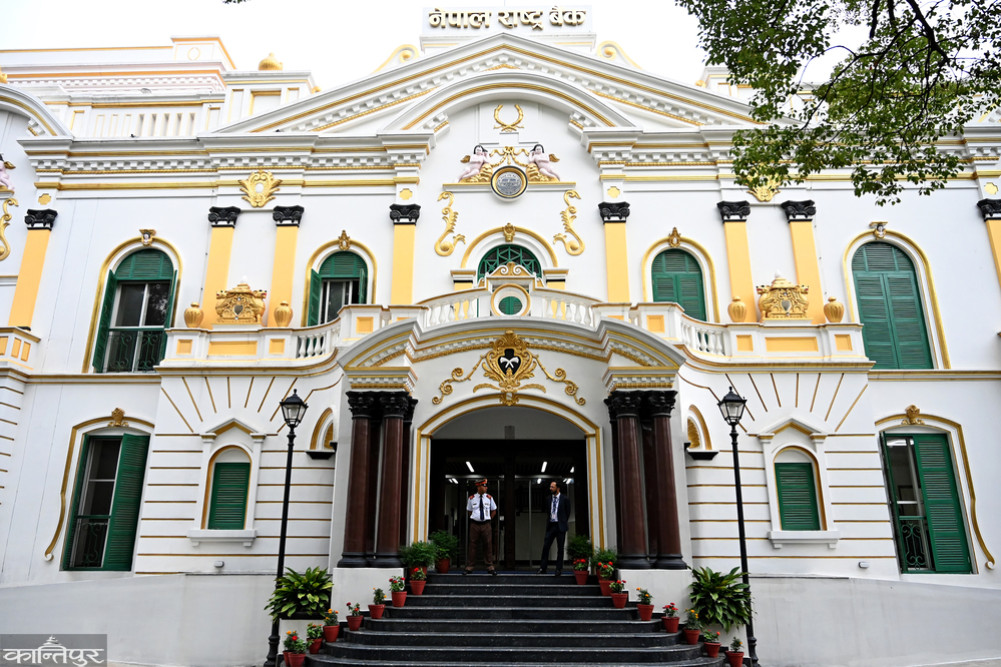
The objective of the monetary policy is to achieve the economic growth target set by the financial policy and the government’s policies and programs for the coming fiscal year. What impact will the recently published monetary policy by Nepal Rastra Bank have on the financial system?
We use Google Cloud Translation Services. Google requires we provide the following disclaimer relating to use of this service:
This service may contain translations powered by Google. Google disclaims all warranties related to the translations, expressed or implied, including any warranties of accuracy, reliability, and any implied warranties of merchantability, fitness for a particular purpose, and noninfringement.
The practice of introducing monetary policy in Nepal began in 1966. However, according to the provisions of the Nepal Rastra Bank Act, 2002, the formal commencement of the Governor publicly announcing the monetary policy started from the fiscal year 2002/03. As in previous years, the monetary policy for the fiscal year 2026/27, issued by Nepal Rastra Bank, has just been made public. At a time when the country's economic situation has slowed down, a government with nearly a two-thirds majority, formed through the recently concluded elections of this fiscal year, is in operation.
On one hand, the new leadership must play a strong role to ignite hope among the people and foster a sense of development, while on the other, it must revitalize the economy and lead the country as a whole towards economic growth. The current government has the responsibility to fulfill the mandate given by the Nepali people, with due respect, by cooperating with the old political parties that have long held leadership. Among the various mechanisms of state operation, the monetary policy issued by Nepal Rastra Bank is considered important in fulfilling this responsibility.
With the financial policy for the coming fiscal year, the government's policies and programs, and the hundred-point governance reform program already made public, the objective of monetary policy is to achieve economic growth through monetary management. What impact will monetary policy have on the financial system? If we analyze this issue, we must connect it to the important aspect of banks and financial institutions within the financial system. When discussing monetary policy, the influence of banks and financial institutions within the financial system affects the overall economy. Therefore, let us analyze the impact on these institutions in the days to come.
Will monetary policy strengthen the overall economy, banks and financial institutions, and the financial lives of ordinary people? This question has arisen. Let us analyze points 19 and 20 under macroprudential regulation and financial stability, which are important aspects of monetary policy. From this, we can interestingly observe what the state of the financial sector will be in the coming days, where the mentioned issues are as follows:
1. Financial Sector Reform
Banks and financial institutions are established only after obtaining a license from the regulatory body, Nepal Rastra Bank. There is also a provision that branches and counters of these institutions can only be operated with the approval of the regulatory body. Despite such provisions, there is a current situation where many banks have branches and counters in the same building in urban areas. Was this really necessary? Has it truly contributed to the financial system? The regulatory body needs to analyze this. While this has raised the issue of financial access on one hand, it has also led to unhealthy competition, resulting in a large number of banks, financial institutions, and their branches merging. The impact of this remains to be evaluated.
In addition, if we look at the development of digitization in the financial system due to technological advancement, it appears to have made significant progress. Along with this, the level of risk has also increased. Digitization in the financial sector has made things easier and reduced costs. If this issue is implemented efficiently and the regulatory body pays attention to managing branches of different financial institutions in the same building in cities, it could have a positive impact on rising costs, unhealthy competition, and the quality of services.
2. Removing Unlimited Liability from Personal Guarantees
It is said that those who have legal rights must also fulfill their duties. As a result, the party with rights—whether over personal property or institutional rights—must also bear responsibility for liabilities, and banks and financial institutions have been acting accordingly as per the regulatory body's directives. Accordingly, the issue of removing unlimited liability from personal guarantees is seen to have a more serious impact in the context of institutional loans than personal loans.
Nowadays, it is not uncommon for a single person to establish two or more institutions and rotate funds within their own institutions. While buying from and selling to one's own institution is considered appropriate in chain businesses, the misuse of funds is seen as a tendency in such businesses. Currently, banks and financial institutions seem to be enjoying such investments, and investors have become accustomed to such practices. Although it appears that investments are diversified, it is clear that funds are being used for other purposes, whether it is for tax evasion or misuse of funds. When the borrowed amount is not used for its intended purpose, institutional loans have been problematic for a long time. In such a situation, what impact will removing unlimited liability from personal guarantees have on financial health? That remains to be seen. The results of this provision will certainly be revealed over time for financial institutions seeking loopholes in financial transactions and for investors looking for ways to misuse the funds of financial institutions.
3. The Issue of Blacklisting Hindering Access to Banking Services
The issue of blacklisting in financial transactions arises when customers do not fulfill their obligations as per the directives issued by the regulatory body. There is a provision to blacklist individuals and institutions that do not conduct transactions properly or do not comply with 'compliance' requirements. In the current situation, this provision has made it somewhat easier to measure the health of the financial system. If such measurement mechanisms are removed, what kind of disease will spread in the health of financial transactions in the future? This needs to be considered. The provision of blacklisting identifies those with bad intentions, and to some extent, it has maintained financial health. If this provision is removed in the coming days, what impact will it have? Only time will tell.
4. Management of Non-Performing Loans
Managing non-performing loans is an important task. It has a positive impact on the quality of assets of financial institutions. However, one may question whether non-performing loans caused by malicious intent will also benefit from this facility. If non-performing loans are kept for various reasons, they weaken the state of financial institutions. The full impact of its implementation remains to be seen.
5. Revival of Loans Under Pressure and Stress
With the slowdown in the economy, some loans of banks and financial institutions are under stress. Among the loans of financial institutions, various reasons cause loans to be under stress. Some loans are stressed due to borrowers, some due to financial illiteracy, some due to banks and financial institutions themselves, and some due to external environments. Whatever the reasons for stress in the loans of banks and financial institutions, it is certainly not appropriate to apply the same method of revival to all types of stressed loans. If all stressed loans receive treatment by exploiting loopholes in revival, what will the health report of financial institutions look like? That remains to be seen, and the concerned regulatory bodies need to be vigilant in this regard.
6. Share Collateral Loan Limits Based on Institutional Strength
Among the various types of loan products provided by financial institutions, share collateral loans are considered one such product, which can be easily obtained. The value of share loans is determined based on the share price set by the stock market, but how is the market value of shares being determined? This issue remains unclear. While there should be certain criteria for determining share prices in the market, the question of how share prices are being determined in the stock market always remains. In such a situation, it can be expected that mechanisms to measure the strength and weakness of institutions will be properly utilized. If so, the time will come when distortions in the stock market will decrease and investments will be safer.
These issues have been addressed in the monetary policy with the intention of revitalizing the sluggish economy and accelerating the pace of overall development. The effectiveness of any issue is seen in its implementation. Since that situation plays an important role, the implementation of these issues will affect their outcomes. During implementation, the regulatory body, the implementing banks, financial institutions, and the direct behavior and style of clients—loan customers—determine the outcome or resolution of these issues.
In implementing such issues, there is a need to shore up loans through 'denting and painting.' How successful will the regulatory body, banks, financial institutions, and the direct beneficiaries—the loan customers—be in moving financial institutions forward by removing these issues? What impact will this have on the economy? The coming days will reveal this.
Let us hope that if the concerned regulatory bodies can move forward with greater sensitivity on these issues, the state of the financial system and its components will become stronger, more capable, and more efficient in the coming days, and the economy will move towards economic growth. And, there is an expectation for the successful implementation of the monetary policy issued by Nepal Rastra Bank.