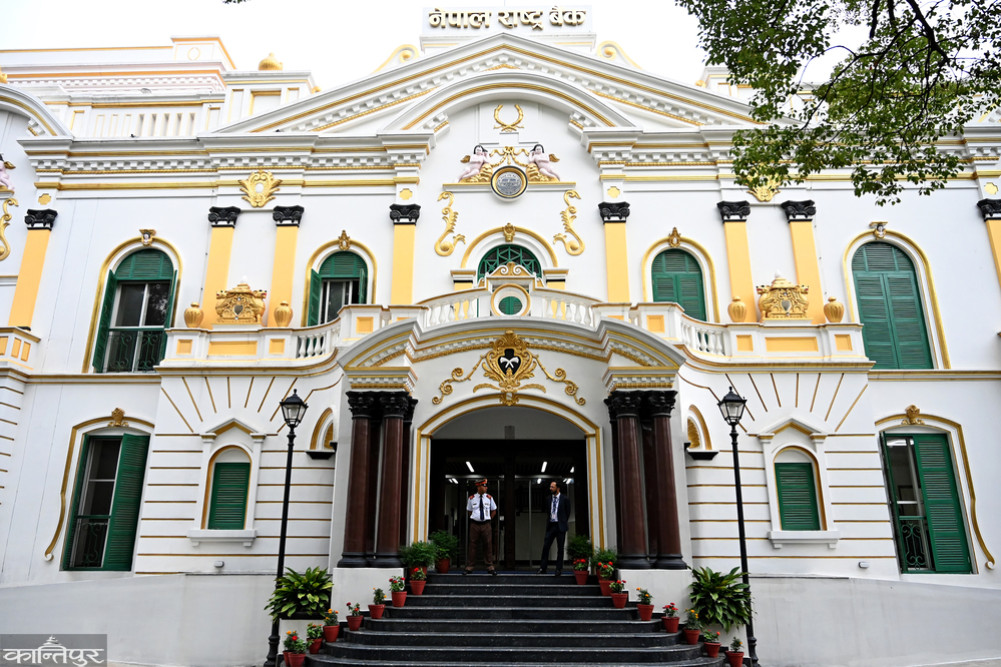
It appears that the monetary policy has not addressed issues related to the current economic problems that it could have tackled within its own scope. There is also a lack of clarity in the policy regarding some matters that Nepal Rastra Bank has said it would address.
We use Google Cloud Translation Services. Google requires we provide the following disclaimer relating to use of this service:
This service may contain translations powered by Google. Google disclaims all warranties related to the translations, expressed or implied, including any warranties of accuracy, reliability, and any implied warranties of merchantability, fitness for a particular purpose, and noninfringement.
The Nepal Rastra Bank has issued the monetary policy for the upcoming fiscal year, estimating a credit expansion of around NPR 650 billion to help achieve the government's target of 7 percent economic growth. In the past, the review of the previous monetary policy, the current state of the broader economy, and the new monetary policy used to be presented together, but this time all three aspects have been made public separately.
The monetary policy has announced measures such as making personal guarantees and blacklisting provisions more flexible, facilitating borrowers in difficulty, introducing separate policy arrangements for the recovery of loans stuck in sick industries, allowing loans against shares based on a company's financial strength, and further easing loans for the purchase of large public electric vehicles. Through these measures, the central bank claims that credit demand in the market will increase, the excess liquidity in banks will flow into investments, and the credit utilization capacity of borrowers and banks will rise.
If the economic reforms announced in the budget, the pace of capital expenditure, and the creation of a private investment-friendly environment do not materialize, the monetary policy alone cannot achieve the economic growth target. The central bank has also indirectly indicated this. However, it appears that the monetary policy has not addressed issues that could be tackled within its own scope regarding the current problems of the economy. There is also a lack of clarity in the policy on several matters that the central bank has said it would address. While the effort to remain within its jurisdiction is positive, the policy does not present a clear roadmap for resolving the fundamental problems currently facing the economy. Much more could have been done to address the structural problems of the banking system. There should have been greater clarity on issues such as capital adequacy pressure, bad loan management, risk weight reassessment, or expanding banks' lending capacity. For this reason, experts ranging from former governors to former executive directors have called this a 'message-less' and 'status quoist' policy.
Given the current situation—ample liquidity accumulated in the financial system, banks under capital adequacy pressure, the private sector hesitant to expand investment, credit expansion consistently falling far short of targets, and sluggish stock and real estate markets—there was a natural expectation for more active intervention from the monetary policy. However, stakeholders feel that the policy has been limited to maintaining the status quo.
The central bank has set a target of 11 percent credit expansion to the private sector for the coming year. But the policy has not presented a basis for achieving this target. In the past two fiscal years, the target for credit expansion was set at around 12 percent. However, even amid low interest rates and ample liquidity, only about half the target was achieved. This shows that the problem is not just about interest rates or liquidity, but is also linked to the investment environment, banks' lending capacity, and the confidence of the private sector. In such a situation, merely announcing targets cannot stimulate economic activity. Because all the issues mentioned in the monetary policy will depend on procedures and future directives. The central bank can make policy announcements as needed after approval from the board of directors. This is where stakeholders' concerns arise.
At present, Nepal's economy requires more effective implementation of fiscal policy than monetary policy. If the economic reforms announced in the budget, the pace of capital expenditure, and the creation of a private investment-friendly environment do not materialize, the monetary policy alone cannot achieve the economic growth target. The central bank has also indirectly indicated this.
The central bank has some fundamental responsibilities and functions. In the past, when policy was focused on strengthening the external sector, foreign exchange reserves reached a historic high. But it has become clear that simply increasing reserves does not make the economy dynamic. In a country like Nepal, the central bank alone cannot control inflation. The general public is not interested in the currently low inflation rate shown in statistics, because it does not match their daily reality.
This time, there were higher expectations for financial sector stability. With excess liquidity, there was an opportunity not only to expand credit to the private sector but also to open up investment opportunities in safe foreign securities. There remains scope to facilitate credit expansion. The adverse situation created by the current capital loan guidelines can be eased. In the past, the central bank operated more according to the aspirations of its leadership than by the book, and it seems the same approach is being pursued now. There is no guarantee that the Nepali economy will not have to face a similar crisis in a different form in the future.
Monetary policy is also a guide to steer economic activity in the right direction. The current challenge is to expand investment, production, and employment while maintaining financial stability. For that, the central bank must make public the announced future reforms and implement them. The government, too, must not delay in implementing expenditures, reforms, and restoring the confidence of the private sector. Otherwise, there is a risk that ample liquidity will remain stuck within banks, credit expansion targets will remain only on paper, and the economic growth target will remain just a declaration.