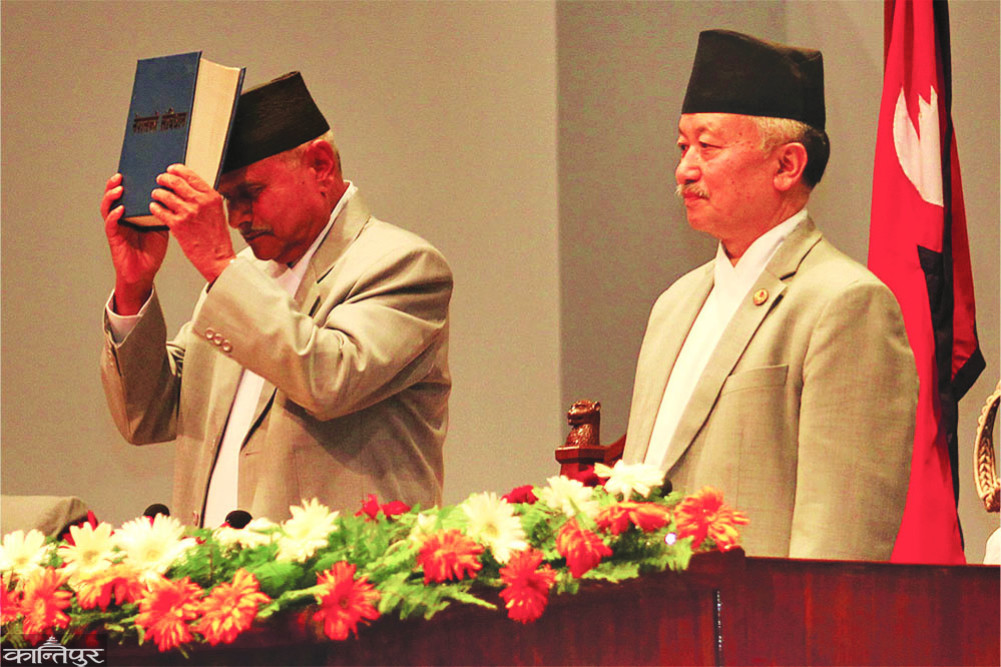
It is not that the constitution writing took eight years, but the process of increasing ownership by incorporating the demands and views of as many parties as possible took time. Like the constitution making, amendments are not rushed. It is not possible to insist on the process and basic principles of the amendment by showing the votes a party received in an election and the majority in parliament.
We use Google Cloud Translation Services. Google requires we provide the following disclaimer relating to use of this service:
This service may contain translations powered by Google. Google disclaims all warranties related to the translations, expressed or implied, including any warranties of accuracy, reliability, and any implied warranties of merchantability, fitness for a particular purpose, and noninfringement.
As the discussion of the constitutional amendment continued, the scene in front of the Constituent Assembly building (Birendra International Conference Center) on 14 Jestha 2069 comes to my mind. I rode my bicycle, left my job ID card at home, and reached the building, ready to witness the moment the constitution was proclaimed and, if necessary, to join a protest or support rally. I liked some of the provisions of the draft constitution that had come to the public's attention, while I and the group (of civil society) including me did not like some of the provisions. I was in a strange mood of both welcoming and opposing the constitution.
The atmosphere and learning of the constitution-making
Countless small and large groups were protesting in front of the Constituent Assembly building, holding banners of their demands on the road. Some groups wanted 'secularism', others wanted 'Hindu state'. Some were saying, 'Keep the cow as a national animal', some were saying, 'Cows should be slaughtered and eaten'. Some wanted 'federalism and name based on caste', some were saying, 'We don't want federalism at all', or 'federalism based on population'. Some groups were shouting 'executive president', while others were arguing over 'directly elected prime minister' and 'prime minister elected by parliament'. There was a separate front of women, Dalits and tribals who were demanding 'proportional participation' and 'ensuring citizenship in the name of the mother'. They were the opposing voices of different classes and groups of society, rather than political parties. Not only that, there was also a threat not to issue a constitution against their demands. It seemed that even if the constitution was announced that day, it was likely to be rejected. The demands came from opposite poles, and it was certain that if one's demands were met, someone else's would not be.
All the members of the Constituent Assembly were locked inside the assembly building. Outside, it could be heard that political parties were trying to bring about uniformity on the basic issues of the constitution such as the form of government, federalism, secularism, and proportional participation. The next morning, it was learned that the assembly had been dissolved overnight, without promulgating the constitution. The second Constituent Assembly, formed after the elections on 4 Mangsir 2070, promulgated the constitution on 3 Asoj 2072 after gathering the consent of as many political parties and members of the assembly as possible on the draft prepared by the first assembly. Perhaps if the earthquake of 12 Baisakh 2072 had not devastated the country, the political parties would not have agreed to promulgate the constitution so quickly. The earthquake also inspired the main opposition to say, ‘From today on, we are all in favor of the government’ and to join the reconstruction work after completing the work on the constitution. For the first time, the country got a constitution made by a people-elected Constituent Assembly.
The current constitution, which was born from a long struggle, has gained popularity as a relatively progressive constitution in the world, and although it could not be unanimously adopted by the major political parties in the assembly and representatives of the then civil society, is being revised before it can be fully implemented. That too, without a 'critical' review by constitutional experts of what provisions worked, what did not work, and why, and without the participation and acceptance of the process by the parties participating in the constitution-writing process. On the one hand, the current largest party, the Rashtriya Swayamsevak Sangh (RSS), which led the government, has already made its party's views public on the most controversial agendas, including the form of government, during the constitution-writing process. On the other hand, individuals, groups, and political parties who saw, heard, and understood the struggle of constitution-making are outside the pre-amendment process. The party currently leading the government was not even born at the time of constitution-writing, and most of the members of the Council of Ministers and Parliament were probably students studying at home or abroad or were involved in professions. There is a lot of doubt that the amendment effort, initiated by an advisory group that was not involved in the economic, political, and social aspects behind the provisions of the constitution and the issues of the then consensus, without the trust of the main political parties and without a formal review, will lead the country to another conflict and disaster.
Amendment process and acceptability
The first aspect of constitution-making that must be accepted is that in a country like ours, which is full of diversity, it is not possible to write a constitution that satisfies all parties. However, if the constitution can address the views and demands of everyone as much as possible, it will gain acceptance. Both the process and the content are equally important aspects in amending the constitution. The description of the then situation described above on the issue of the process suggests many contexts. The first aspect that must be accepted in constitution-making is that in a country like ours, which is full of diversity, it is not possible to write a constitution that satisfies all parties. However, if the views and demands of everyone are addressed as much as possible, the constitution gains acceptance. The existing constitution is very long, and there are contradictions on many issues. Because it does not carry the views of any one party, but is a document of consensus between different views. If there was no consensus on conflicting issues, the management of armed conflict and the movements of various groups for identity would not have been easy, and the country would not have been in a position to withstand another conflict. The same environment applies to amendments.
Time is of particular importance in the process. It was not that it took eight years to write the constitution before, but the then members say that a rough draft was ready within two years of the thematic committees starting their work. But the process of promulgating the constitution by incorporating the demands and views of as many parties as possible and with the support of as many people as possible took time. For this acceptance, it is not enough to praise the wise and inclusive leadership of the then Constituent Assembly Chairman, the late Subhash Nembang. The current heads of the federal parliament can learn a lot from his working style. Like constitution-making, amendments are not done in a hurry. Similarly, it is not possible to insist on the process and basic principles of the amendment by showing the votes received in an election and the majority in parliament. The amendment of the constitution is done by the parliament and the amended constitution is the property of all citizens because it directly affects everyone's lives. Therefore, the involvement and ownership of the government, parliament, political parties, civil society, and the private sector is necessary from the beginning in the amendment process. Only if the amendments are made in accordance with the methods and processes determined by the constitution itself with the strong participation of the political parties participating in the writing yesterday, under the leadership of constitutional experts, will there be multi-party ownership. If the multi-party does not take ownership of the process, it is certain to be difficult. Another aspect of the
process is an independent and in-depth review of the current constitution. In the decade of implementation, some provisions such as ambiguity, ambiguity, and double meaning have been seen in the constitution. This has led to problems in implementation and has even affected the fundamental essence of the constitution such as equality, proportional participation, and federalism. Therefore, before going directly to the subject of the amendment, it is necessary to conduct an independent and in-depth review by constitutional scholars and legal experts on which provisions of the constitution are problematic and how to resolve them. Along with the review, a multilateral consensus is necessary on the issues on which constitutional amendments are limited and which cannot be amended. Otherwise, just like during the drafting of the first constitution, everyone may have their own demands and stances and the amendment may never be completed.
Identification of the subject matter and problems of the amendment
The government has not officially made public its views on which issues to amend and what changes to make. However, the party leading the government has made its support public in the name of ‘different views on the constitution’. Since the party was born almost eight years after the drafting of the constitution, it is natural to put its views before the public at the time of the amendment. But the issues put forward as views seem to have attacked the very essence of the constitution. Issues such as state structure, inclusiveness, proportional participation, and federalism are the core essence of the current constitution. Political parties must first be clear about whether or not amendments can change the basic principles and essence of the constitution. And, are those ideas appropriate to Nepal's geography, economic politics, diverse society, and internal democracy of parties, and in line with the essence of the movements for inclusiveness, republic, federalism, and identity? It is also worth considering.
For example, some issues such as moving to a directly elected executive for stable leadership, adopting a fully proportional system in elections because the direct election system is expensive, and abolishing or restructuring the provincial assembly because it is ineffective have come up for discussion. On the first issue, it is natural for new parties, having seen the self-serving coalition culture and unstable government that the country has experienced in the ten years since the constitution was drafted, to opt for a directly elected executive. But the unstable leadership that the country has experienced is not because of the constitution, but because of the momentary interests and extreme lack of ideological and political culture that dominate the political parties and leadership. A directly elected executive may provide stability to the government for an election period, but if an unruly elected person becomes a dictator, or if he acts against the national interest due to some interest or whim, who will control his work and intentions? While advocating for a directly elected executive to prevent an unstable government, shouldn't we face a greater challenge than instability, namely authoritarianism and a risk to the country's security? Therefore, why has the country suffered instability in the past 10 years rather than weakening the sovereign parliament's oversight and control over the executive? It seems necessary to debate how to strengthen the parliament and how to bind political parties to morality and political culture.
The second issue is that the current constitution has adopted a mixed electoral system. In a Nepali society full of social diversity such as geography, caste, gender, class, religion, age, and physical disability, a common understanding was formed during the drafting of the constitution that a mixed electoral system would help ensure fair representation in the distribution of state power. In practice, just as the direct electoral system is being criticized for being expensive, we have also experienced some limitations and challenges of the proportional electoral system. We have seen that party leadership has repeatedly given opportunities to their own family and people around them. There are also examples of people who are essential for the country and preferred by the people being deprived of opportunities in both direct and proportional ways. But here too, the problem is not in the mixed system, but in the weak democracy within political parties, lack of good governance, and weak monitoring by regulatory mechanisms including the Election Commission. Moreover, in the past local elections and the election of the Vice President, political parties interpreted the provisions of the constitution in their own way, challenging the essence of the constitution, which calls for ‘equal participation of women and men at the leadership level’. 10 years of experience says that the problem is not in the electoral system, but in the intention of those implementing it. Therefore, rather than changing the system, the internal democracy and intention of political parties should be regulated through the constitution itself, clarifying the ambiguous and ambiguous provisions of the constitution.
Third, perhaps the most discussed issue during the constitution-making process is federalism. The structure of the province is the heart of federalism. There are complaints that the provincial structure has not been able to achieve the expected results in important aspects such as facilitating access to services and facilities for the people, ensuring proportional participation in the decision-making process, guaranteeing good governance, and utilizing the resources available in the province in economic and social transformation. But for the provincial structure to work effectively, the province must be strong in legal, financial, and administrative terms. As long as the federation does not make adequate laws and standards for the provincial structure, as long as the province does not have the financial resources required and is not able to independently mobilize the personnel administration, no matter how much restructuring is done, the province cannot become effective. अनि संघले आवश्यक कानुन पनि नबनाउने, कर्मचारी प्रशासनमा नियन्त्रण जारी राख्ने, आवश्यक वित्तीय स्रोतसाधन नदिने, तर ‘प्रदेश प्रभावकारी भएन, त्यसैले खारेज वा पुनःसंरचना गर्ने’ भन्ने भाष्य बनाउनु न्यायोचित हुँदैन । प्रदेशको प्रभावकारिता कम हुनुमा संविधान दोषी होइन, हाम्रो राजनीतिक दल, संघीय सरकार र सम्बन्धित निकायहरूको केन्द्रीकृत मानसिकता दोषी छ ।
समग्रमा, संविधान ढुंगामा लेखिएको शिलालेख होइन, यो एक गतिशील र सहमतिको दस्ताबेज हो । देश, काल र परिस्थिति अनुरूप संविधानका प्रावधानहरू संशोधन गर्नुपर्छ । संशोधन प्रक्रिया र विषयवस्तुको चयनमा प्रमुख सरोकारवालाहरूबीचमा सुरुदेखि नै साझा बुझाइ, स्वीकार्यता र अपनत्व अपरिहार्य छ । यसो भएन भने संशोधन विवादित वा कहिल्यै नटुंगिने विषय बन्छ र देश द्वन्द्वमा फस्न सक्छ । देशको भौगोलिक, आर्थिक, सामाजिक, राजनीतिक र सांस्कृतिक विविधतालाई सम्मान गर्न र दिगो शान्तिका लागि संविधान संशोधनलाई फेरि पनि बहुपक्षीय सहमति र स्वीकार्यताको दस्ताबेज बनाउनुपर्छ । यसका लागि सरकार, संसद् र प्रमुख राजनीतिक दलहरूको नेतृत्वमा अझै धेरै संवेदनशीलता, सहिष्णुता र मिहिनेत आवश्यक छ ।