The true success of a government is built by the sense of belonging it inspires in the hearts of its citizens, not by the cheers of the crowd. There is a difference between a crowd and citizens. No power in the world can make a government successful if it has lost the trust of its citizens.
We use Google Cloud Translation Services. Google requires we provide the following disclaimer relating to use of this service:
This service may contain translations powered by Google. Google disclaims all warranties related to the translations, expressed or implied, including any warranties of accuracy, reliability, and any implied warranties of merchantability, fitness for a particular purpose, and noninfringement.
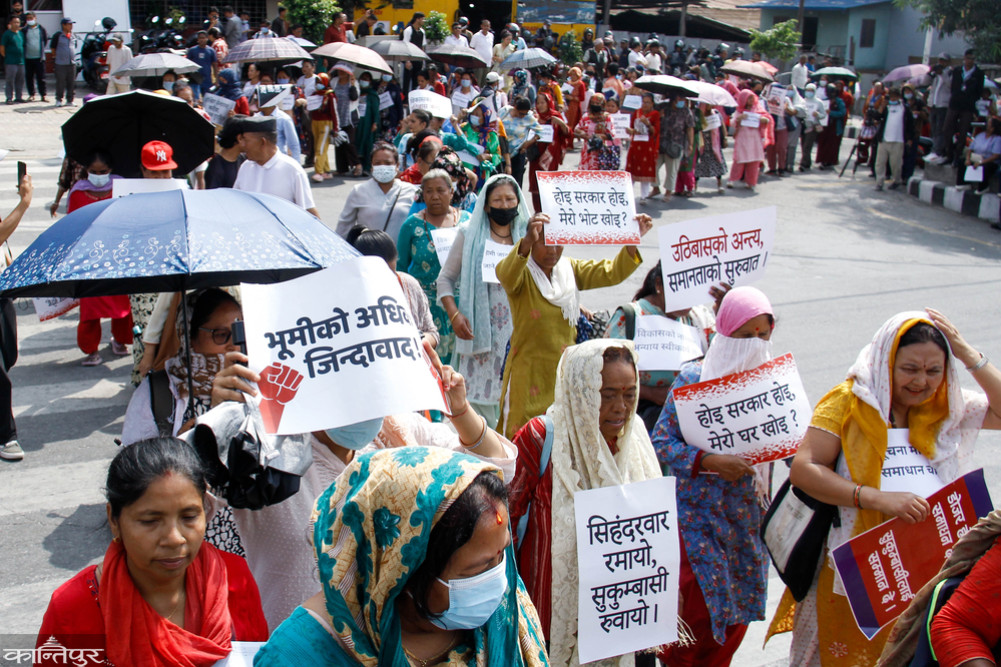
This was the day after the government issued an order for squatters to vacate the holding center. I was around Maitighar Mandala. And there they were, squatters dissatisfied with the government. Some were chanting slogans on the street while carrying small children, others were sharing their grievances with journalists in a slow and weary voice. The glow had vanished from their faces, and their dreams had disappeared from their eyes. In the middle of the crowd, a woman was shouting loudly—“When fish bones are found on the Home Minister’s plate, the government punishes the hotel owner. Every day we find worms in our food—who will punish you? Have we committed a crime by eating worms?” She continued, “Our children can’t go to school. New mothers have neither warm clothes nor food. In the heat, the wind burns us, and in the rain, our bodies are half-soaked. We have neither work nor shelter. Now tell us, government, is it our crime to be landless? Is it our crime to have voted for you? On whose whim are we being toyed with? And who will punish them for this crime?”
I listened very carefully to the squatters that day. I looked at their faces. I looked into their eyes. In fact, I have been observing Nepal’s squatters for the past 30 years. In that time, I have read reports from various land commissions and heard promises of land reform. The facts say—squatters and farmers have been deceived time and again. But this time, the way the government treated the squatters was reminiscent of the Panchayat era. The only difference was that, during Panchayat, settlements were demolished with elephants; now, it’s bulldozers. But it was the same vile, cruel, and unforgivable act. Demolishing settlements without a plan and driving people out in an inhumane manner. Giving no alternatives. Turning holding centers into prisons. And recently, even issuing an order for squatters to vacate the holding centers. None of this is something a civilized government could ever do. Under normal circumstances, all this would have become the subject of a political movement. But right now, people are giving Rastriya Swatantra Party the benefit of the doubt. The government has just completed its first hundred days. And in some respects, people still have high expectations of the current government. Some believe that criticizing this government is tantamount to disrespecting the Janajagaran movement. For these and other reasons, people are in a dilemma. And the government is basking in self-satisfaction, taking advantage of that very dilemma.
Needless to say, self-satisfaction is such a dangerous problem that it gives the government neither the wisdom to think with its mind nor the conscience to feel with its heart. That must be why the government is currently acting with neither its mind nor its heart and emotions. It is acting purely on a whim. The word “whim” is used deliberately here, because otherwise, squatters would not have taken to the streets before the government’s first hundred days were up.
It is true that the government must work equally for everyone. But it must start from the very bottom, where people truly need the government. Because the rich can build their own homes; it is the poor who need help. The strong can run on their own; those who cannot walk need a cane. The powerful will seize opportunities by any means; the weak need support. The success of a democratic government is not measured only by major indicators of economic growth, but also by the changes it brings to the lives of the poor. So that the agendas of the weak are not lost in the noise of populism, let me remind the government: “Honorable sirs, please remember, the government must first and foremost be for those who do not own even a single plot of land in this country. Who have no courtyard. No porch. Whose hearth is empty and who see no alternatives ahead.”
Some may think the squatter problem is not new. And that the government cannot perform miracles in a hundred days. This argument is valid. Indeed, this is not a new problem, nor can it be solved by magic. Because it is a very deep-rooted issue. Here arises the question: if that is so, why did Singha Durbar feel compelled to evict squatters within a month of forming the government? Why was the gravity of the issue not understood? Why were alternatives not considered? And while doing all this, why did the government forget its humanitarian responsibility? It is true that no one should expect miracles from the government. But at the very least, the government could have talked to those people, offered alternatives, and reassured them—those who truly needed the government. Or at least, the government could have soothed their parched hearts with compassion—those who were on the riverbanks, facing a mountain of crisis ahead.
But unfortunately, the government does not speak to its citizens; it only performs miracles on social media. It is blocked from communicating with citizens by its own arrogance. Perhaps the advisors have “modeled” the Prime Minister in this way and told him—keep your distance from ordinary citizens. Don’t communicate too much. Make yourself mysterious. You are special, so be special. Otherwise, the Prime Minister would not have to be begged to speak in Parliament. Otherwise, the government would have explained what alternatives it was offering to the squatters.
But when there is no dialogue between the government and the hungry, what humility, what empathy? What emotion, what compassion? Otherwise, while squatters writhe in hunger, the Prime Minister would not be enjoying cheese advertisements. While squatters sink into depression, the Prime Minister would not be smiling for photo shoots. He would be humble toward the homeless squatters. He would be accountable to the children unable to attend school. He would be responsible to the new mothers who cannot get hot soup. But the reality is the opposite. So opposite that this government, by issuing ordinances that even the Oli government could not bring, tramples on the spirit of the Janajagaran movement. Doing things even previous governments could not, it shows bravado by keeping constitutional bodies under the shadow of the executive. It dodges questions and answers them with negligence. For example, if someone asks how Singha Durbar caught fire, for this government, that is an anti-Janajagaran question. If someone asks how the Parliament building, Sheetal Niwas, and the Supreme Court caught fire, it is considered an anti-government question. And the Home Minister’s priority becomes investigating the Royal Palace massacre. The Ministry of Health issues orders to hide the news of a rabies vaccine shortage. The Agriculture Minister is nowhere to be seen amid the plight of tea farmers. The Finance Minister is busy reconciling budget figures and pages, and neutralizes questions with retaliatory answers. Why is the spirit of the Janajagaran movement being toyed with? Some people say, “Such governmental arrogance and meteor showers did not exist even during the Maoist era.”
People around Singha Durbar say the government should not be too emotional. Issues should not be viewed only through the lens of emotion. But let’s think: if the government loses its heart, emotion, compassion, and love, what kind of state would that be to live in? Therefore, the government must be compassionate and emotional, so that humanity does not die. If the government has emotion and compassion, it will seek alternatives. It will communicate. It will not drive people out. It will not make children cry. It will not torment the elderly. Of course, one day people had to be relocated from the riverbanks. But a government with compassion gives citizens alternatives; a government without compassion drives them out.
This is not just about squatters. Let us remember, where are those cooperative victims whose every last rupee of savings disappeared from the very place they deposited it? Where are the sugarcane farmers, whose blood and sweat’s worth vanished into the sweetness of sugar, and even they do not know where? Where are those crushed by predatory lending, whose homes, fields, honor, and livelihoods were all taken? Elderly people who deposited their life savings in cooperatives have been knocking on the doors of justice for years. Sugarcane farmers have had to protest to get the value of their sweat. Victims of predatory lending are running to courts and administration for their own property. The plight of squatters is already well known. But all these are worthless issues for the government. Because there is no miracle in them. There is no “algorithm.” There is no spectacle. And especially, there is no flavor or color to show off. No publicity, no entertainment. As a result, such issues touch neither the government nor the Prime Minister. Because they consider emotion and compassion useless, and spend their holidays joking around as slaves to their own whims. What does this indicate? Is the government gradually fading from the eyes of those who needed it most?
Because, for the poor, the government does not disappear all at once. It disappears gradually. First, it disappears in documents. Then in policies and programs. Then in the budget. Gradually, it disappears in ministries. In Parliament. In Baluwatar. In Singha Durbar. Then on the banks of the Bagmati. On the banks of the Bishnumati and Manohara. Then it disappears from the hearts of squatters. And after that, slowly, the government disappears from the hearts of ordinary people.
Let us consider: if a citizen feels orphaned in their own country, that is not just their personal pain—it is the government’s failure. This is what we see today on the banks of the Bagmati and Manohara. This is what we see today in the desolate and gloomy holding centers where squatters live. In this sense, the biggest question today is not how strong the government is. The question is—has the government reached the courtyards of citizens who truly needed it? Are squatters and poor farmers starting to see this government as alien? Remember, the true success of a government is built by the sense of belonging it creates in the hearts of citizens, not by the cheers of crowds. There is a difference between a crowd and citizens. And it need not be repeated that no power in the world can make a government succeed once it has disappeared from the hearts of its citizens.
Finally, while the squatters’ protest was ongoing, a woman was giving an interview to television. She said, “I myself voted for the bell. I told my family to vote for the bell too. But now, when I remember, I feel regret and shame.” This interview has already been broadcast. I believe that when voters feel regret, shame, and no pride in the vote they cast, it is a very dangerous thing. It indicates that this government no longer belongs even to those who helped bring it to power. As the first hundred days come to a close, let us ask those sitting in Singha Durbar—Honorable sirs, tell us, is this government also for those who cannot eat cheese and cannot even enjoy looking at the Prime Minister’s photo eating cheese?