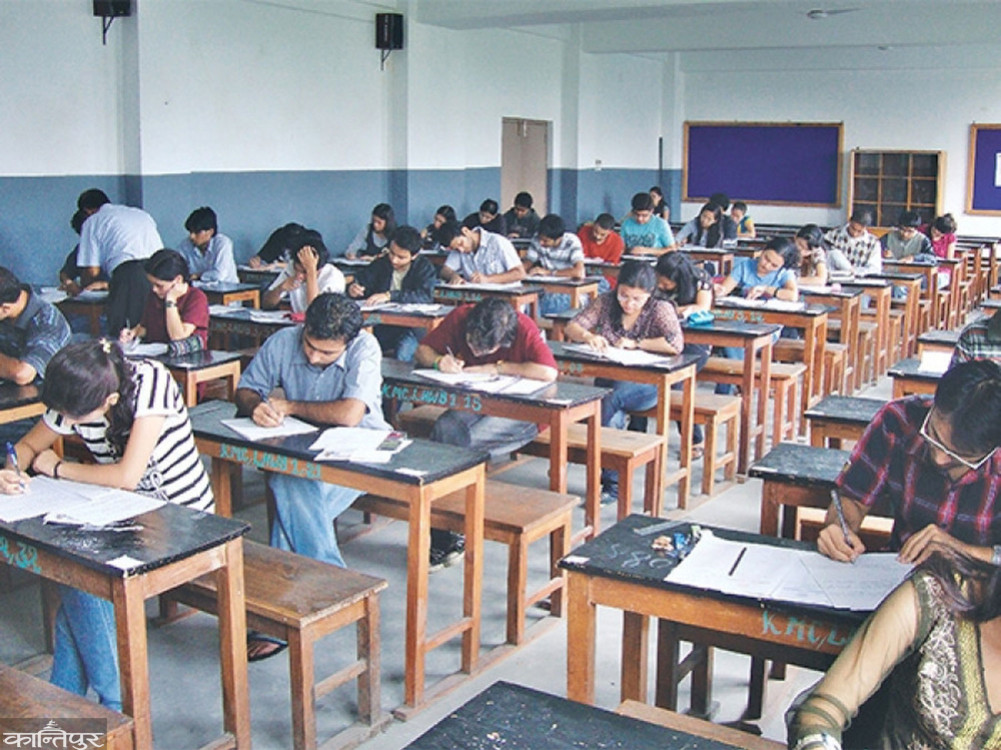
If the government can develop quality policies, universities can develop timely curricula, and society can develop a positive outlook, humanities education will become a center of attraction for students. Strengthening humanities education is an indispensable need today for building a prosperous, inclusive, and democratic Nepal.
We use Google Cloud Translation Services. Google requires we provide the following disclaimer relating to use of this service:
This service may contain translations powered by Google. Google disclaims all warranties related to the translations, expressed or implied, including any warranties of accuracy, reliability, and any implied warranties of merchantability, fitness for a particular purpose, and noninfringement.
Currently, the admission program for the first year of the undergraduate level is starting . Some are preparing to go abroad after passing grade 12, while some are looking to study in various colleges in Nepal . The number of students in science and management at the undergraduate level is looking good . The issue of decreasing student attraction in the humanities and education faculties has now become the center of academic debate . Although the number of students studying higher education is increasing overall, the share of the humanities faculty is gradually decreasing .
According to the report on higher education, the attraction of students is highest in the management faculty, while the proportion of students in the humanities faculty is continuously decreasing . The report of the University Grants Commission has also indicated that the attraction of students in the humanities faculty is weakening compared to management and other faculties . Although the share of humanities in higher education was significant until a few years ago, its proportion has been decreasing in recent years .
Prestigious universities around the world have adopted a policy of advancing humanities and technology together, emphasizing interdisciplinary education. The role of humanities is becoming increasingly important in solving complex issues such as artificial intelligence, digital transformation, climate change, democracy, human rights, and social justice. However, the gradual decline in the number of students studying humanities in Nepal is worrying.
The main reasons for the decline in attraction towards humanities education in Nepal are the perception of a weak link with employment, lack of timely curricula, lack of career counseling, limited research and internship opportunities, and social thinking. Many parents and students perceive humanities as a subject that will lead to ‘less employment’, while the reality is different.
Today, graduates and postgraduates from the Faculty of Humanities are successfully working in various fields such as public administration, development sector, communication, journalism, policy research, local government, social development, international organizations, teaching, consulting, diplomacy, and research. Students who have studied humanities have more skills and abilities to understand society in depth. They are more knowledgeable about the real state of society. Students of the humanities faculty have the opportunity to understand and study aspects of economic, social, cultural, and religious subjects, including socio-scientific importance, which gives them the opportunity to learn about the real nature of society.
Now, structural reforms are indispensable to increase student attraction to humanities education. First, the curriculum should be made digital-age-friendly. Data analysis, public policy, artificial intelligence, digital research, communication technology, project management, and entrepreneurship should be included in sociology, anthropology, political science, history, language, philosophy, and psychology. Second, fieldwork, community studies, internships, and research should be made mandatory in every program. Third, programs linked to employment should be expanded through collaboration between universities, government, the private sector, and development partners. Future education should be linked to labor and employment, only then will the country produce the skilled manpower it needs.
Society is the lab for the Faculty of Humanities. Here, human relations, customs, rituals, and festivals play an important role in guiding people's lives in the right direction. The current situation in society is due to the low number of students studying the Faculty of Humanities and Sociology. Similarly, effective career counseling is necessary from the school level. If students can be informed about the various professional opportunities available after studying the Faculty of Humanities, they will be able to choose subjects according to their interests and abilities, not just based on social pressure.
Let's discuss the importance of sociology in the Faculty of Humanities. Sociology has played an important role in understanding and learning about society. Sociology plays an important role in identifying practical solutions that are suitable for society. The main field of sociology is the in-depth study of different castes, languages, regions, classes, cultures, and communities. At the school level, life skills are taught through social studies, social education, and moral education. At the college level, socio-practical knowledge is imparted through sociology. Today, there is a need in society to teach moral values, beliefs, and traditional knowledge and skills, which sociology fulfills.
The field of sociology is also gradually growing. The more society moves towards modernity, the more social problems increase in an unknowing way. Therefore, realizing the need for sociology in every discipline and department, sociology has been made a mandatory subject in many faculties (be it nursing, forestry, or BBM). Sociology helps in understanding the core issues of society. It provides in-depth study of problems and various solutions to solve them. As society continues to embrace modernity, many problems are increasing rapidly. Sociology also creates an environment where they can easily and simply solve the root causes of those problems.
Sociology has become a center of attraction at the undergraduate, postgraduate, MPhil and PhD levels. Since sociology can be studied in any subject or faculty at the postgraduate or higher level, the attraction of students towards sociology has increased. Those who studied other subjects earlier later realize the need for sociology and even older people come to study sociology. That is why people from young to old are found studying together in the same class. Apart from the coursework, they exchange knowledge and experience in their fields with each other. That is why classes provide theoretical knowledge, while practical knowledge is exchanged in other informal discussions, tea chats and informal meetings.
Therefore, it is time to re-establish the humanities not as a weak alternative, but as an intellectual foundation for building the future. If the government can develop quality policies, universities can develop timely curricula, employment opportunities, and society can develop a positive outlook, humanities education can once again become a center of attraction for students. Strengthening humanities education is an indispensable need today for building a prosperous, inclusive, and democratic Nepal.