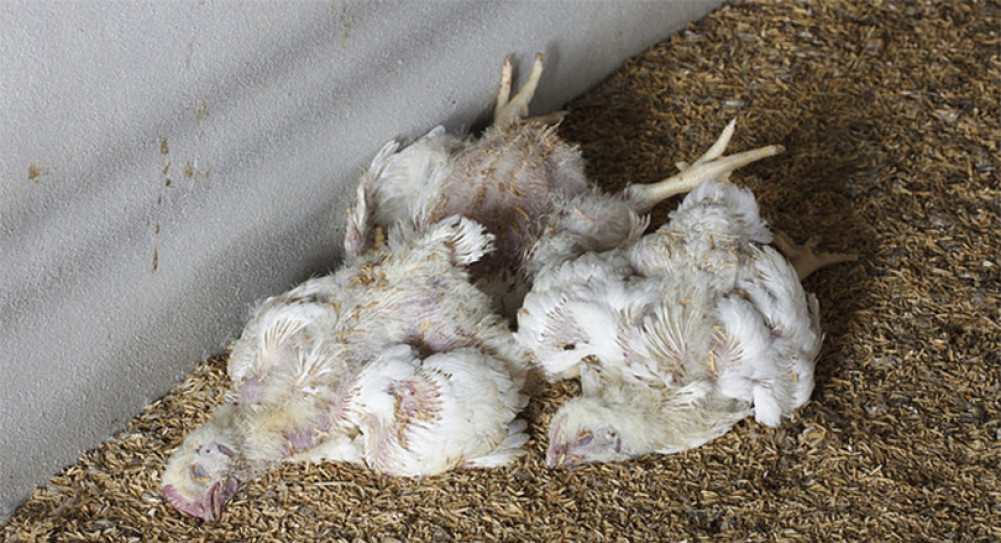
Farmers are left alone in difficult times due to the lack of strong farmer-friendly policies. Not only does the initial investment not yield returns, it also takes a long time to recover and return to the previous situation.
We use Google Cloud Translation Services. Google requires we provide the following disclaimer relating to use of this service:
This service may contain translations powered by Google. Google disclaims all warranties related to the translations, expressed or implied, including any warranties of accuracy, reliability, and any implied warranties of merchantability, fitness for a particular purpose, and noninfringement.
The various outbreaks that spread from time to time disrupt the economic cycle along with health risks. The bird flu that is currently spreading has also added risks to human lives. Poultry farmers have also suffered financial losses along with health risks. Although there has been no human loss in the latest wave of bird flu, infection has been confirmed in chickens.
Poultry farmers have become victims of this. On the other hand, the confirmed infection in crows is also likely to increase the risk of bird flu. Therefore, people should follow safety standards to avoid bird flu infection. Poultry farmers in particular should be extra vigilant. The government should be sensitive to the economic losses they face. Farmers should be helped to reduce the pressure of the financial burden by providing relief. The fight against bird flu should mainly be made a joint campaign by the government and the citizens.
The latest wave of bird flu started in the east on Chaitra 4. The outbreak in Jhapa, Morang, and Sunsari was brought under control only after a month and a half. Bird flu was also seen in Bara, Mahottari, Chitwan, and Nawalparasi. The spread of bird flu infection, which began in the Kathmandu Valley in mid-June, has reached the zoo in Lalitpur.
Overall, bird flu outbreaks have been seen in 82 places in 11 districts since Chaita. During this period, about 750,000 birds and about 1.09 million eggs have been destroyed. The Department of Animal Services says that the loss to farmers will be more than Rs 700 million if 250,000 kg of feed is destroyed. This data alone shows the increasing impact of bird flu and the impact it is having on farmers.
In any outbreak, human safety is the main issue. For this, it is imperative to be personally aware. Bird flu is transmitted to humans only from infected birds and birds. Therefore, efforts should be made to stay away from contact with birds and poultry that are likely to be infected. People who work directly with poultry, poultry farmers, farm workers, and traders are especially at risk.
They should follow safety standards. Bird flu infection has now been confirmed in migratory birds and local crows. Therefore, if such birds are found dead, they should not be touched in an unsafe manner. Children should especially be kept away. Similarly, potential damage can also be minimized by issuing information on safety standards targeting everyone who is or is not at high risk of infection.
Doctors have said that if a bird flu infection occurs, it can cause problems ranging from high fever to muscle pain. Anyone who comes into contact with birds and poultry that are likely to be infected with bird flu and shows such symptoms should contact a doctor.
Meat should only be eaten after cooking it properly. Also, when any outbreak occurs, misinformation and information also spread. It makes people worry more than necessary. Therefore, citizens should only believe the information provided by doctors. Accordingly, they should moderate their behavior.
Another aspect of bird flu infection is also related to the financial losses suffered by farmers. Agriculture and animal husbandry in Nepal are always risky. Because its returns are always uncertain. Due to the lack of a strong farmer-friendly policy, farmers are left alone in difficult times. If the return on large investments is not received, not only the immediate investment is lost, but it takes a long time to recover from it. There are many indirect effects.
Because, when farms are closed, new poultry farming is not possible, which leads to loss of potential income and profit, which is a loss in another sense. In some cases, farmers are even forced to change their profession to manage the financial loss. That is why the government should assure farmers that agriculture and animal husbandry are not unsafe at this time. That is why the government should properly address the farmers who have suffered losses due to bird flu infection.
The Department of Animal Services has said that the loss to farmers has reached about 700 million. According to the criteria for relief for goods destroyed during bird flu control, 2079, farmers will receive compensation from the government. It is mentioned that the compensation will be determined according to the market value. There is a provision to provide relief to farmers up to 75 percent of the cost price based on the recommendation of the Rate Determination Committee coordinated by the Chief District Officer.
Therefore, even if 700 million is considered a loss, 525 million rupees should be provided as relief. But according to the Department of Animal Services, only 20 million rupees have been allocated under the heading of providing relief to farmers in the current fiscal year. However, the government has allocated Rs 500 million for compensation to farmers affected by bird flu. Now the relief should be received as soon as possible. In the process, farmers should not face unnecessary hardship.