After the new government was formed, bulldozers were used on the outskirts of Kathmandu, and the impact was felt throughout the country. The state sees the landless people living on the roadside, riverbanks, or in the forest as encroachers, land mafias, or squatters. Today, the landless people are feeling extremely insecure in their own country.
We use Google Cloud Translation Services. Google requires we provide the following disclaimer relating to use of this service:
This service may contain translations powered by Google. Google disclaims all warranties related to the translations, expressed or implied, including any warranties of accuracy, reliability, and any implied warranties of merchantability, fitness for a particular purpose, and noninfringement.
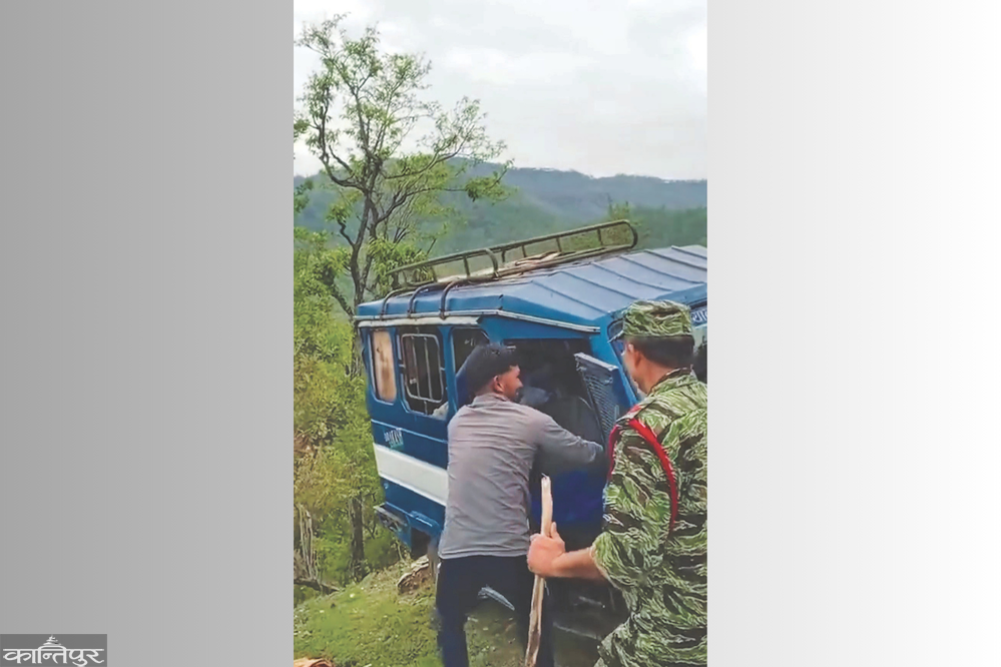
Many Nepalis were saddened by the scene of the Chure forest in Kailali that went viral on social media. The video of the Division Forest Office employee brutally pushing a tempo off a cliff is extremely sad and disturbing.
The shameful behavior of the responsible state employees towards the poor and laborers who are struggling to make ends meet by sweating day and night has defied human sensitivity. There has been outrage on social media against the tendency to have zero sympathy for the low-income working class and misuse of power.
A joint statement by the Forest Division employees, who were finding it difficult to contain the all-out protests, came out. They said, ‘We had already asked to remove the tempo, but when they refused, we removed it by force.’ The statement also did not elicit sympathy for the forest employees who kicked the poor over their sweat, and instead received more abuse.
No one has the right to cause physical damage to the property and livelihood of the common people in the name of implementing the law. Even if the rules were violated, legal procedures should have been followed. Mainly, this incident has shown – how lenient is the state machinery towards the poor? How can the state go after a poor person?
A Nepali citizen is not allowed to do anything for his livelihood? Is this the way the state treats its citizens? Why was a woman forced to live by doing business on the roadside? Should the state think about this or not?
A Nepali citizen is not allowed to do anything to earn a living? Is this how the state treats its citizens? Why was a woman forced to live by doing business on the roadside? Should the state think about this or not? Such incidents against ground-level citizens have occurred not only in Kailali, but also in many other places in recent months. The incident of a woman with a caravan being dragged on the road on the Surkhet road is not old. After the new government was formed, bulldozers were used on the outskirts of Kathmandu city, and its impact has been felt throughout the country. There has been a change in the way the state, state employees, police administration, and city police view the landless and squatter communities living on the roadside, river banks, and near the forest – they are encroachers, land mafia, squatters, etc.
The squatter community is increasingly being looked down upon. Today, poor, sad, landless, laborers, and squatter communities in Nepal are feeling unsafe in their own country. They are forced to live in fear and anxiety about being evicted from somewhere. This is a serious injustice in a state governed by law. It is a violation of national and international human rights. It is a suppression of the right of citizens and humans to live freely.
Some people may have become poor due to their own actions, some due to fate, some due to bad circumstances, and some due to their own circumstances. Everyone's situation, day and intention do not always follow the same rhythm. Every poor person and the poor have many and different stories.
No country is of a single caste, single class, single community, single language, single party or single culture. Nepal is also class-based. We need to manage all of these and move forward. But the question arises – why were dozers used in poor settlements by showing various laws? Why were small carts, carts and tempo businesses that the poor were operating on the roadside and earning a living by showing laws? Why were tempos thrown off cliffs? Couldn't laws be made and amended to manage and promote them? More debate is needed on this issue between civil society, media and the conscious class.
Why do some people still remain in poverty? Let's find out the reason. Are the poor in poverty because of the country's governance system, lack of pro-poor policies, lack of programs targeting the poor, or is it because of their own reasons? Let's define it clearly. And, what are the treatment methods that can end poverty and make citizens prosperous? Let's find out.
The Constitution of Nepal has written in the fundamental rights - the right to live with dignity (Article 16), the right to equality (18), the right to justice (20), the right to property (25), the right to employment (33), the right to labor (34), the right to food (36), the right to housing (37), the right to Dalits (40), the right to social justice (42) and the right to social security (43). Why were these rights written in the constitution? Isn't it to uplift the poor, workers, and landless people by providing them with justice, respect, and various rights? It is not right to remove the poor from their places of residence, cause them suffering, and take away their wages. This is a violation of the constitution.
Let all parties and representatives, both ruling and opposition, think in time - are our laws, methods, and programs pro-poor? Is it trying to uplift the landless class or is it oppressing them more and more? Please review.
Why could the laws made in the past not liberate the poor and landless people? How will they be managed now? Let us pay attention to that. All the people know this much - laws are made by people's representatives and can be amended and repealed in a timely manner. Those who are happy to evict landless people and landless settlements today should understand - no ruler created the land himself. This is a gift given by nature even before the development of the human race. It was only after a long time since the beginning of human development that the ruler and the representative started the governance system, when the state was born. Rather, let us not forget this fact that the 'land' people have been earning a living by mining since before the birth of the state.
Therefore, let us set a poverty eradication target program and set a time limit of 6 months or a year or 2 years and take the initiative to solve the problem with appropriate alternative management. Instead, let us focus on making the employees who provide housing, carts, tempos and buses for the poor as facilitators to facilitate their management. Coercion certainly does not provide a sustainable solution, but rather makes the problem worse. Again, where will the poor, the destitute, the workers, the squatters, the landless be picked up from the streets, banks, houses, wages... everywhere? Our Constitution has given these groups the right to live with dignity, hasn't it?