This has helped to positively expand the identity of Nepalis. At the same time, a situation has been created where citizens of many countries can benefit from Nepali knowledge and skills.
We use Google Cloud Translation Services. Google requires we provide the following disclaimer relating to use of this service:
This service may contain translations powered by Google. Google disclaims all warranties related to the translations, expressed or implied, including any warranties of accuracy, reliability, and any implied warranties of merchantability, fitness for a particular purpose, and noninfringement.
Foreign assistance is often added to some of Nepal's national and local level plans and programs. Some programs are being implemented on the initiative of foreigners. That is why many people think that Nepal and Nepalis are doomed to receive financial and technical assistance from foreigners. But this is only one side of the truth. Many Nepali citizens have provided leading technical assistance to small and large projects being implemented in many countries of the world.
The number of Nepalis involved in economic, academic, and social programs is even greater. They have shown efficiency not as workers without options, but as capable and skilled citizens. This has helped to positively expand the identity of Nepalis. At the same time, a situation has been created where citizens of many countries can benefit from Nepali knowledge and skills. If Nepal can adopt a strategy of using its citizens scattered around the world as diplomatic capital, it can benefit a lot.
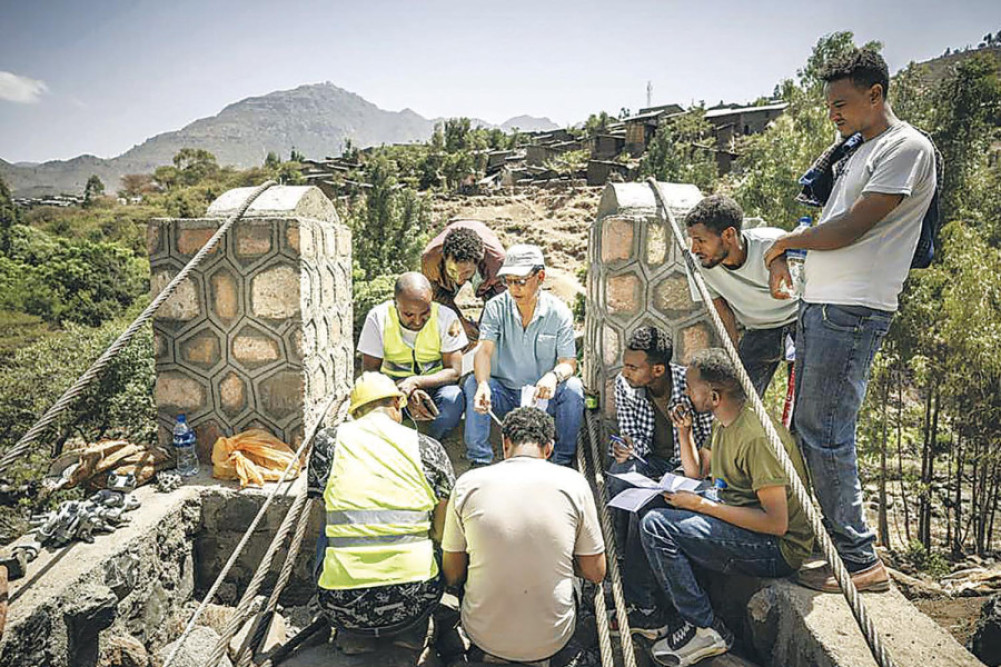
There are many countries that are geographically remote like Nepal and face difficulties in transportation. Since the construction can be completed with low investment, suspension bridges are an essential option for them too. Therefore, Nepal's experience is an achievement that the world can follow. The context is Padam Gurung, who grew up in Sindhupalchowk, and other experts, who are currently contributing to bridge construction work in various countries. Gurung, who himself was forced to travel from Tuin during his childhood, is currently active in providing safe transportation facilities to communities in various countries through the construction of suspension bridges. In fact, after joining the suspension bridge program run by the Swiss development organization Helvetas in 1996, Gurung has contributed to the construction of hundreds of suspension bridges across Nepal.
After that, he has been traveling to various countries including Burundi, Cameroon, and Ethiopia to train engineers, provide technical advice to the government, and help remote communities solve the problems they faced in their childhood. With the aim of institutionalizing the experience gained by Nepal, Helvetas established the South-South Cooperation Unit in 2008, which is now known as Track-for-Change. Through this, work is being done to build bridges and enable the countries concerned to build bridges.
Nepal itself is a beneficiary of the expansion of suspension bridges. By the time Helvetas stopped its direct assistance in 2023, more than 11,000 suspension bridges had been built across Nepal. More than one million people use these bridges daily. Various studies have shown that after the construction of such bridges, the attendance rate of students in schools increased by 16 percent and access to health services for women during pregnancy increased by 31 percent.
The contribution of bridges can be understood in many aspects such as increased sense of security among people and increased productivity. Suspension bridges are especially built in remote places, where people are having a difficult life due to the lack of a bridge. Using alternatives like Tuin, one has to bear insecurity and economic burden. Therefore, the construction of suspension bridges is also a special contribution to adding safety and convenience to people's lives. It is the responsibility of the state, concerned bodies or skilled manpower.
There are many countries like Nepal that are geographically remote and face difficulties in transportation. Since the construction can be completed with low investment, suspension bridges are an essential option for them too. Therefore, Nepal's experience is an achievement that can be followed by the world. Because, Nepal's model is considered simple, standard-based and economical. Earlier this year, a team of Tanzanian government officials came to Nepal to study the suspension bridge program closely.
They traveled from Kathmandu to Pokhara and observed suspension bridges in various places. With Nepalese assistance like Gurung, 272 suspension bridges have been constructed across Ethiopia. The number of bridges is on one side, local capacity building is established as a greater achievement. Because now Ethiopian engineers do not have to depend on Nepali experts for every project. Ethiopian engineers have been able to design and build steel truss and suspension bridges spanning up to 120 meters without external assistance. The country has become self-reliant in the construction of suspension bridges. Nepal is strong in establishing a strong model in the construction of suspension bridges. Another strong point is the production of expertise and the fact that such experts can reach every corner of the world and make the journey of their citizens safe, easy and short. This will definitely develop a positive attitude towards Nepal in the minds of the concerned countries and the benefiting citizens. It is also a strong diplomatic force. It can be used for the development of Nepal's economic, educational and social aspects. On the other hand, Nepal's expertise and technology help to expand to different countries, while the experience provided by aspects such as the geographical structure and nature of the soil of the concerned country further matures such expertise. This incident also sends a message to Nepalese who are forced to go abroad for cheap labor.