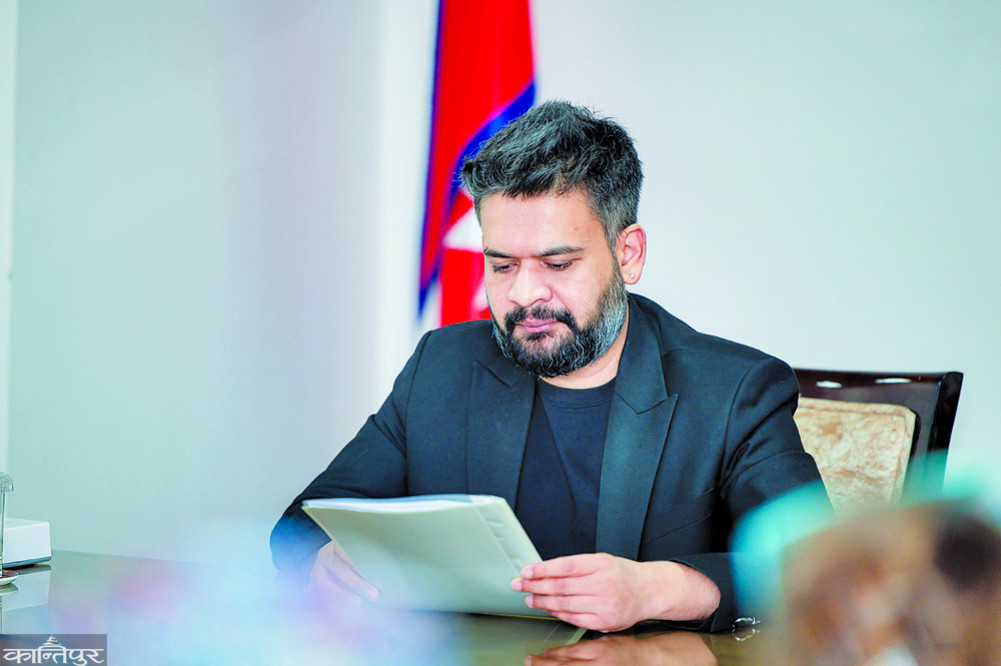
The Prime Minister has bowed down before his controllers and the pile of 'work'. However, as the Prime Minister of the Nepali people, he has no right to bow down before anyone. He must raise his head and face all the truth.
We use Google Cloud Translation Services. Google requires we provide the following disclaimer relating to use of this service:
This service may contain translations powered by Google. Google disclaims all warranties related to the translations, expressed or implied, including any warranties of accuracy, reliability, and any implied warranties of merchantability, fitness for a particular purpose, and noninfringement.
One hundred days have passed since the senior leader of the National Independent Party, Balendra Shah, took office as the Prime Minister of the Federal Republic of Nepal. During this period, many major upheavals have taken place in the country. The latest upheaval is that the green-painted public transport buses will now be painted blue. Blue is considered the color of peace. The border color of the Nepalese flag is blue. If the Balendra government is going to respect the blue color and paint green buses blue, it should be considered appropriate.
The capital city of Nepal, covered with blue skies, once had the glory of green. Kathmandu was famous for its agricultural work. The vegetables and grains grown in the fields of the Kathmandu Valley made the capital city self-sufficient. Gradually, the city of Kathmandu changed its face. Large government buildings and private residences began to be built in the fertile fields of the valley. With the modernization of the city, its original character changed. Kathmandu developed as an international city. The idea of shifting the country's capital from Kathmandu to the historical city of Banepa in Kavre district or Battar in Nuwakot district has not been discussed from time to time. However, that was not possible. Kathmandu's 'political' image was attractive.
The rulers and administrators of that time, knowingly or unknowingly, preserved the color green to establish the importance of the remaining green culture in Kathmandu city. The public transport buses plying in the city were decorated with green. Although symbolically, large and small parks were built in places to protect greenery. Kathmandu city has adopted a commercial 'mall' culture. Now the times have changed.
Nepal has repeatedly changed prime ministers simply by saying ‘I can’ to run the country’s power and government. There are many people who say ‘others could not do it, I can do it’ within the current majority national party. Kathmandu city faced destruction in the name of Gen-G. There is no doubt that this destruction was well-planned. Against this backdrop, an 'invisible' power flourished. In the unprecedented political game that began thereafter, a game of counterattack began between various groups of established political forces. Mainly, there was a sharp divergence and disintegration in the Congress, UML, Maoists and the parties divided into various camps. The party leaders lacked foresight. They seemed to take the ‘rebellion’ in the name of Gen-G for granted. Was the Gen-G rebellion free or directed? The two general secretaries of the Nepali Congress, Gagan Thapa and Bishwaprakash Sharma, had not clarified this. However, in the name of a special convention, they consolidated their ‘grip’ over the party power. They were recognized by institutions such as the Election Commission and the Supreme Court. After this, the facts began to emerge.
It was not unusual for the impact of this undeclared division in the Congress in the name of a special convention to affect other political parties. With the division of the Congress, the same game began in the UML and Maoists. The crowd that came in the name of the Gen-G movement humiliated Congress President Sher Bahadur Deuba and other leaders. Other party leaders also had to suffer a lot of 'insult'. The Congress leadership, which was established in the name of the special convention, did not seem to have any interest in these incidents. None of the leaders established from the special convention seemed to have any goodwill towards the displaced leaders.
In the elections held against the backdrop of the Gen-G rebellion and 'tiffs' within the major political parties, the Congress, UML and Maoists, including parties, suffered humiliating defeats. After the special convention, the Congress leaders who went to contest the elections with the slogan 'Let's change the Congress, let's change the country' were defeated by the National Independent Party established under the leadership of Ravi Lamichhane.
The people did not believe Gagan Thapa, who, confident of his popularity, went to Sarlahi to contest the elections carrying the Congress flag. His defeat ruined the 'special convention' he had organized. Gagan and the world's fickle politics helped strengthen forces outside the Congress. In particular, the leaders of the National Independent Party, who specialized in the use of social media, used social media as a powerful weapon. Gagan of the Congress seemed to consider his political skills and diverse connections important.
The behavior shown by senior leader Walendra Shah of the National Independent Party, who won the parliamentary elections with almost two-thirds of the vote, after being appointed as the Prime Minister has been very unnatural. According to parliamentary procedures, Walendra, who invited the President to read out his government's policies and programs, got up from his seat and left the parliament meeting while the President was reading it, which was indecent behavior in itself. Walendra had won the election battlefield according to the Constitution of Nepal. He had no right to violate the dignity of the Constitution. The Prime Minister did not fail to understand this. However, there was no significant questioning of his behavior in the parliament. This must have happened because the diligent people who raised the questions lost the parliamentary elections. The tendency to think that he is omnipotent as soon as he wins the election and reaches a powerful position should be considered a political irony of our country.
What did Prime Minister Balendra do in the first 100 days of his tenure as Prime Minister? It is not unusual for the public to be interested in this matter. It is natural for the public to be interested in the decisions taken by the Prime Minister as the leader of the country. His activities are discussed on social media and regular newspapers. It is the duty of the Prime Minister's aides to fulfill this curiosity of the public. However, this is not the case now. Inviting representatives of various diplomatic missions for a group visit is not a big task.
Or, Inviting your friends and associates and seeking their opinions and advice is not an important task. Trying to manipulate government employees in the name of work is also not a task. It is the duty of the Prime Minister to understand the feelings of the people through his aides and find solutions to the problems accordingly. However, Prime Minister Balendra, on his own initiative, removed the squatters living on the banks of the rivers of the Kathmandu Valley. However, his rehabilitation has not yet taken off. Looking at the composition of the government led by Balendra, it seems to include people from all walks of life.
However, the Prime Minister does not seem to have made him responsible for his responsibilities. This is certainly not a pleasant thing. Nepal currently has a federal republican system. This is not the system of yesterday. Who will point the finger at it? Leaders seem to be curled up in the feeling that. However, the crisis of 24 Bhadra has so far shaken everyone. Words and emotions are being revealed from the mouth of Prime Minister Balendra. However, the reasons are not contained in it. What is this? Why has this happened? Has Prime Minister Balendra thought about it?
Prime Ministers have changed repeatedly in Nepal just by saying 'I can' to run the country's power and government. Those who say 'others could not do it, I can do it' are found in abundance within the current majority national party. Why does the 'daring' of someone who wants to become Prime Minister arise in the mind of a person who wants to become Prime Minister? Such a thing may have also arisen in the mind of Prime Minister Balendra. Every country has its own problems. A prime minister cannot change the country's economic growth rate overnight if he wants to.
There is nothing that can be done or done with the support of vested interests gathered around the prime minister. The class or caste in which the country's affairs are in the hands of individuals cannot do anything for anyone else except for their own class interests.
This is the situation prevailing in Nepal today. The leadership position of the Congress, UML, Maoists and Madhesh parties in Nepal today is unclear. The situation of the leaders of the old parties seems to have been shaken, shaken, and shaken. None of the concepts before them seem to be in a viable state.
Whatever illusions the people have about Prime Minister Balendra at the moment, they should be allowed to cherish them. Because, illusions act as a life-giving force for the common man. Prime Minister Shah is an artist, a singer. His 'rap' singing, his neatly trimmed beard and his working style have become symbols of greatness. How will the prime minister maintain his greatness?
This is not just his personal concern. As the Prime Minister, he has not set priorities for his work. Because, it is not easy for a Prime Minister to set priorities for his work. How can he set priorities if he has only one job? Now he is kneeling before his supervisors and a pile of 'work'. However, as the Prime Minister of the Nepali people, he is not allowed to bow before anyone. He must raise his head and face all the truth.