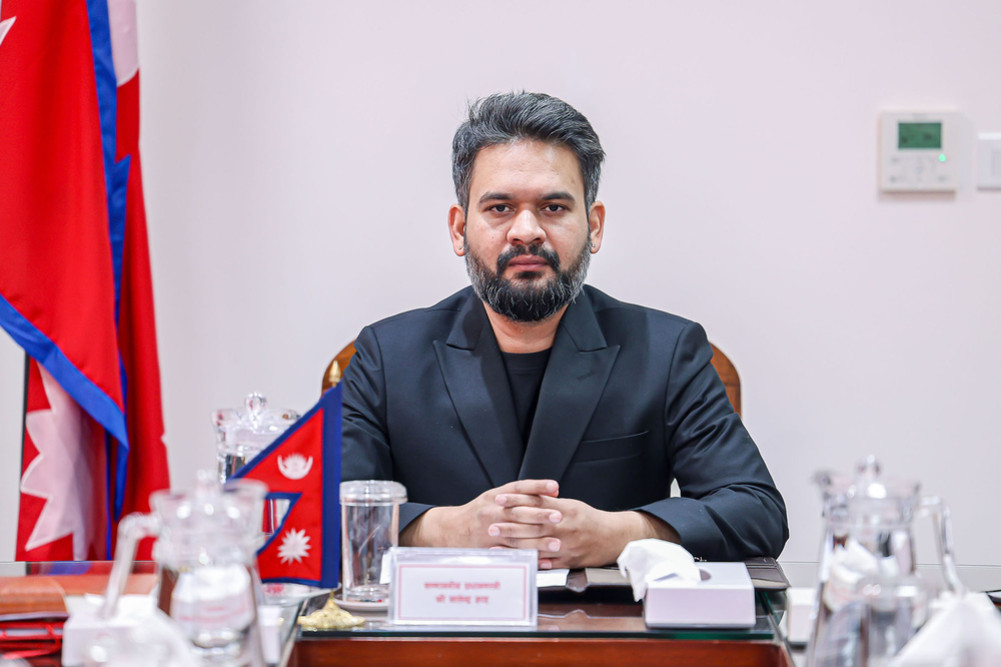
The government has no right to hide its mistakes and inadequacies under the guise of spreading misleading statements such as 'nothing happened for 35 years' or 'having to start from scratch'.
We use Google Cloud Translation Services. Google requires we provide the following disclaimer relating to use of this service:
This service may contain translations powered by Google. Google disclaims all warranties related to the translations, expressed or implied, including any warranties of accuracy, reliability, and any implied warranties of merchantability, fitness for a particular purpose, and noninfringement.
It has been 100 days since the formation of the Council of Ministers under the Prime Ministership of senior leader of the National Independent Party, Balendra Shah. In parliamentary democracy, it is customary to analyze the merits and demerits, criticize or oppose the newly formed government only after completing 100 days. The government has already presented its first policy and program and budget. The basis for evaluating the 100 days is not the number of daily administrative activities such as arresting criminals, stopping smuggling at the border, and legal and policy preparations. What policy characteristics have the government's presence, activities and working style presented during this period? In which direction is it trying to take the country? What far-reaching effects will its initial results have? A review should be conducted on that. The public support received by the Rashtriya Swayamsevak Sangh (RSS) with a two-thirds majority in Parliament is, in the words of Finance Minister Swarnim Wagle, a 'rare opportunity', but how capable and successful the government will be in utilizing the opportunity received, cannot be concluded right now, waiting and testing remain.
On the very day of assuming office, the government approved and implemented '100 agendas related to governance reforms'. In point number 3 of the 100-point agenda, an 18-point national commitment was made public in accordance with the resolution 'to synthesize the implementable issues included in the manifestos, pledges, and commitment letters of the six parties recognized by the national party, and to prepare a national commitment...'. The government is viewed by the opposition in this context. Out of the 100-point agenda, 38 have been implemented and 62 are yet to be implemented. Therefore, declaration-oriented governance, slowness in implementation and negligible results appear.
The Prime Minister did not address the Republic Day, the President suddenly left the meeting while reading the policy and program in a joint meeting of both houses of Parliament, the Foreign Minister had to answer for running the Parliament meeting that was blocked for weeks after he said, 'We have also encroached on India's land...', and the RSVP President called an all-party meeting that should have been called by the Prime Minister, and the actions like this, have led to people pointing fingers at the government's commitment to 'good governance and transparency' and saying 'slogans on one side, actions on the other'. The Prime Minister's presence and accountability in Parliament is not voluntary, it is mandatory. The government's creator, director and changemaker is the Parliament. The gross neglect of the Parliament, the representative of the sovereign people, is not only undemocratic, but also an insult to the voters and an indication of undemocratic character.
Within 26 days of the formation of the government, two ministers had to resign due to controversial reasons. The sudden adjournment of the Parliament session has posed a serious challenge to good governance by bringing 8 ordinances in 12 days. The ordinance granting veto power to the Prime Minister in the Constitutional Council has become the most controversial. The established tradition of giving priority to seniority in the appointment of the Chief Justice has been broken. The provision of two public holidays a week has badly affected the academic calendar and many essential service sectors such as health services. The pressure to publish the results of the Secondary Education Examination (SEE) and Class 12 exams within 40 days, the extreme lack of adequate preparation, and the government's stubbornness in hasty decisions have seriously affected the evaluation and future of thousands of students, raising doubts about their credibility.
This is not the time to 'doubt the government's ability and intentions'. The opposition has supported the efforts to provide good governance with a message of generational change and change with a relaxed mindset. The opposition could have blocked the policy, program and budget in the National Assembly, but we supported it responsibly.
After the Corona pandemic, capital expenditure was limited to 35 percent by the end of Jestha of the current fiscal year. The evil practice of 'unsustainable development' could not be broken even a little. In an environment where the country is on the strict surveillance (grey list) of international financial institutions and the deadline for liberation is less than 6 months away, there is no concrete commitment in the 100-point agenda. Digital commitments such as passport and license applications through the Citizen App within 45 days, delivery of documents to homes within 100 days, and implementation of the file tracking system within 30 days are limited to announcements.
The government does not have the freedom to hide its mistakes and inadequacies under the pretext of spreading misleading statements such as 'nothing happened for 35 years' or 'having to start from scratch'. It received a mandate from an overwhelming majority on the basis of statements that it could not do that. The official data compiled by the Council of Ministers Secretariat can be the appropriate and irrefutable answer to this.
Let us look at the comparative data of the development inherited by the democratic system in 2047 (at that time) and the development achievements made by the country from then until 2082 BS. In 2048 BS, the elected government for the first time channeled 71 percent of the total budget to the villages. The national budget has increased from Rs. 20 billion to more than 21 trillion 24 billion. The gross domestic product (GDP) has increased from Rs. 103 billion to more than 61 trillion. The road network has increased from about 9 thousand kilometers to about 35 thousand kilometers, while the number of vehicles has increased from a little over 76 thousand to more than 5.5 million 30 thousand. The total electricity generation has increased from about 500 megawatts to about 38 hundred megawatts. From a situation where only 24 percent of the population of 18.5 million had electricity, 98 percent of the population of 30 million has now received electricity.
Nepal, which has adopted a national policy of multi-university from just two universities (Tribhuvan University and Sanskrit University), has now grown to 24, including 19 full-fledged universities and seven medical academies. There was only one medical college, now there are 29. There are now more than 50 engineering colleges from one. The literacy rate has increased from about 40 percent to 76 percent.
Looking at human development in comparative statistics, the 2047 Constitution first defined ‘Nepal as a multi-ethnic, multi-lingual, multi-religious and multicultural country’. The average life expectancy of Nepalis has increased from 55 years to 73 years. At that time, there was no provision for social security allowance, currently citizens are benefiting from eight types of social security allowances. The infant mortality rate has been limited from 96 per thousand to 16 at present, and every government has been expressing its commitment to bring it to zero. There are now 215 government hospitals. The number of health posts has increased from 1,096 to 7,898. The number of medical and private hospitals, including 7,394 beds, is 154. There is a provision for government assistance for serious diseases such as cancer and heart disease that require a lot of treatment, and a provision for maternity grants for mothers who give birth in hospitals. There are many such ground realities of development. But from what meaning, logic or perspective has the ruling party spread the misinformation that ‘nothing had happened’?
But in the latter period of that time, democracy transformed into a party system, party system into a leader system, and gangs and middlemen dominated the leader system, and the pressure of the demand for change was not understood, which led to an unfortunate outcome. The protection of corruption, lawlessness, and the height of impunity are the factors behind the Gen-G movement and today's situation. Its repetition and outline have begun to appear.
The number of ministries has been reduced to 18. Although a program was announced to merge boards or bodies with dual jurisdictions, cancel appointments, and link employee evaluation results, no results were seen because a structural resistance and implementation mechanism was not formed. The decision to reduce the number of ministries became a joke with the decision to allow a minister to have up to 9 experts, advisors, and personal secretaries in full-government responsibilities, including as a secretary. On the other hand, the administrative structure and institutional processes were weakened and oriented towards a parallel path. What is the truth about the case prepared by the Commission for the Investigation of Abuse of Authority in the case of 6 vehicles, including a Land Rover Defender, that were imported by evading customs, being 'put into execution after the direct intervention of the Office of the Council of Ministers'? The scandals surrounding the printing of passports and easy supply and the Prime Minister's Secretariat controversy were tried to be played up like a drama. It is necessary to clarify the alternative system and the dozer terror scandals carried out without identifying the actual squatters before the parliament and the public.
The government is under the illusion that service delivery will be resumed by setting a deadline by preparing a 'good report'. The public enthusiasm that existed during the formation of the government is seriously eroding today. The people's daily lives are being affected by skyrocketing inflation, unemployment, and farmers' hunger for fertilizers.
Problems such as continuous disregard for parliamentary tradition and accountability, lack of political coordination, and complications in administrative reforms are emerging. The goal of the RSP leadership's result-oriented good governance (delivery-based governance) has become incomplete, incomplete, and dim due to its working style and inexperience. The opposition is interested in the stability of the government and constructive cooperation. But governance should be conducted through methods, procedures and processes, not individuals. Constitutional institutions and administration cannot be made helpless. It is absolutely necessary to understand that the process of following the law is an essential condition. Democracy is the combination of methods, procedures and trends. Therefore, we cannot accept control, tyranny and prohibition that stifles constitutional rights under any pretext. Elected tyranny-oriented, controlling peaceful expression or protest and prohibition of constitutional rights are not accepted by the people. In such a situation, the opposition may have to launch a strong protest.