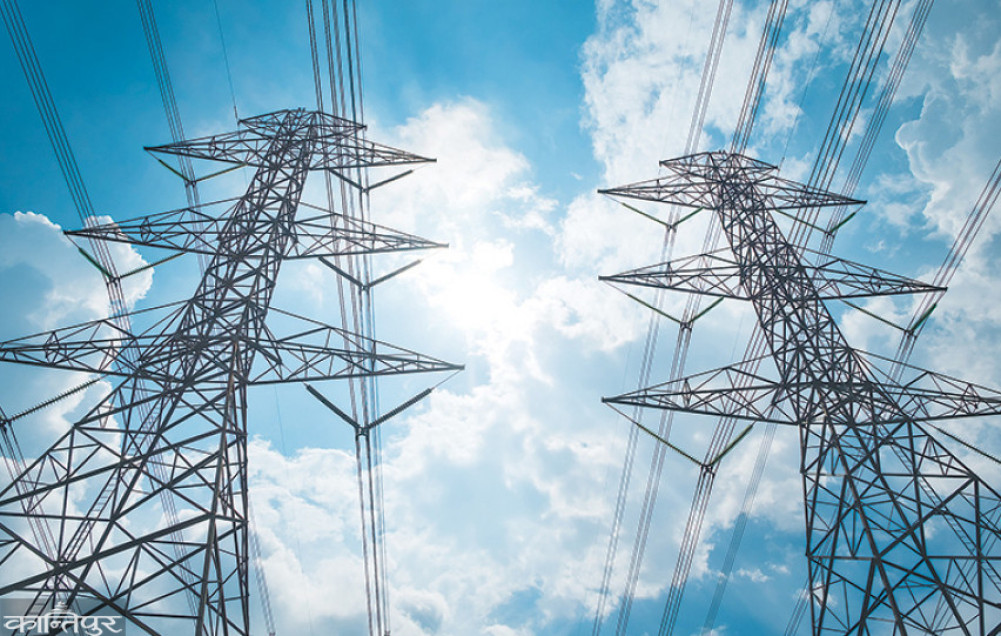
We are being deprived of the ability to efficiently manage and maximize the benefits of hydropower, which has immense potential. Therefore, the government needs to formulate its strategy by paying attention to various aspects such as electricity generation, transmission, utilization, and trade.
We use Google Cloud Translation Services. Google requires we provide the following disclaimer relating to use of this service:
This service may contain translations powered by Google. Google disclaims all warranties related to the translations, expressed or implied, including any warranties of accuracy, reliability, and any implied warranties of merchantability, fitness for a particular purpose, and noninfringement.
The potential of hydropower in Nepal has been discussed, but the returns have not been achieved. At times, the political leadership has even dreamed of becoming rich by selling electricity produced in Nepal. Although partial success has been achieved in selling electricity, it has not been able to contribute much to making the country rich. Due to the government's policies, citizens have not been enthusiastic about consuming electricity.
The Electricity Authority has asked the promoters to reduce electricity production during the rainy season. If we put all these aspects together, it seems that the electricity sector as a whole is being consumed by contradictions. That is, we are being deprived of efficient management of hydropower, which has abundant potential, and getting maximum benefits. Therefore, there is a need for the government to prepare its strategy by paying attention to various aspects such as electricity production, transmission, utilization, and trade.
The Authority has been keeping projects that cannot be operated at full capacity due to lack of transmission lines or substations in 'contingency'. According to Mohan Dangi, president of the Independent Power Producers Association of Nepal (IPPAN), more than 30 projects are currently in ‘contingency’. Due to the lack of transmission lines in the Marsyangdi corridor, projects such as Dordi-1, Upper Dordi ‘A’, Chepe Khola, Dordi Khola, Super Dordi, Nyadi Khola, etc. have been in ‘contingency’ for a long time.
Due to low electricity consumption and high production, and insufficient capacity of transmission lines and substations, the NEA has been instructing projects in ‘contingency’ to reduce production every year during the rainy season. Even now, the NEA has started instructing hydropower projects to reduce production, citing the need to maintain the stability of the system (grid) due to the fact that the transmission lines are not ready, the substation capacity is not sufficient, there are problems in the grid, and electricity production is more than the demand. However, even projects that are not in ‘contingency’ have been instructed to reduce production.
Currently, the maximum ‘peak load’ of Nepal is about 2200 MW. The Authority has received approval to export about 1,200 megawatts to India and Bangladesh. Although the export and consumption will reach 3,400 megawatts, about 900 megawatts of electricity are wasted as the installed capacity in the national grid has reached about 4,300 megawatts. In such a situation, a strategy has been taken to reduce production, which has affected projects that are or are not in 'contingency'. Because, if the Authority does not do as it says, the projects cannot be operated at full capacity. As this continues, a situation of wasting electricity is developing in Nepal. If we do not build strong infrastructure and adopt a strategy for electricity utilization and trade, we are sure to continue to suffer further losses.
At this time, the government needs to prioritize some work. First, our electricity infrastructure is in a very weak condition. There is a lack of transmission lines or substations. If there is no system to distribute the electricity generated, electricity will continue to be wasted. Therefore, improving transmission lines or substations should be the government's priority. Second, a policy should be taken to increase electricity consumption. Nepal imports a lot of goods such as cooking gas, petrol, diesel and kerosene.
Due to reasons such as low electricity consumption and high production and insufficient capacity of transmission lines and substations, the NEA has been instructing ‘contingency’ projects to reduce production every year during the rainy season. This has not only played a role in increasing the trade deficit, but has also increased environmental pollution. It has also increased the cost of health services. However, encouraging the use of electricity for cooking or operating public/private vehicles could have increased electricity consumption and led to import substitution. Foreign currency would also have been saved. Using electricity in kitchens or roads alone cannot make a big difference, but it is certain to provide some support.
Third, we must create a situation where industries can open and electricity can be consumed. However, this is linked to the broader issue of creating an investment environment in the country. There has been criticism for a long time that governments have not been able to make significant improvements in this regard. It has been analyzed that domestic or foreign investment has not flourished due to an unstable government and policy instability.
But after the elections on 21 Falgun, a strong and stable government has been formed. It is also expected to bring policy stability. Now, necessary reforms should be made to create an environment for investment. If large industries are opened in the country, the electricity produced in Nepal will be consumed in Nepal. Production can be increased by providing electricity to industries at a concessional rate.
Fourth, a permanent alternative to electricity export should be prepared. Currently, the NEA has received approval to export about 1,200 megawatts to India and Bangladesh. But Nepal has the capacity to export more electricity. For that, diplomatic initiatives should be taken with those countries. A situation should be created where more electricity can be sold. Fifth, there has been a demand to allow the private sector to trade so that electricity is not wasted.
Currently, even if the private sector produces electricity, it can only be sold to the NEA, and only the NEA can sell that electricity elsewhere. Therefore, if the private sector were allowed to sell, they would find a market and sell it. The state would get revenue from that. However, a safe alternative should be prepared in the situation where on the one hand, the NEA cannot create a sufficient market and on the other hand, the private sector cannot find a market and sell it.
If the current situation continues, the production of electricity projects that have invested billions will have to be curtailed. That will not be in favor of anyone, whether investors, consumers or the government. Therefore, the state's policy should be such that maximum benefit can be gained from our potential areas. It should increase the potential of itself and other sectors as well. Nepal's hydropower sector is waiting for a similar policy and strategy. In particular, a policy should be taken to increase exports from domestic consumption. Initiatives should be taken.