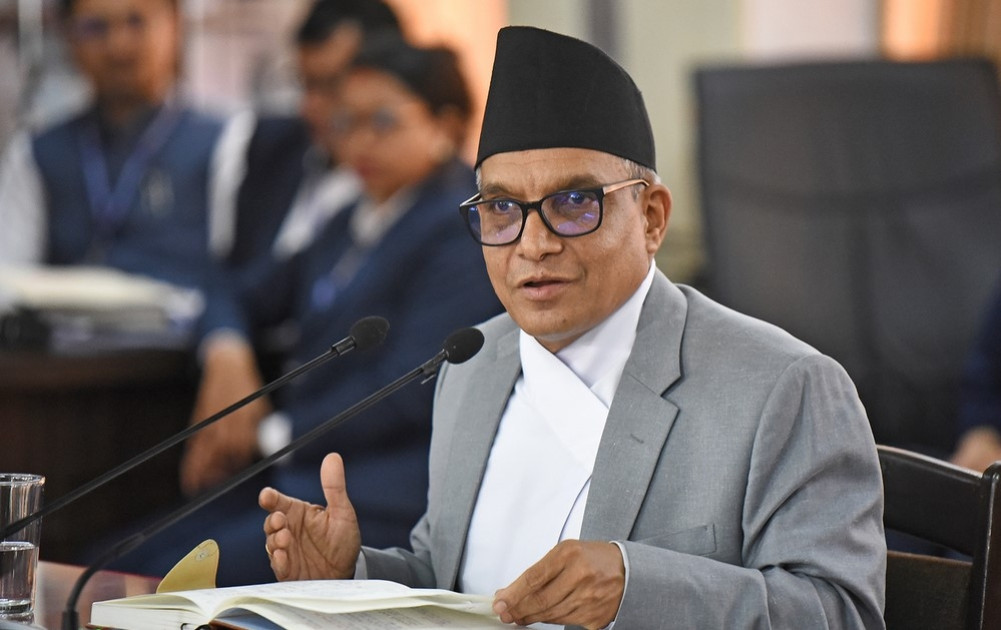
Chief Justice Manoj Kumar Sharma has not even been able to hold a meeting of the Judicial Council. The trend of increasing caseload in the courts due to a shortage of judges but not even holding a meeting of the Judicial Council, which recommends judges, is a contradiction in itself.
We use Google Cloud Translation Services. Google requires we provide the following disclaimer relating to use of this service:
This service may contain translations powered by Google. Google disclaims all warranties related to the translations, expressed or implied, including any warranties of accuracy, reliability, and any implied warranties of merchantability, fitness for a particular purpose, and noninfringement.
Speedy access to justice is a basic condition of a democratic country. For that, constitutional, legal, administrative, and technical management should be made. Necessary posts should be maintained. But the judiciary itself, which dispenses justice in Nepal, has had to face many shortcomings. Especially since judges are vacant for a long time, the process of obtaining justice has been prolonged. As a result, thousands of citizens have had to experience 'lack of justice' due to 'slow justice'. This situation is felt more in the Supreme Court.
The weaknesses of different organs and bodies are discussed at the relevant places, but since the Judicial Council, led by the Chief Justice, is itself weak, recommendations for the appointment of judges have not been made. Chief Justice Manoj Kumar Sharma has not even been able to hold a meeting of the Judicial Council. The trend of increasing caseload in the court due to lack of judges but not even a meeting of the Judicial Council, which recommends judges, is a contradiction in itself. Chief Justice Sharma should be aware and sensitive in this regard. He should convene a meeting of the Judicial Council and recommend judges.
There are currently only 18 judges in the Supreme Court, which has a strength of 21, including the Chief Justice. Of these, Justice Til Prasad Shrestha has been on leave for three months due to ill health. Similarly, five posts of Chief Justice and Judge are vacant in the High Court. The Supreme Court's Tuesday reference may be useful to understand the impact on the administration of justice due to the shortage of judges. The Supreme Court had scheduled the presentation of 463 cases on Tuesday. But only 131 cases were decided and ordered, while the other cases were postponed for various reasons. The number of cases listed as 'unwatchable' was only 193. This is not the first time that such a large number of cases have been postponed in the Supreme Court, it happens every day. There are various reasons for the postponement of most of the cases, one of which is the shortage of judges. As a result, there are 27,739 cases in the Supreme Court as of mid-Jeshta. Of these, 10,234 have served for more than two years and 1,442 have served for more than five years.
The Judicial Council is responsible for recommending judges of the Supreme Court, Chief Justices and judges in the High Courts. The Judicial Council Act, 2073 BS states that the Judicial Council shall determine the posts of Supreme Court judges who retire due to age limit and recommend them for appointment at least one month before such posts become vacant, if the posts of Supreme Court judges become vacant for other reasons, it shall recommend them for appointment within one month, and if the posts of Chief Justices and judges from the High Courts become vacant, it shall recommend them for appointment within three months.
Calling a meeting of the council is not a matter of the Chief Justice's discretion. It is a constitutional and legal obligation. The Supreme Court itself has already issued a mandate in the name of the Judicial Council for the timely recommendation of judges. The advance recommendation remains a separate issue, even after months of vacancies for judges from the Supreme Court to the highest courts, the Judicial Council has not been able to make recommendations. Because, the Chief Justice has not convened a Judicial Council meeting. There is no indication that a meeting will be held immediately. However, during the parliamentary hearing held on 5th Jestha after being recommended for the post of Chief Justice, Manoj Kumar Sharma had promised to establish a system of appointing judges before the position becomes vacant in the court.
The Judicial Council consists of senior-most judge Sapana Pradhan Malla, Law Minister Sobita Gautam, as well as Mahesh Kumar Nepal (appointed on the recommendation of the Prime Minister) and Damodar Khadka (appointed on the recommendation of the Nepal Bar Association). It is the practice for the Chief Justice to call a meeting of the Judicial Council. But the reason why the Chief Justice has not been able to hold a meeting of the Judicial Council is mainly seen as problems within the Supreme Court, especially the misunderstanding between Sharma and Malla.
As soon as the Constitutional Council recommended Sharma, who was ranked fourth, as the Chief Justice, replacing Malla, who was ranked first, the senior judges of the Supreme Court expressed their dissatisfaction in the full court. They said that the tradition of the court was violated and there was interference by the executive. In addition, the writ that would have been inconvenient for Sharma was not registered. That played a role in increasing the controversy. However, it is the responsibility of Chief Justice Sharma to reconcile the situation. After reaching the leadership of the Supreme Court and automatically leading the Judicial Council, he should be able to reconcile the dissatisfaction and misunderstanding.
Calling a meeting of the Council is not a matter of the Chief Justice's will. It is a constitutional-legal obligation. The Supreme Court itself has already issued a mandate in the name of the Judicial Council for the timely recommendation of judges. On 18 Jestha, the Supreme Court had issued a mandate in the name of the opposition parties, including the Judicial Council Secretariat, to complete the process prescribed by law and appoint judges within the time limit. The Chief Justice should respect all these parties. If he does not comply with the obligations of the constitution and law and even the mandate of the Supreme Court, he will not be considered to have performed his role, but rather it will be considered disobedience on the part of the Chief Justice. Such a message is not desirable. Therefore, he should immediately hold a meeting and make the necessary recommendations.
The time for deciding cases has been prolonged due to the lack of appointment of judges. This has added to the frustration and hassle of litigation among citizens. On the other hand, the possibility of people who have the potential and expectations to become judges has also been pushed aside. To minimize these and other effects, the Chief Justice should immediately create a situation where vacant positions of judges can be filled. This issue is also related to his official responsibilities and the implementation of the Supreme Court's mandate. Therefore, it is his responsibility to solve practical complications within the organization he leads and create a favorable situation. How can this be done? He should immediately hold a meeting of the Judicial Council and recommend a judge.