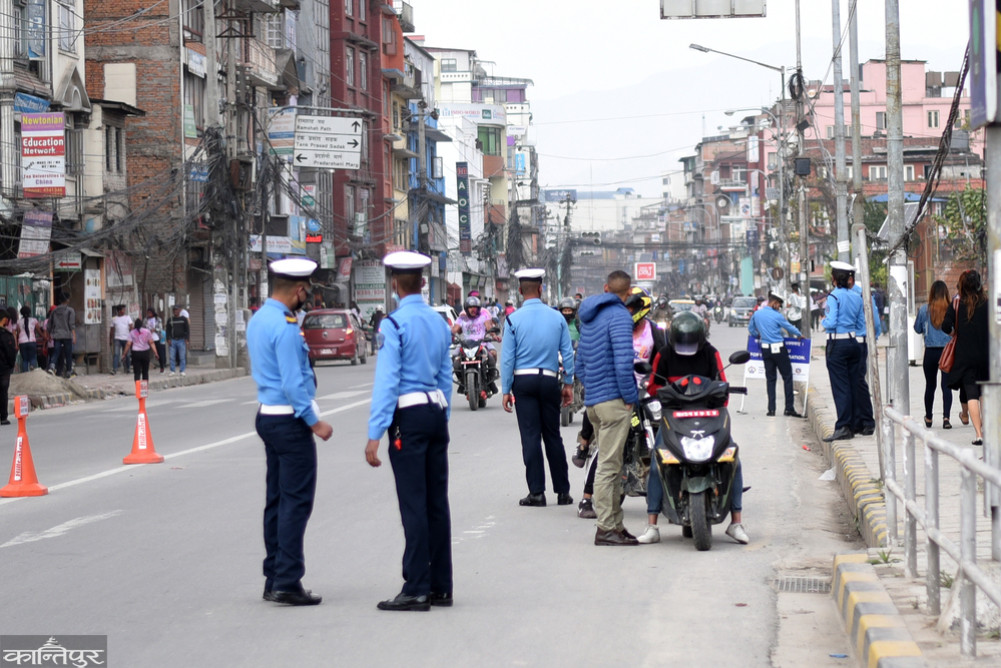
The draft bill indicates that the government, which has not fulfilled its responsibilities, is trying to adopt a strategy to create a financial burden on citizens and achieve its objectives.
We use Google Cloud Translation Services. Google requires we provide the following disclaimer relating to use of this service:
This service may contain translations powered by Google. Google disclaims all warranties related to the translations, expressed or implied, including any warranties of accuracy, reliability, and any implied warranties of merchantability, fitness for a particular purpose, and noninfringement.
Road accidents and the resulting deaths are alarming in Nepal. According to the World Health Organization, about 28 percent of the deaths in Nepal in a year are due to road accidents. Road accidents mainly affect people of active age. This leads to death or dismemberment.
Family members also have to bear the brunt of the death or permanent dismemberment that occurs after an accident. Some families also have to bear the financial burden. Perhaps with the aim of reducing such problems, the Ministry of Infrastructure Development has prepared a draft bill to amend and consolidate the laws related to vehicles and transport. The government's sensitivity to a major problem and its initiative to reduce the problem is positive. However, controversy has arisen due to the proposal of large financial penalties. The government should be aware of this and, while finalizing the bill, it should be improved by taking into account the public debate that is currently underway.
The draft bill sent by the Ministry of Infrastructure Development to the Ministry of Law, Justice and Parliamentary Affairs, seeking consent, proposes a fine of 25-50 thousand rupees for driving under the influence of alcohol or drugs. Similarly, a fine of Rs 500 has been proposed for pedestrians travelling outside the designated area, Rs 3-5,000 for driving a vehicle faster than the prescribed speed, Rs 15,000 for carrying more than the prescribed weight, Rs 5-20,000 for carrying more passengers than the seat capacity, Rs 3,000 for driving without a seat belt or helmet, and Rs 5-25,000 for leaving construction materials, vehicles or livestock on the road and causing an obstruction.
It is not true that imposing large fines will reduce offenses. Rather, there should be practical fines and their implementation. The belief that the law applies equally to everyone helps reduce offenses. There is no doubt that the government has set the objective of increasing road safety through the bill. If traffic rules are followed as much as possible, road accidents will automatically decrease. But the debate in this context should start from the cause of the increase in accidents and mitigation programs should be implemented by identifying with it. The causes of accidents can be divided into two parts - poor infrastructure and the tendency to not adopt safety measures/rules. High fines have also been proposed for other offenses. There is criticism that such a fine does not take into account the socio-economic status of citizens. At the same time, there is an accusation that the government is trying to increase the financial burden on citizens by not prioritizing the work that should be done by the government to address road safety.
The physical arrangements adopted for the quality and safety of Nepal's roads are very weak. Not only are the roads in remote areas unsafe, but the condition of the roads connecting the capital is also pathetic. Traffic signals in big cities are not effective. The method of enforcing traffic rules is not scientific. Potholes on the roads, destroyed zebra crossings, non-working traffic lights, and unclear signals are common problems in many cities.
There are 'sidewalks' that narrow and end as you walk, or in some places they are not there. There is another practical problem. For example, some vehicles come with black glass, which cannot be removed. But if you put opaque glass in a vehicle, a fine of one lakh has been said. What to do in such a situation? The government's first priority should have been to improve and clarify such aspects. It is not heard that the government has taken much initiative in this regard.
The draft bill indicates that the government has not fulfilled its responsibility and is trying to adopt a strategy to create a financial burden on the citizens and fulfill its objectives. What needs to be clear is that there is a tendency to not follow traffic rules on the roads of Nepal. This has added insecurity to the lives of not only the person concerned, but also others. Therefore, it is the responsibility of the government to make everyone follow traffic rules and make everyone's lives safer. However, the laws adopted for this should be practical. The law should have the objective of reducing accidents, not adding burden to the citizens.
The draft bill has failed in this regard. It is not said that imposing large fines will reduce crimes. Rather, there should be practical fines and their implementation should be ensured. The belief that the law is applied equally to everyone helps reduce crimes. A situation may arise where bribery transactions may be made to evade large penalties or risky measures may be adopted to avoid fines.
The draft bill presents a positive initiative by the government. However, the provisions mentioned there should be suitable for the economic and social environment of the citizen and practical in implementation. This aspect is seen as weak in the bill. In cases where the intentional offense and the harm it causes to other parties are or will be greater, relatively higher punishments can be proposed. However, it is impractical to try to impose a large fine even in cases where an incident occurs due to human weakness or confusion, which does not cause much harm to oneself or other parties.
The government should understand that it is not harsh punishment that helps to reduce accidents, but rather public awareness. The government's weakness in this already exists. Although the bill is currently in the draft stage. Even before reaching the parliament, it must go through many processes and tests. Only then can its provisions be made practical. The main responsibility for making laws lies with the parliament. Therefore, once the bill reaches the parliament, it can be expected that the lawmakers will use their discretion to include practical provisions.