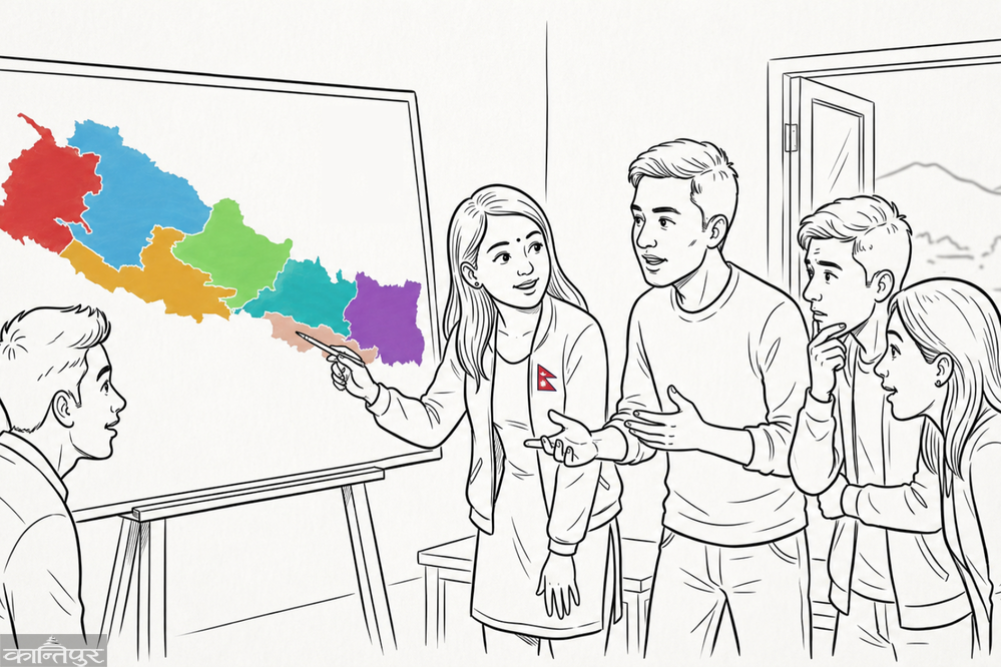
The success of implementing federalism does not depend solely on laws and structures, but also on continuous dialogue, collaboration, and awareness, especially with the youth.
We use Google Cloud Translation Services. Google requires we provide the following disclaimer relating to use of this service:
This service may contain translations powered by Google. Google disclaims all warranties related to the translations, expressed or implied, including any warranties of accuracy, reliability, and any implied warranties of merchantability, fitness for a particular purpose, and noninfringement.
There was confusion in the country during the Gen-G rebellion. There was concern that the constitution and order would not remain. Moreover, there was a situation where it was forbidden to speak/write about the provinces. Those who said that federalism was not needed and that the provinces should be abolished were in a hurry. Federalism seemed to be the most targeted issue mainly on social media. There was a situation where anyone who wrote something in favor of federalism on social media would be persecuted.
In a similar situation, I had spoken to Gen-G leaders. I had telephone conversations. In some programs, I had informed about various types of movements since 2007. I had even made videos and shown them about the terrible Maoist, Madhesh, indigenous-tribal movements. I had said that many movements and many people's blood and sweat had been shed on the 2072 constitution. Gradually, those who thought that federalism was necessary became more vocal.
However, at that time, the views of Gen-G in Kathmandu were becoming more public, while the views of the youth including Gen-G outside Kathmandu on the federal governance system were not very public. There was no study in that regard. There was no discussion or interaction. Someone in a closed room might have understood the views of the youth including Gen-G.
They might have also woven the fabric of the conspiracy. However, there was no openly available analytical document. During the election, it was a different matter for the media, including social media, to speculate.
Recently, I had the opportunity to reach the capitals of all seven provinces and interact with about 350 youth under the age of 40 on the subject of the views of youth in various places and roles in the country on the constitution and federalism. This program was coordinated by the offices of the Chief Ministers of the provinces. This article has been prepared based on the discussions held there. This article basically focuses on four topics. First - The topic of 'provincials are expensive' that comes up on social media and the media.
Recently, I had the opportunity to interact with about 350 youth under the age of 40 by reaching the capitals of all seven provinces on the issues of the constitution and federalism, including the views of youth in various places and roles in the country. That is, the question of whether provincial governments are really expensive. Second - The topic of whether federalism has increased inclusiveness in state bodies or not. Third - Whether federalism has brought government services to the doorsteps of the people. Fourth - What was the understanding of Nepal's federal system of governance after participating in the dialogue. Answers to questions other than the fourth were collected through mobile voting (Mentimeter) at the beginning of the dialogue before entering the dialogue.
In terms of inclusivity, 88.85 percent of the youth said that inclusivity has become a priority in every organ and body of the state due to federalism. 4.46 percent of the youth did not agree with this. 6.69 percent said that they did not know anything about this. Provincially, the youth of Lumbini Province (96.97 percent) agreed the most. The least was from Sudurpaschim Province (71.43 percent).
Inclusivity is an important pillar of the constitution. 41 percent of women are in local government. 35 percent of women are in parliament. Women, Dalits, indigenous peoples, Madhesis, Tharus, Muslims, backward classes, minorities, marginalized, disabled people, and other backward classes and communities have access to every organ and body of the state. Those who demand rights are in the place where rights are given. It is found that the youth are aware of such issues.
Behind inclusion is the role of a great movement and sacrifice of classes and communities, including women in Nepal. Many have endured imprisonment, shed blood and sweat. It is necessary to inform the youth about such issues. The achievements that should have been made regarding inclusion have not been as much as they should have been. Programs such as maintaining the achievements and informing the youth about additional achievements are necessary.
86.91 percent believed that government services have reached the doorsteps of the people. Province-wise, 100 percent of the youth in Karnali Province agreed with this. This was followed by 93.48 percent in Gandaki Province. The lowest percentage (71 percent) was in Sudurpaschim. 26 percent of the youth in the Far West Province did not agree with this, and three percent said they did not know anything.
Earlier, they had to go to the district headquarters for small work. They had to go to Kathmandu. Previously, most of the thematic offices centered in the district headquarters are now in the municipalities. Employees who never went down from Singha Durbar have reached the municipalities and provinces. They had to go to the National Planning Commission and the Ministry of Finance for small plans and programs. This is not the case now. There are employees. The budget has arrived. There are various offices. During the conflict, there was no environment to live in the villages. State structures were displaced. Citizens' hearts were broken. Even 'Kathmandu' did not sleep well. Now there is stability in the country. There is peace.
Government services have reached the doorsteps of the people. Certainly, they have not reached as far as they should have. There are many reasons behind that. For example, the federal government has not been able to respect the rights of the provinces and local levels. Rather, they are subordinate to us, and the federal government has the mindset that they should do whatever we say. The expected progress has not been made because the federal government and the old parties have a mentality that we should appoint employees, the law should be as we say, and the plans and programs should be from our pockets. But there is no need to be disappointed with what has happened.
About 87 percent of the youth are satisfied with the services reaching the doorsteps of the people. This should be appreciated. If the federal government had facilitated it in accordance with the spirit of the constitution, the provinces and local levels could have done a lot. However, the federal government itself could not work according to the people's feelings. It did not focus on the people and the service delivery. This is the reason why the Gen-G rebellion took place. The current government led by Balen Shah has given good governance and service delivery as its first priority. The current government has got the opportunity to correct the shortcomings of yesterday.
There are also those who believe that the provincial structure is expensive on social media and in the media. This is also a question for the common citizen. When I asked this question at the beginning of the conversation with the youth (before entering the topic), 67.97 percent thought that it was expensive. This was not a particularly surprising statistic. I had been telling the first-term Chief Minister that the task of informing the citizens of the province about the justification and necessity of the provincial structure was to inform them. Even now, my opinion is the same. However, the provincial governments are not seen to be serious about it.
After about two-thirds of the youth said that the provincial structure was expensive, I discussed the financial aspect of federalism. I provided information about the statistics of the Government of Nepal and the political, economic, and administrative issues behind the provincial structure. When they saw the details of the total expenditure of the three levels of government, the share of the province in the total expenditure (less than 5 percent), including officials, they were convinced.
They understood that the provincial structure was not as expensive as it was rumored. Despite all this, there is no need to improve the provincial structure, and I do not mean that what is there is fine. There is a need for further extensive cuts in administrative expenses. The National Assembly's Federalism Implementation Monitoring Parliamentary Special Committee had recommended that the number of ministers in the provinces be reduced from 20 percent of the provincial assembly to 10 percent, not to exceed 5. Many unnecessary structures have been created in the provinces. They have been added. All those structures should be streamlined.
The current economic situation of Nepal (white paper) recently published by the Ministry of Finance states that the provincial expenditure does not even account for 10 percent of the total expenditure of all three levels, including administrative and development. The total expenditure of the provincial assembly, provincial government employees and officials is not even 5 percent of the total expenditure of all three levels. It is not even 10 percent of the total expenditure of all three levels, including development and construction. This confirms that the expenditure of the provinces is not much. However, the constitution recognizes that the provinces are the carriers of development and that development and construction work should come from the provinces.
The development of Karnali should be done by the Karnali government. The development of Madhesh should be done by the Madhesh government. The construction work of the provinces, including the Far West, from laws to development, should come from the provinces. This is also the spirit of federalism. This is what is written in the constitution. When this happens, the graph of provincial expenditure goes up. But the federal government's approach towards the provinces is not right. The old parties did not allow the provinces to function properly. They did not even allow the police to exercise their rights despite being on the single rights list.
The Prime Minister had said in his first election address held in Janakpur that he would not go to Kathmandu to demand rights, but to go for a walk. If only this statement of the Prime Minister is implemented, the provinces and local levels will be able to exercise the rights granted by the constitution. Development will gain momentum. As the Prime Minister said, some of the government's activities are also in favor of the provinces and local levels. Such as the issue of transfer of secretaries and chief administrative officers in the proposed civil service law, reduction of ministries in Singha Durbar, initiatives to abolish unnecessary structures, etc.
The concern among the youth towards the provinces is also related to stability. Due to the frequent changes of Chief Ministers and changes in the Council of Ministers, there is disappointment among the citizens towards the provinces. The provinces should also improve in the selection and implementation of plans. The youth are angry at the arbitrary implementation of plans. The way plans are being distributed in the name of MPs, there is also dissatisfaction among the youth. There is anger. It is the province's job to instill trust and confidence in the citizens of the province, including the youth. The provinces themselves should be serious about this. The province cannot function in this manner. Extensive reform is needed in the way it works.
At the end of the dialogue, the participating youth were asked about their understanding of Nepal's federal governance system. The responses received showed the effectiveness of the dialogue. 81 percent of the youth said that their understanding of the federal governance system was good, 12 percent said that the learning was very useful and effective. Only 7 percent said that they received a general level of information. Discussions based on facts, evidence, and open dialogue confirm that they are playing an important role in dispelling the misconceptions spread on social media, increasing trust in the constitution and federalism, and connecting the youth with accurate information.
Therefore, the success of the implementation of federalism does not depend only on laws and structures, but also on continuous dialogue, collaboration, and awareness, especially with the youth.