The value of the phrase 'We are evolutionists' is proven when development becomes a system, not a speech. The system becomes a result. And the result is reflected in the daily routine and experience of citizens.
We use Google Cloud Translation Services. Google requires we provide the following disclaimer relating to use of this service:
This service may contain translations powered by Google. Google disclaims all warranties related to the translations, expressed or implied, including any warranties of accuracy, reliability, and any implied warranties of merchantability, fitness for a particular purpose, and noninfringement.
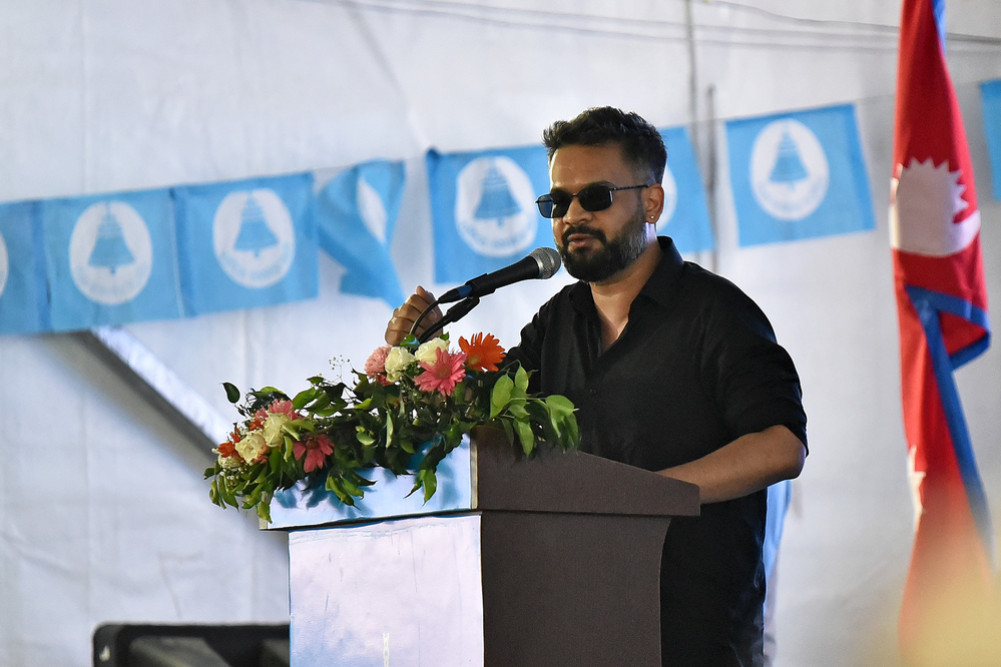
I have understood Prime Minister Balendra Shah's speech at the first general convention of the Nepali Congress Party (NCP) as an indication of the economic and political roadmap of this government. After taking oath as Prime Minister, the columnist had put forward the term 'Balenomics' (Waiting for 'Balenomics', Kantipur, Falgun 28, 2082). In public debate, this term has been used in the language of praise and in the language of satire. Now, its expanded form may be called 'developmentalism'. In this article, I will discuss the issue of 'Is the expanded form of 'Balenomics' developmentalism?'.
The government has publicly set a target of maintaining a 7 percent economic growth rate and taking the economy to a size of 100 billion US dollars within the next five years. There is general interest in the process of achieving this target. The question remains whether the target will be achieved or not. Failure to achieve the target is not only a failure of the government and the NCP. It is also an attack on the trust of the citizens.
This goal will not be possible without five consecutive years of high productivity, a stable policy environment, and external balance. Moreover, if economic growth is driven solely by import-based consumption, the trade deficit will increase, foreign exchange will come under pressure, and the goal of making the economy bigger will become even more difficult. Therefore, the development of the Rashtriya Swayamsevak Sangh (RSS) should not be based on ‘showing numbers’ of economic growth, but on the principle of ‘building a nation’ through production and competition.
Nepal’s history has given two lessons for development – vision and warning. If we translate the insistence on self-reliance, resource conservation, and careful relations with external powers found in Prithvi Narayan Shah’s divine sermon into today’s language, it is a warning of ‘strategic independence’ and ‘domestic production capacity’. But another side of history also provides a lesson. Although there was a glimmer of modernity during the Rana period, opportunities remained limited when the power structure was unified and one-sided, and development could not transform the lives of citizens. During the Panchayat period, ‘development’ became the official word of the state. But centralized planning and command-based administration did not give the desired space to local accountability, competition, and innovation. The changes of 2007, 2046, and 2062/63 increased the scope of political authority. But there was no significant achievement in the capacity of the ‘economic state’. There were weaknesses in areas such as project implementation, transparent public procurement, rule of law certainty, justice, and efficient regulation. And, they kept recurring. Therefore, today, putting forward the goals of 7 percent economic growth and an economy worth 100 billion US dollars is making a promise to the country’s history. Now, development should not be just a power of speech, but a proof of the state’s systemic capacity. The state itself must be aware that it should not be one-sided like the Rana period and elegant like the Panchayat.
The literature of world development does not give Nepal any ‘ready-made notes’. But it does provide an eye-opener to ask the right questions. Walt Rostow (1916-2003) had given the concept of ‘take-off’, showing development as a journey of various stages. It gives the leadership the dream of flying. But in Nepal, the problem is often the ‘runway’ rather than the engine of the plane. There are many problems due to unstable regulations, uncertain policies, delays in permits, contract disputes and a weak justice system. An airplane cannot take off if the runway is not smooth. In the view of Arthur Lewis (1915-1991), the process of labor migration from agriculture to the industrial sector was considered the engine of development. In Nepal, the major path for that labor migration opened not to industry, but to abroad. Which increased remittance-based consumption. But the domestic production base remained weak. Danny Rodrick has said that the same policy does not work everywhere and that the country needs to identify its own main obstacles and focus on improving them. Nepal’s main obstacles are very concrete. Development cannot have both a speed of 7 percent and a size of 100 billion without directly attacking these obstacles.
The backbone of development must be institutional reform. American economist Douglas North (1920-2015) has called institutions ‘the rules of the game’. If the rules are clear and stable, investment increases, risk decreases, and productivity increases. In Nepal, rules in many places remained arbitrary, uncertain, or access-based. This led to distrust of the state by both the private sector and citizens. Daron Acemoglu and James A. Robinson argued that sustainable prosperity is not possible without ‘inclusive institutions’. In the Nepali context, this meant that only a few groups had access to taxes, contracts, permits, finance, and justice. In this context, development may be seen in ‘average’, but not in ‘expansion’. Development without expansion is unstable in the long run. Therefore, it is imperative to keep fair competition, equal implementation of rules, and transparency in public institutions at the center of development.
But limiting development to numbers and institutions diminishes its human meaning. That diminished development ultimately weakens political legitimacy. Amartya Sen has defined development as ‘capacity expansion’. Development is the expansion of what people can become and do in their lives. The success of development in Nepal is not only about increasing the gross domestic product (GDP), but also about improving the quality of learning in schools, improving access to health care for the poor, providing services to citizens, and seeing a future for the youth in the country. Karl Polanyi (1886-1964) said that society reacts when the market is placed above society. In Nepal too, if development increases inequality, access-centric opportunities, and regional divisions, development itself becomes the center of opposition. Therefore, Balenomics should make ‘speed’ and ‘justice’ two wheels of the same journey. Otherwise, the country will not move forward with just one wheel.
Nepali literature has put the ‘human’ aspect of development in very clear language. Bhanubhakta increased access by translating knowledge into the vernacular. This is the evolutionary basis of education and inclusion. Devkota’s ‘Munamadan’ showed the pain of being forced to go abroad and the structural deficiencies within the home. Today, that story is not only in sentiment, but in data. Youth have gone abroad, labor is declining, farming is non-existent, the social structure of the family has changed or collapsed. And, the economy is stuck in remittance-based consumption. The central question that development needs to answer is why there is no decent employment in the country. BP Koirala called democracy a way of life. That means development is also the daily life experience of the citizen. Development ultimately means protecting the time, labor, and dignity of the citizen.
Now let's come to the question of where the 'engines' of 7 percent growth are in the country. The first engine is agricultural productivity. Agriculture is not just a tradition. It is the basis of employment, food security, and import substitution. Developmental policy is not a list of grants. It is about creating a value chain through irrigation, water resource management, reliable supply of seed technology, fertilizers, and equipment, storage/humidification centers, agricultural insurance, market information, and processing industries. As agricultural productivity increases, dependence on imported food decreases. This increases rural income and improves domestic demand. But agricultural reform is not just a matter of ‘farmers’. It is also about improving land conditions, logistics, good governance of cooperatives/groups, and the intermediary structure in the market. Agricultural reform will not last without a policy that respects farmers as entrepreneurs, not beneficiaries. Economic growth based on broad employment is not possible without sustainable agriculture.
The second engine is energy conversion. Especially hydropower and its associated transmission/distribution capacity. In Nepal, there is a tradition of talking about hydropower as ‘potential’. But potential alone does not give economic shape. The energy used in production, consumption, and the value chain is the economic shape. Only improvements in transmission lines, distribution systems, leakage control, stable and cheap supply to industry, and household energy conversion (electric stoves, electric transportation) can change the cost structure. Energy conversion can save foreign exchange by reducing dependence on imported petroleum. This can provide the most tangible support on the path to the $100 billion goal.
The third engine is tourism and the service economy. But it should be taken out of the measurement of 'arrival numbers' and brought to 'per-tourist income', service quality and local benefits. Mountains, culture and nature are our capital. But prosperity can only be achieved by improving quality and sustainable management, not by selling capital cheaply. In the tourism sector, emphasis should be placed on environmental management, waste management, safe trail/travel infrastructure, local community participation and high-value services. In addition, digital service payment systems, e-commerce, logistics and government service delivery reduce transaction costs, save time and increase productivity.
The fourth engine is industry and small and medium enterprises. These sectors often drive sustainable economic growth and the basis for employment. But buildings or 'declarations' are not enough for industrial development. Regulatory certainty, infrastructure (energy, roads, internet), access to finance, quality standards and a competitive market are needed. The situation where entrepreneurs have to spend more time and energy on starting a business than running it is not consistent with a developmental state. The state should not view enterprises with suspicion, but as partners in production and employment. But this does not mean removing regulations. It means making regulations simple, clear, predictable, and free from corruption. As Joseph Schumpeter said, productivity does not increase without innovation and competition. Therefore, creating an environment where new businesses are born, old businesses are modernized, and monopolies/cartels do not form in the market are essential parts of development.
The ‘fuel’ that drives all these engines is public finance and good governance. This is where the country has repeatedly underperformed. Delays in capital expenditure, project delays due to contract disputes, cost escalation, and compromises on quality reduce development to a paper plan. If ‘Balenomics’ is developmental, the government’s annual budget should not be a list of ‘spending skills’ but a document of a ‘system that delivers results’. Project selection should include cost-benefit, employment impact, time frame, and maintenance plans. There should be transparency and competition in public procurement. There should be technical capacity and rigor in contract management. And, after completion, there should be a public report on the performance. The tax system should also be broad-based, the rates should be fair, and tax evasion control should be effective. Balen's Finance Minister Dr. Swarnim Wagle will also be tested in this.
External balance remains at the heart of development. An economy that 'looks big' with increased imports, increased trade deficit, and increased foreign exchange pressure is raw prosperity. To move towards the goal, a structure is needed to expand exports (goods and services), increase tourism income, reduce imports through energy conversion, and divert remittances not only towards consumption, but also towards production/enterprise. Remittances are today's reality. But a developmental strategy should find ways to make it 'productive capital', not 'helpless dependence'. Safe savings instruments, small enterprise finance, skill-based return, and opportunities to connect with local production should be increased. Even when taking external loans, the question should not be 'how much did we bring in?' but 'how will we pay it?' Debt is a developmental tool only if it increases the ability to earn foreign exchange. Otherwise, it becomes a burden for the future. The experience of the African country Zambia can be seen. Unproductive debt reduces the country's policy freedom. The caution of the sermon can be expressed in today's language as follows: Development that increases dependence ultimately becomes the enemy of development.
The most difficult issue is continuity. The problem of policy instability, priority changes, and getting stuck between projects is an old one in Nepal. Maintaining 7 percent growth for five years is not 'performance', but 'discipline'. It may be possible if the government works with discipline in terms of legal certainty, policy stability, clear division of roles between the center, state, and local levels in the federal structure, and public accountability based on measurable indicators. Time will tell the introduction of a developmental Prime Minister. It is not an announcement that the country needs, but delivery. It is not popularity that the society seeks, but credibility.
त्यसैले ‘बालेनोमिक्स’ को विस्तारित रूप विकासवादलाई अन्ततः तीन वटा सर्तमा बाँध्न सकिन्छ– उत्पादन बढाउने साहस, नियम सुधार्ने अनुशासन र नागरिकको गरिमा बढाउने नैतिकता । ७ प्रतिशत वृद्धि र १०० अर्ब डलरको लक्ष्य सम्भावनाको सीमाभित्र पर्छ । तर त्यो सम्भव तब मात्र हुन्छ, जब वृद्धि आयात–आधारित चमकबाट होइन, कृषि–ऊर्जा–पर्यटन/सेवा–उद्योगका इन्जिनहरूबाट आउँछ । जब संस्था र नियम कानुनले निजी क्षेत्रलाई डर होइन, भरोसा दिन्छ । र, जब विकासको उपलब्धि शिक्षा, स्वास्थ्य, रोजगारी, र सेवाको गुणस्तरमा नागरिकले प्रत्यक्ष महसुस गर्छ ।
‘हामी विकासवादी हौं’ भन्ने वाक्यको मूल्य त्यतिबेला प्रमाणित हुन्छ, जब विकास भाषण होइन, प्रणाली बन्छ । प्रणाली परिणाम बन्छ । र, परिणाम नागरिकको दिनचर्यामा र अनुभवमा परावर्तित हुन्छ ।