Although, according to established practice, statements by high-ranking state officials are evaluated as relevant evidence, their evidentiary value is determined based on treaties, historical maps, administrative practices, effective controls, government records, diplomatic correspondence, and other objective evidence.
We use Google Cloud Translation Services. Google requires we provide the following disclaimer relating to use of this service:
This service may contain translations powered by Google. Google disclaims all warranties related to the translations, expressed or implied, including any warranties of accuracy, reliability, and any implied warranties of merchantability, fitness for a particular purpose, and noninfringement.
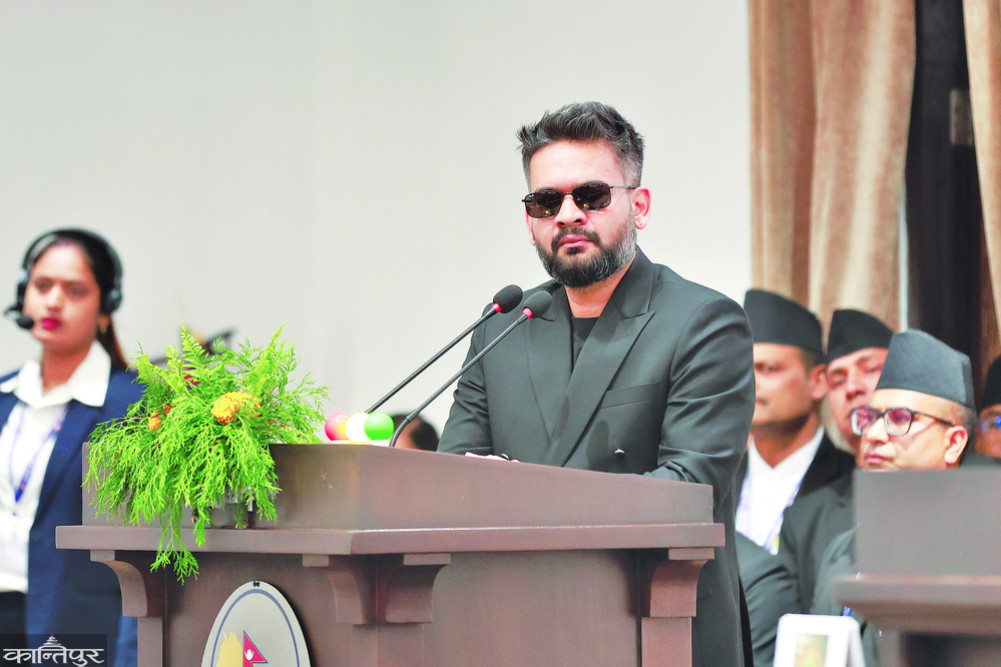
‘One thing may come as a surprise, I also came to know only after becoming the Prime Minister yesterday – India has encroached not only on Nepal’s land, but also on India’s land in many places’ – this is the statement made by Prime Minister Balendra Shah in Parliament regarding the Nepal-India border dispute. The words, sentiments and content of the statement have brought the sensitivity of the border dispute with India back to the center of domestic politics.
The Ministry of Foreign Affairs has issued a statement stating that the Prime Minister’s statement is ‘encroachment on the Dashagaja area’ and ‘related to the right of occupancy of land across the border’. But the question arises, why did the Prime Minister, who was present in Parliament for the first time, make such a controversial statement? He has said that he made the statement after studying the border, but has not given a clear explanation. After all, even if he spoke on the advice of any study report or any other expert, it is a serious matter for the Prime Minister to make such a controversial statement in Parliament on a sensitive issue like the border. Therefore, are those who provide such erroneous material and give wrong advice knowledgeable about international law or not? If so, the basis on which they have used the phrase 'Nepal has encroached on India's land' is a serious issue. If so, if such materials and consultations are factually and legally flawed, it can lead to another problem. There is a risk of adversely affecting Nepal's national interests and stance.
Public opinion is divided over the Prime Minister's statement. Supporters are in favor, critics are against. Most are against the Prime Minister's statement. But Prime Minister Shah has not backed down from his statement. Even when he last addressed the general convention of his party, the Rashtriya Swayamsevak Sangh (RSS), instead of clarifying what he said in Parliament, he said, "No one should doubt my nationality" to control the damage caused by the statement.
It is not appropriate to generally doubt the Prime Minister elected by a party with two-thirds of the seats in Parliament. But it is the duty of citizens to question the government's work and the Prime Minister's statement and to constructively criticize it. It is the responsibility of the opposition parties. Similarly, independent analysts can present their views in a factual manner. Supporters have taken it as a diplomatic expression to resolve the dispute with India. Time will tell whether such an expression will actually help in a diplomatic solution or not.
Who has encroached on whose land?
According to international law, ‘encroachment’ by one nation on the land of another nation is called encroachment. Such an act done without authorization is considered a serious violation under international law. Also, encroachment is prohibited according to prevailing international law.
Land encroachment, cross-border military occupation, interference The concepts of ‘cross-border holding occupation’ by the residents of the border areas, that is, the people of the border areas interfering in the enjoyment of the land of another country, are legally different. ‘Encroachment’ means the unauthorized entry, occupation or use of the land or border area of another state. ‘Cross-border military occupation’ means that a state maintains control over the territory of another state by using military force. Similarly, ‘interference’ means interfering in the internal or external affairs of a state by using pressure and military force. The fact that the residents of the border area interfere in their enjoyment does not mean that the government of the country concerned has encroached. The government can remove citizens of any country who are occupying the land illegally in this way. Therefore, the presence of the government is mandatory behind the act of crossing the border, encroachment and interference, not the people.
It is a self-evident fact that Nepal has not occupied any territory of India as Prime Minister Shah said. On the contrary, it is a fact that India has occupied Limpiyadhura-Lipulekh-Kalapani by using military force. In addition, it is another fact that the Sashastra Seema Bal has been deployed every four km of the encroached areas including Susta and encroached on that land. While Nepal has neither seized any land of India on the basis of military force, nor has it placed its security personnel in the encroached land in such a way.
Clarification of the Ministry of Foreign Affairs
In a democratic country, the statement of the Ministry of Foreign Affairs cannot overturn the decision or opinion of the Prime Minister, but can only clarify the official policy of the government. But after the Prime Minister's statement created a controversy, the statement issued by the Ministry of Foreign Affairs said, 'The issue mentioned by the Prime Minister in the Parliament is basically related to 'encroachment of ten-meter areas' and 'cross-border occupation', i.e. 'right to occupy land across the border'. Due to the adoption of the 'fixed boundary principle' in the river border area while determining the Nepal-India border, there is a situation of 'cross-border occupation' and citizens of one country are farming and living on land falling within the territory of another country.' Therefore, this clarification of the Ministry can be understood point by point as follows.
First, no man's land is an area that is not under the sovereignty, occupation or effective control of any state and cannot be legally claimed by any country. The use or settlement of land by border residents in no man's land cannot be considered an 'encroachment' by the state, because the private behavior of an individual cannot be interpreted as an act of the state. Therefore, even if the Prime Minister's intention was a land dispute between the residents of the border area, it would not have been appropriate to say that 'Nepal has also encroached on India's land'. Even if the ministry tries to clarify, the meaning and connotation of words like 'Nepal' and 'Nepali', 'India' and 'Indian' cannot be changed. The legal identity of any country and its citizens is different.
Second, the legal status of no man's land, border lines and questions related to the jurisdiction of the state are mainly governed by public international law. However, the principles of private international law may also be relevant in cross-border private disputes arising from the use, occupation or enjoyment of private land by individuals in such areas. The ministry's explanation does not even indicate the difference between these two legal aspects.
Third, the 'fixed boundary principle' means that the predetermined international boundary does not automatically change if the course of a river changes. However, principles such as 'accretion', i.e. the process of gradual addition of land by a river, and 'avulsion', i.e. the sudden change in the course of a river, are recognized in general international boundary law. But the Nepal-India border is based on the 'fixed boundary principle'. Therefore, the problem as mentioned in the ministry's explanation is not based on the 'fixed boundary principle', but the weakness of the state machinery in border management, monitoring and implementation.
Fourth, the Ministry of Foreign Affairs clarified that ‘cross-border occupation’ is a situation where citizens of one country cultivate and settle land within the territory of another country. However, the mere cultivation or settlement of land by citizens of one country in the territory of another country does not constitute land encroachment or extension of sovereignty by a state.
In international law, ‘cross-border holding occupation’ is often related to military occupation or effective control by a state. In disputes regarding the use of cross-border property, the principles of the domestic law of the country concerned may be relevant depending on the circumstances, but questions related to border delimitation, sovereignty and territorial rights fall under public international law. The International Court of Justice (Democratic Republic of the Congo v. Uganda-2005) explained the issues of cross-border occupation, military control and international responsibility, but has not established any general legal principle regarding the private use or enjoyment of cross-border land by individuals.
Fifth, according to the ministry's explanation, 'The study of the technical committee has shown that in some places the land currently under Nepal's use and enjoyment may fall towards India and the land currently under India's use and enjoyment may fall towards Nepal. The context of the statement made by the Prime Minister in Parliament that 'in some places the land of India may fall towards Nepal' is linked to this technical conclusion.'
However, a conclusion cannot be drawn about the legal ownership or sovereignty of the concerned territory just on the basis that a technical study shows a different current state of use or enjoyment. The question of whose use or enjoyment the land is under and the question of who has legal sovereignty over that land are separate issues. The demarcation of borders and the legal status of the territory are determined on the basis of treaties, border maps, boundary pillars and principles of international law, and not on the basis of current use or enjoyment. Therefore, the state of use seen from the technical study cannot be automatically linked to land encroachment by the state or change in ownership of the territory.
Since the above-mentioned ‘Technical Committee Report’ is not public, it is difficult for any analyst to test its conclusions, study methods and legal expertise of the experts. However, the report alone does not automatically prove sovereignty, ownership or border changes. For that, public international law bases such as border treaties, official maps, boundary pillars and agreements between states are required. ‘Encroachment’, ‘use’, ‘occupation of usufruct’, ‘ownership’ and ‘sovereign rights’ are different legal concepts, which cannot be used in the same sense.
Sixth, border disputes between states and questions related to external occupation fall under public international law, while disputes regarding land ownership between individuals are private law questions, where ‘lex sit’ i.e. the law of the place where the land is located generally applies. In such disputes, the jurisdiction of the court and the applicable law are determined by private international law (the national laws of Nepal and India). Therefore, the Nepal-India border dispute and the land dispute between the residents of the border area cannot be viewed from the same perspective, because the legal basis, process and resolution of both are different. Therefore, although the clarification of the Ministry of Foreign Affairs has tried to clarify the disputed issue, it has not been able to completely remove the legal confusion created by the Prime Minister's statement.
Seventh, India cannot acquire sovereign rights over the Limpiyadhura-Lipulekh-Kalapani region of Nepal by military force. According to the Charter of the United Nations and the principles of international law, military occupation alone does not establish legal sovereignty over any territory. 'Encroachment' is considered reprehensible in international law and countries involved in such acts are seen as states that behave unacceptable in the international community. Nepal does not dare to speak out against the continued Indian military presence in the Limpiyadhura region in the hope of a diplomatic solution. That is probably why the clarification of the Ministry of Foreign Affairs does not mention the withdrawal of Indian troops from the Limpiyadhura region.
Suicide statements by government officials
Statements by heads of state or government are considered to be expressions of official opinion of the state and may serve as evidence of state practice, legal belief, or binding unilateral commitments. Some examples in this regard are as follows:
The decision of the Permanent Court of International Justice in the Eastern Greenland (PCIJ, Denmark v. Norway 1933) dispute is notable. Norwegian Foreign Minister Nils Klaus Elen assured the Danish representative in 1919 that ‘Norway will not create any difficulties in Denmark’s claim to sovereignty over the whole of Greenland’. Later, after Norway claimed East Greenland, the Court found that the official statement of the Foreign Minister was binding on the Norwegian State and accepted it as significant evidence in support of Denmark's sovereignty over Greenland. Norway was held not to be able to retract its previous statement and Denmark's sovereignty over Greenland was confirmed.
There is a 'principle of prohibition' that prohibits a head of state or government from unilaterally admitting guilt or contradicting a previous statement. For example, in the case of 'Nuclear Tests' (Australia v. France, 1974), the International Court of Justice considered statements by French President Valéry Giscard d'Estaing and other high-ranking government officials as official statements of France. The statements announced that atmospheric nuclear tests would be terminated. The Court accepted that a unilateral legal commitment could be created and concluded that France was legally bound to act in accordance with the declaration.
In the case of United States v. Nicaragua (1986), the International Court of Justice considered public statements by US President Ronald Reagan and other officials as evidence. The statements included policy statements of US support for the ‘Contra’ rebels in Nicaragua. The Court considered such statements in conjunction with other evidence, using them as factual indications of US policy and as supporting evidence. Overall, the Court concluded that the US had unlawfully interfered in the internal affairs of Nicaragua.
In the case of South Africa v. Israel (2024), the International Court of Justice considered public statements by Prime Minister Benjamin Netanyahu and other Israeli officials as relevant material. The Court considered the statements made during the military operation in Gaza, together with other available factual material, to determine whether South Africa’s rights under the Genocide Convention were ‘probable’ and whether there was a risk of irreparable harm.
The statements were considered relevant material in the initial assessment of the allegations of State conduct, intent and potential liability. However, the Court did not at this stage reach a final conclusion that genocide had occurred or that Israel had a specific intent to commit genocide. Rather, it considered the statements to be important material in its initial assessment of the credibility, seriousness and potential risk of the allegations.
Caution when making public statements
According to the ‘principle of estoppel’, if a person by his words, conduct or actions leads another person to believe something and the other person changes his position or takes some action on the basis of that belief, the first person cannot subsequently claim to have said or done something contrary to his previous words or conduct. Although estoppel is considered as evidence in national law, in international law it is a legal principle based on good faith, which is applied with caution as it can affect the fundamental interests of the state.
The legal principles described above can consider the Prime Minister's statement that 'Nepal has also encroached on Indian land' as a statement made on behalf of the state of Nepal or an indication of a possible admission. However, no single statement alone can be considered conclusive evidence in a complex matter like a border dispute. As per established practice, even if the statements of high-ranking state officials are evaluated as relevant evidence, their evidentiary value is determined on the basis of treaties, historical maps, administrative practices, effective control, government records, diplomatic correspondence and other objective evidence. Therefore, the statement alone does not automatically establish the conclusion that Nepal has encroached on Indian land. The resolution of the border dispute is not based on political statements but on an objective and legal assessment of the overall evidence.
The ministry's explanation states that the Prime Minister's controversial statement was made on the basis of a report. However, clarity is needed regarding the source of the secret report, the agency that prepared it, and its factual and legal basis. Since it is a sensitive issue related to national borders and sovereignty, it would be appropriate for the Prime Minister to re-examine the credibility of the report. If the statement is found to be based on incomplete or erroneous information, it would be a responsible step to correct it publicly and express disagreement with the related information.
It seems necessary for the Prime Minister to clarify his statement when the opposition parties are demanding the removal of the statement from the parliamentary record, correction, or clarification. If the statement is found to be based on a factually erroneous or unverified report, rejecting such a report and correcting his statement if necessary will be a step to strengthen the Prime Minister's credibility, transparency, and accountability.