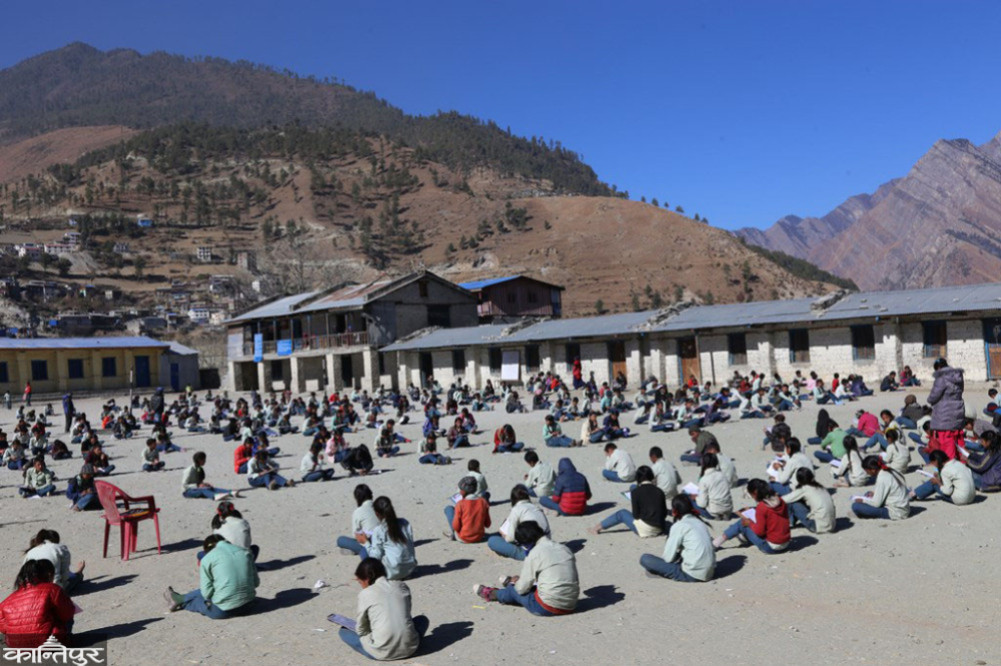
For decades, the trend of appointing qualified teachers through political favors or bribes, without making permanent appointments through the Education Service Commission, has destroyed community school education.
We use Google Cloud Translation Services. Google requires we provide the following disclaimer relating to use of this service:
This service may contain translations powered by Google. Google disclaims all warranties related to the translations, expressed or implied, including any warranties of accuracy, reliability, and any implied warranties of merchantability, fitness for a particular purpose, and noninfringement.
The ground reality of destruction
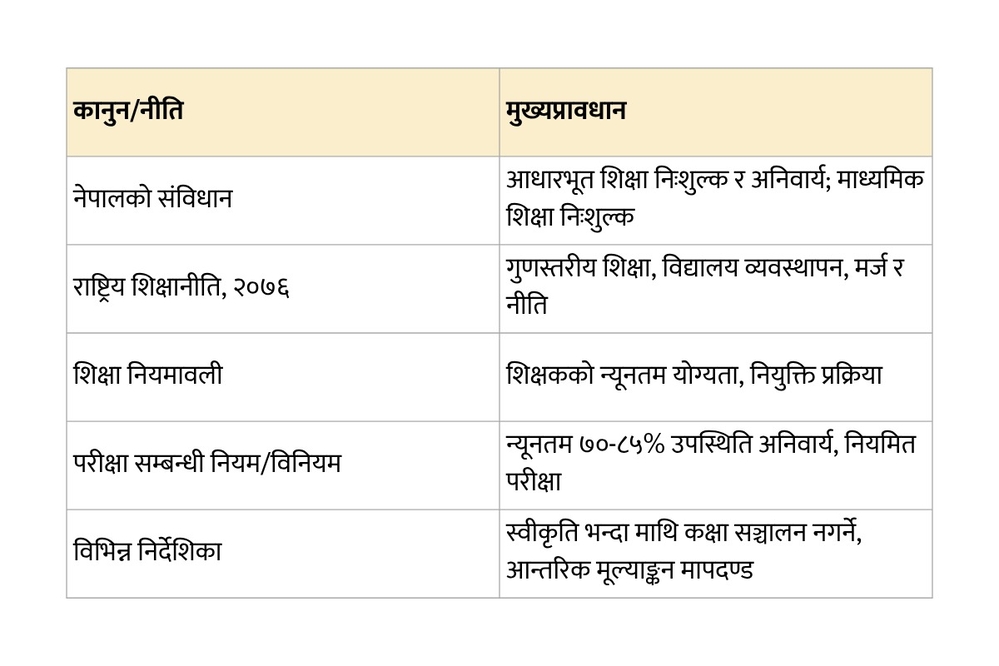
The Constitution of Nepal has established education as a fundamental right. The state has given a constitutional guarantee that ‘basic education shall be free and compulsory, secondary education shall be free.’ However, today’s reality is different – about 7 million students are enrolled in schools across the country. About 211 billion rupees are spent on education annually for them. But, the result? Half of the students in grades 4-5 of community schools do not even know the alphabet, 1-2-3, and ABCD well. This plight is not limited to schools – even universities of higher education do not follow the academic calendar and there are widespread irregularities in examinations. As a result, a crowd of ‘educated’ people is being produced who are not fit for the labor market.
Important fact
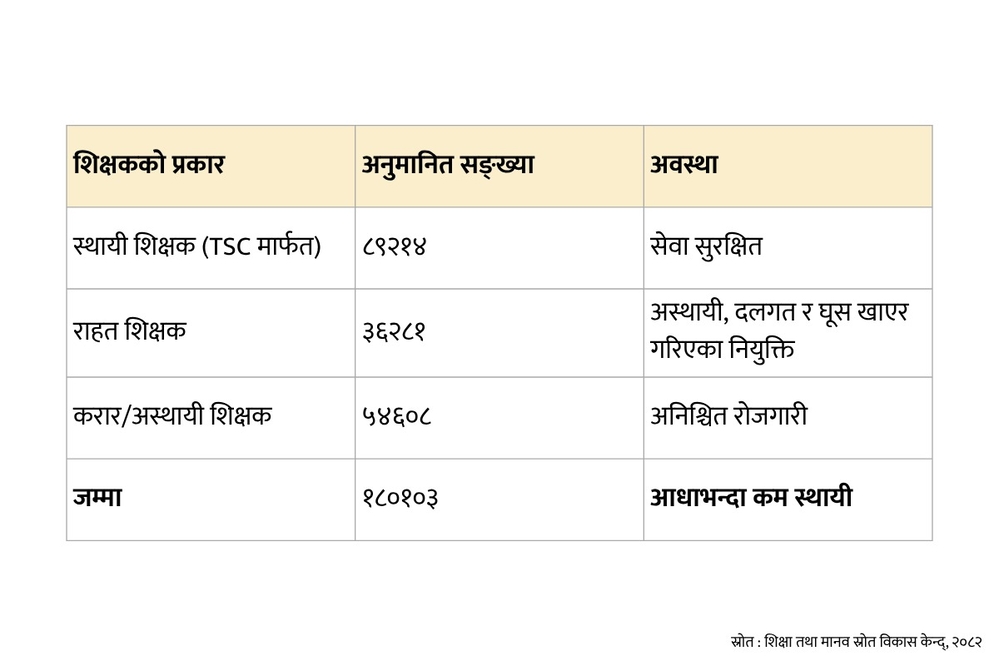
Neither the academic calendar is followed in universities, nor are exams regular! As a result, the country is producing a crowd of people who are 'educated' but do not work according to the demands of the labor market. The number of enrollments in community schools is continuously decreasing. According to the report of the Ministry of Education-2082, more than 40 percent of community schools do not have full-time principals. There are a total of 180,103 teachers in community schools in Nepal. Of these, only 89,214 (about 49 percent) are permanent teachers. The remaining 90,889 teachers are relief, private source, contract and other temporary teachers.
For decades, the trend of appointing relief, private source and contract teachers by sidelining qualified people and accepting bribes has destroyed community school education. On the other hand, there is no room to argue that the state has to resort to temporary instead of qualified human resources. If we look at the data of the Teachers Service Commission for the past four years (from 2079/80 to 2082/83), a total of 746,102 youth applied for teacher teaching licenses at both secondary and lower secondary levels. Out of them, 152,084 qualified personnel have passed the exam and obtained their certificates after overcoming stiff competition. This data proves that more than 1.5 lakh skilled personnel licensed for teaching are ready to serve in the market at any time. While such a large number of licensed and competitive youth are unemployed on the streets, maintaining more than half of the teachers in schools on temporary and relief basis can be nothing but the culmination of policy deviation and the state's managerial apathy.
Review of SEE exam results
SLC started being called SEE from 2071. Every year, about 5 lakh regular and part-time students participate in this class 10 exam. There are about 2,000 examination centers across the country.
The passing percentage in the exam has improved in recent years. However, there is a huge gap between the results of community and private schools. The passing rate of community schools has always been much lower than that of private schools. According to the 'National Student Achievement Assessment', one-third of grade 8 students have a minimum level of knowledge in mathematics, while more than half of grade 5 students do not know how to write a correct sentence in Nepali.
Arbitrary internal evaluation
There is a widespread trend of schools giving 'A-plus' or 'A' in internal evaluation, but those students fail by failing to score 35 percent in the final exam. This fact can be seen by looking at the students' mark sheets. There is no need to make a new law to stop this irregularity; it is enough to implement the existing law that provides for withholding grades and other actions against the concerned principal.
Reasons for the poor condition of community schools
Why is the quality of education in community schools poor? The main reasons for this are as follows:
a) Political interference and the prevalence of ‘super head masters’
In community schools, there are ‘sirs’ of political parties who are more powerful than the principals, who also control the headmasters. Teachers are appointed, transferred and posted with the interference of local leaders. This is especially widespread in Madhesh as a ‘super head master’ system.
b) Abundance of incompetent and temporary teachers
More than half of the teachers are relief, private sources or contract, who lack qualifications and accountability. Such teachers are not appointed after passing the aptitude test and the service commission. It is natural to question the qualifications of those who become teachers based on political parties, personal access, bribery, etc. In private schools too, in some places, it is found that those who have passed grade 10 are taught only up to grade 8-9-10.
c) Low attendance of students in class
About half of the enrolled students never attend class. In the Terai, these are called 'sleeping' students. There are those who do not come to class and only 'attend' internal assessments.
A vivid example of this is the data from the on-site monitoring conducted in 9 community schools of two local levels (Bishnupur Rural Municipality and Kanchanrup Municipality) of Saptari a few days ago on a Friday. A total of 2,208 students were found to be registered (enrolled) in the community register in the monitored schools. However, only 1,313 were present in the classroom on that Friday. This shows that 40.54 percent of the total enrolled children, or almost half, are in a 'sleeping' state, who are only limited to paper but do not step foot inside the school premises. This data proves that the rate of ‘sleeping’ students in schools in Kanchanrup Municipality is even more alarming, where 43.94 percent of students are absent from class and are just waiting for internal evaluation and marksheets. In Bishnupur Rural Municipality, about 39 percent of students do not come to school.
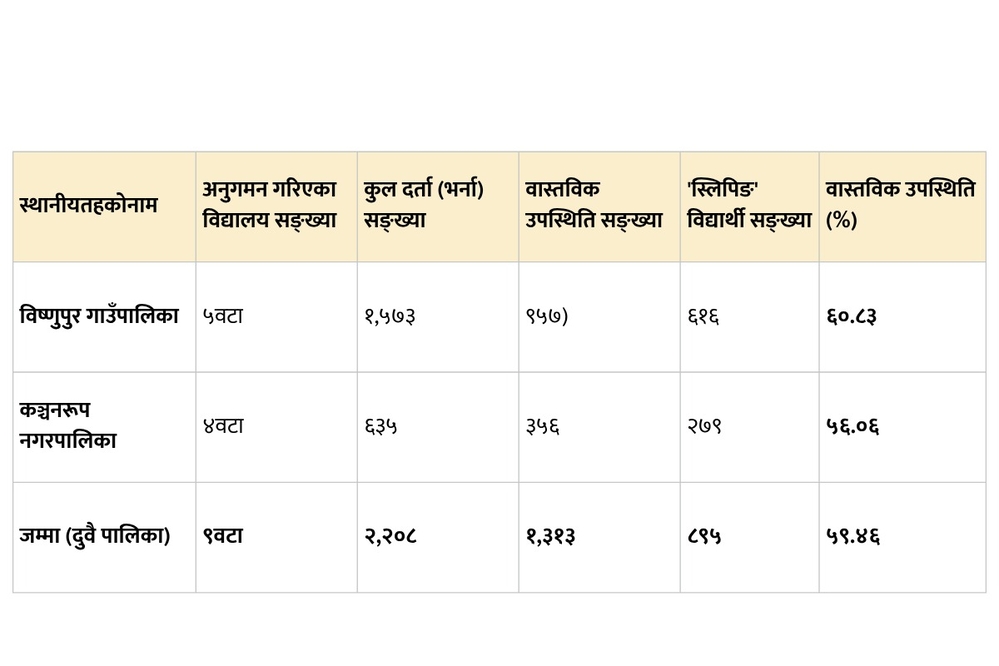
These data make it clear that children from Dalit, marginalized and poor families dependent on wages in the Tarai have stopped coming to school due to family compulsion and lack of awareness. This ‘sleeping’ disease, where names are on the register but classrooms are always empty, is ultimately making the quality of community education just a means of digesting government subsidies day after day.
d) Widespread irregularities in examinations
‘Center setting’, ‘flap’ and irregularities in copy checking allow even those who have not studied to pass. There is a tendency to make everyone pass even if most students in the same examination center have the same answer.
e) Dual enrollment and illegal practices
The Constitution of Nepal has placed the full responsibility of education up to the secondary level in the sole list of rights of the local level. But, ironically! Local public representatives themselves have not been serious about improving the condition of community schools. Although some community schools that can be counted on the fingers of the country have done exemplary work, it is numerically insignificant.
A new type of educational crime is now being institutionalized across the country, that is – ‘dual enrollment and paper students’. Families with means and access pay expensive fees to send their children to private (boarding) schools. However, to avail government services and facilities and scholarships and to take advantage of government quota in SEE, they register their children’s names in the Integrated Educational Management Information System (IEMIS). This trend of studying in private schools but taking exams from community schools is not only a legal crime, but a great blow to the future of the entire society and the nation.
On the other hand, the tyranny of private schools that add classes without permission is equally rampant . Some private schools that have permission to operate only up to class 5 or 6 are illegally teaching up to class 10 . To hide this illegal act, they make upper-class students take the exam by 'paper-filling' in a nearby community school .
There is a strong nexus between the people's representatives themselves, the management committees of community schools, teachers and people with a grip on the local power structure in this heinous crime . Most local leaders are afraid to take action and regulate this educational mafia system due to the fear of losing their 'vote bank' and losing the election .
f) Misuse of national investment in education
The action plan to make only 422 schools 'model schools' out of 25,623 community schools is unscientific . The annual report of the Auditor General has shown that the annual investment of Rs 145 billion in school education has not been utilized properly.
Similar situation in higher education
Tribhuvan University is the oldest and largest university in Nepal. Established in 1959, this university currently has 460,632 students and 7,838 teachers. Its budget is Rs 26.169 billion. This university also holds the 'Guinness World Record' - the record of more than 73,000 students receiving degrees in a single convocation ceremony. However, this university also holds other records:
- It takes 5 years to complete a 3-year course. The academic calendar is not followed.
- The CMAT exam for MBS (Management) had to be conducted twice due to lack of students.
- The MBM program was closed due to lack of students.
– MBA Marketing and MBA Corporate Leadership are operating at only 75 percent capacity .
– 21 constituent campuses are in the process of merging .
– The curriculum is outdated and not in line with the demands of the labor market .
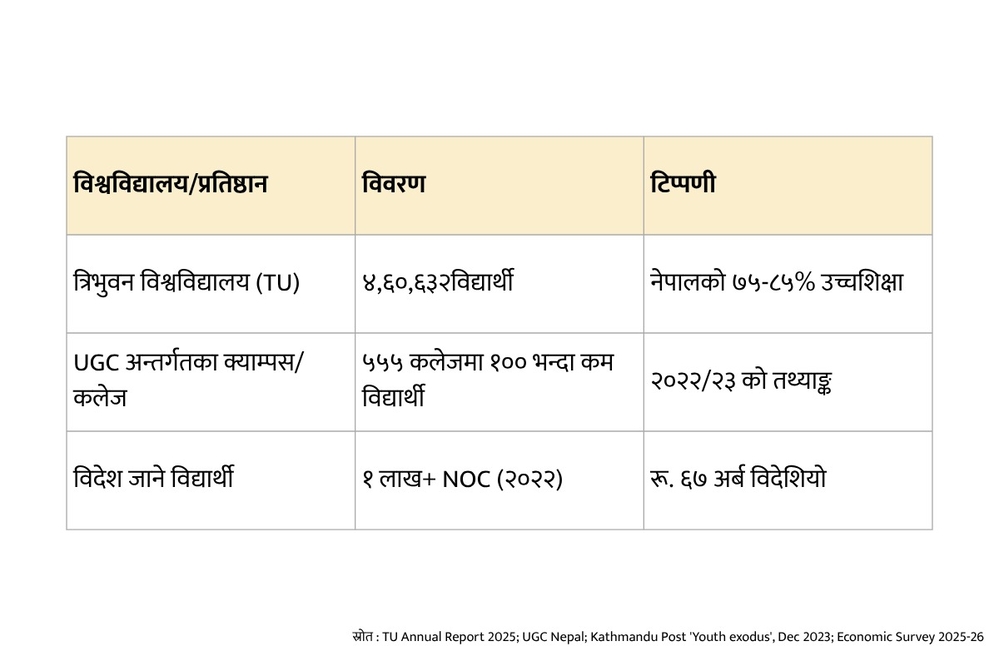
Mischief by employed students
Thousands of people working in government jobs in Nepal are simultaneously attending an office and obtaining certificates as ‘regular students’ in private colleges hundreds of kilometers away . According to university rules and regulations, at least 70 percent attendance in classes is mandatory . This illegal work is done for this:
– A higher-level certificate is required for the job,
– Enrolling in a private college,
– Passing the exam only through ‘center setting’ without ever going to class,
It does not take more than a week to find this evidence of corruption . When checking the ‘employment period’ and ‘date of certificate’ of the employee, everything is revealed . Tens of thousands of such 'fake' degree holders are in government service. It is the government's job to find and take action.
Irregularities in examinations
There are widespread irregularities in the examinations of universities and affiliated/affiliated colleges:
– Most private colleges provide 'home centers', exams are held on their own premises, after which the results naturally become high.
– The practice of 'center-setting' and 'flap' is widespread, the government should monitor it in a pseudo-manner.
– There is widespread arbitrariness in copy checking and 'scrutiny'.
– Although there is a legal provision that at least 70 percent attendance in classes is mandatory, attendance is usually not practiced in colleges.
Crimes against the poor: Class division in education
There is a serious violation of social justice in the education sector in Nepal:
– ‘Hunekhane’ sends children to private schools but ‘EMIS’ sends them to community schools and SEE is provided from community schools
– Government scholarships for higher education are given to the children of the rich, the poor always lag behind
– They send students from 5-6th grade to 10th grade with permission and ‘EMIS’ of private school students to the nearest community school. In this way, government resources are being spent in the name of the poor for the rich. This is a serious ‘structural crime’ that cheats both the poor citizens and the nation.
Unimplemented laws
There is sufficient legal basis for education reform in Nepal. These legal provisions are good on paper, but the problem is in implementation. For example, despite the government’s directive to ‘not run classes above the approved’, this crime continues throughout the country. And, it is more widespread in the Terai districts. The government agencies, local levels, and school administrators who are responsible for stopping it have all agreed, but they are silent.
The main message of solving this and similar problems is that new laws do not need to be made to improve the quality of education. Even if existing laws are strictly implemented, major changes are possible.