It is clear that a federation cannot be formed without states. Therefore, the end we will reach through the practice of building a state structure without states is the end of federalism. That is, the end of the current constitution.
We use Google Cloud Translation Services. Google requires we provide the following disclaimer relating to use of this service:
This service may contain translations powered by Google. Google disclaims all warranties related to the translations, expressed or implied, including any warranties of accuracy, reliability, and any implied warranties of merchantability, fitness for a particular purpose, and noninfringement.
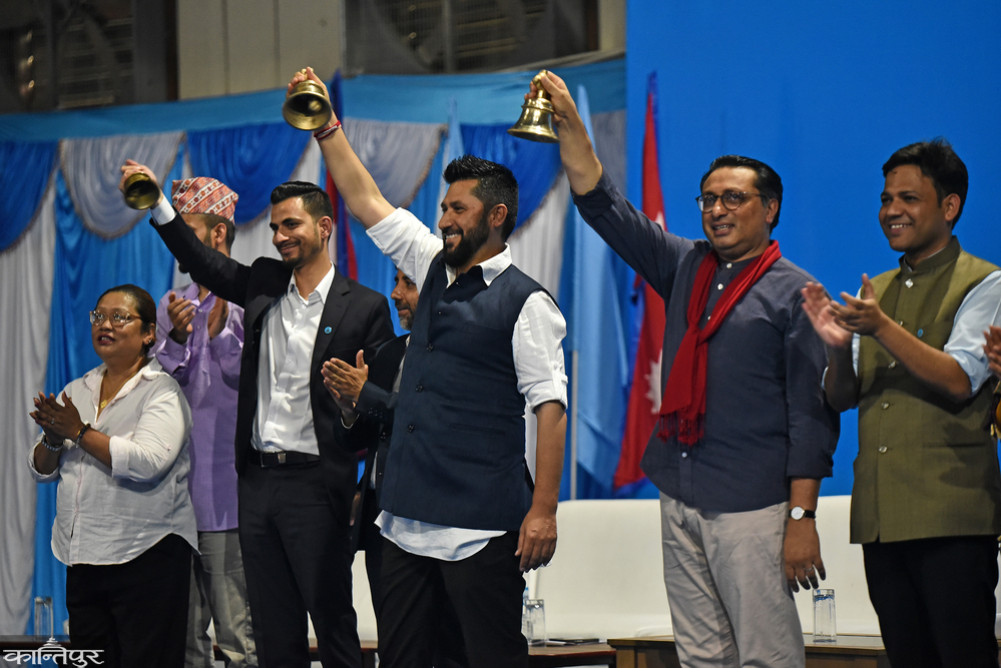
The first convention of the ruling party Rashtriya Swayamsevak Sangh (RSS) has concluded. Due to the documents presented and made public by its leadership, the attention of the entire country was focused on this convention. But at the moment, the economic and political proposal presented by the party's Vice President and Finance Minister Swarnim Wagle is in the news. It says - 'Restructuring of federalism with the abolition of the provincial assembly.' The entire country is shaken by such a proclamation. Moreover, it is very suspicious.
On the one hand, the RSSP government has formed a task force to prepare a constitutional amendment debate paper to amend the current constitution. The task force is also continuously communicating with the stakeholders. Wagle, who had been shouting 'We will amend the current constitution the day we reach our numbers and strength' a year ago, had managed to say '...restructuring of federalism with the abolition of the provincial assembly...' at that time. He had said that the provincial assembly was used as a place for cadre management (parking) by the big parties (then Congress, UML). Today, with its own government formed and a Prachanda majority in the parliament, the party general convention held in Chitwan has given further strength to the old statement.
Since the restoration of federalism in the country, a section has been engaged in creating a narrative that this state system is expensive and difficult for a poor country like Nepal to sustain. One of them is Swarnim Wagle, who is also an economist known as an educated person. Overall, the current state of mind of the political forces driving the 'express vehicle' of power is meaningful. There is widespread concern that this will push the nation towards another new political conflict.
This political force, which claims to be different and innovative from the old forces, while expecting effectiveness in the role of the province, should have realized the reality that the centralist mentality existing in the ruling power and the liberal behavior in the lawmaking necessary to guarantee autonomy are the main problems. How and in what form should the provincial governments under the federal structure be allowed to operate? It would have been possible if those issues had been taken forward to follow from international practice. It would have been possible to discuss how our young federal state system, which is approaching a decade old, could have been modified and made sustainable. Which would have been a real indicator of a progressive and innovative force. But why did the mentality of the dissolution of the provincial structure develop? What does this indicate?
Federalism is not only a state system, but in reality it is also a political ideology in itself. Therefore, it is considered not only in the form of the state but also in the form of 'federalism'. In the early 17th century, German philosopher John Althus, while advancing the idea of federalism as a new principle, had mentioned that this would develop the ownership of the state administration of all parties, classes, communities and regions within the country and would sustain national unity. The United States of America came into existence in 1789 as a good political practice to unite the different governing units in North America, which had recently become independent from the British colonies, with the common interests of defense and economic development. This is the world's first federal structure. The Swiss Federal Confederation was formed in 1848 as a way to bind the diverse and scattered 26 'cantons' into a single system through a written constitution. Today, more than 28 countries, including neighboring India, Pakistan, Malaysia, Australia, Iraq, the United Arab Emirates, Mexico, South Africa, Russia, Brazil, etc., are in a federal structure.
The goal of federalism is basically to develop a common sense of belonging to the state in a diverse, pluralistic society and to strengthen unity among them. The basic political belief under this is - inclusiveness, representation and collective responsibility of all in the operation of the state. Therefore, the principle of this state system says - guarantee of rights, distribution and partnership. It does not accept centralized power. For its practical implementation, the state is made hierarchical. Considering their respective social, geographical characteristics, needs and originality, states, provinces, emirates, cantons are named somewhere, Nepal's provinces are in those basic forms of federalism.
Similarly, local units are found in the form of communes, municipalities, counties. But these hierarchical structures are not geographical and demographic boundaries determined for administrative convenience. They are autonomous governments with legislative and administrative powers that can make their own decisions. In reality, the federal structure is completed by governments at various levels. Generally, the federal structure is understood as an integrated form of the center, provinces, and local levels. Therefore, while dividing the powers constitutionally, it is said that the real meaning of federalism is common governance at the center and autonomy and self-government at the provinces and local levels. This is the international recognition of federalism and the practice to this day.
The question at this time is – what form will our state structure take if the provincial assembly is abolished as the ruling party is currently proclaiming on the basis of majority? If there is no provincial assembly, who will play the legislative role for the provincial level and how? Who will play the executive role at the provincial level? Will the return of the zonal governors be made at the behest of the center in the style of governance adopted by the autocratic, non-party system? In that case, on what basis will the relationship between the center and the provinces be determined?
The way in which responsibilities and duties have been decentralized since the existence of provincial and local level governance has made it easier for service recipients in many contexts including judicial administration. The selection and operation of development projects is becoming decentralized. However, the abolition of the provincial assembly means a ban on multiple constituencies and multiple community representation. Citizens will not have the opportunity to make their own decisions in the formulation of laws and regulations at their own level. Rather, the dominance of the center will continue to strengthen and only certain classes, regions, and communities will dominate at the policy-making level.
It is clear that a union cannot be formed without provinces. Therefore, the end we will reach by practicing the practice of building a state structure without provinces is the end of federalism. That is, the end of the current constitution. Therefore, the announcement of the abolition of provinces is actually an unthinkable accident-oriented political announcement.
On the other hand, federalism in Nepal has a different history. Its inter-story is connected to the then context of the Terai National Congress led by Vedananda Jha. If we follow the voice of almost seven decades, the contribution of Nepal Sadbhavana Party and its leader Gajendra Narayan Singh is also revealed in this line. For a long time, the long struggles and people's movements waged by the Madhesi people of Nepal in various periods and the blood of the Madhesis who died in them have been written in the blood of the Madhesis - the saga of federalism. Similarly, the current federal structure is intertwined with the desires of the marginalized indigenous communities, the neglected people of the Far West, the Dalits and the Muslims. Federalism and the provincial-level structure under it are a system chosen in the desire for fair representation, access to the decision-making level of the state, and decentralized management of development.
The system established after the long struggle, sacrifice, and various forms of movement and rebellion by the Nepali people against the ruling power that the feudal monarchy had accumulated in the palace premises, is today's federal republican democracy. Let everyone remember this. Not every page, line, and sentence of the Constitution of Nepal-2072 is structured in the same way, although there are disagreements and different opinions in them. The indigenous people, Madhesi, Tharu, Muslim, Dalit, and women's communities consider further amendments to the constitution necessary. They are still agitating for that. The desire of those classes and communities is to make the constitution more advanced, progressive, and contemporary.
On the eve of the general election held on 21 Falgun, Balendra Shah, who reached Janakpur to seek votes from the people, had expressed his commitment to the general public - 'Many people ask in Kathmandu and Janakpur too, what is the National Independent Party's view on federalism and provinces?' I say, the province should be made stronger.' These are the words of 5 Falgun. Going further, he had said - 'The province should be made so strong that it is not necessary to go to Kathmandu, all the arrangements should be made in the province. Kathmandu should only be a place to visit Pashupatinath and Swayambhu and visit, not a place to demand rights.' Perhaps, those who became hopeful about the autonomy of the province through these sweet commitments of his got a lot of votes and power. Today, the government is under his leadership, and Wagle, a senior minister in his cabinet and a senior leader of the party, is saying - abolish the provincial assembly.
Due to its strong presence in parliament, there will be no immediate 'red signal' on the stability of the RSP-led government. But the way the issue of 'abolishing the provincial assembly' is being presented now, it is certain that the entire politics of the country can become unstable. Unimaginable conflicts can arise.
Ultimately, the question is – is the Rashtriya Swayamsevak Sangh (RSS) trying to dismantle the constitutional structure of federalism that was achieved through the sacrifices and renunciations of the people? The immense public opinion it has received is waiting for an open response today.