Recently, a frightening scenario of civilized caste discrimination has begun to emerge, even through digital means.
We use Google Cloud Translation Services. Google requires we provide the following disclaimer relating to use of this service:
This service may contain translations powered by Google. Google disclaims all warranties related to the translations, expressed or implied, including any warranties of accuracy, reliability, and any implied warranties of merchantability, fitness for a particular purpose, and noninfringement.
‘Madam, a person like you cannot be a Dalit!’
He was praising me repeatedly – ‘And the ‘Shahi’ surname cannot be a Dalit.’ Despite having the documentary evidence of the Dalit community in his hand, he was not satisfied at all. He was attacking discrimination in civilized language. He did not need to talk about the matter. He was repeatedly discriminating by being surprised that my surname was Shahi and throwing sweet words about not looking like a Dalit. When it was too much, I asked, ‘What should a Dalit look like?’ Then the employee was stunned, no answer came.
A few months ago, an employee at the Land Revenue Office in Bardiya committed civilized discrimination against me. The Dalit community has to face a lot of incidents of rude discrimination using civilized words. ‘Which Shahi are you? Where is Shahi? Which clan?’ – I was put on the dock of all these questions and in the end I also experienced discrimination in civilized language saying, ‘You don’t look like a Dalit.’ Is surname so important? Isn’t being a human being enough in itself?
Two years ago, I had nominated a candidate for the post of secretary from the Dalit quota in the Federation of Nepali Journalists’ elections. I belong to the Pariyar community and write the surname Shahi. How did Dalits give me the right to write Shahi just because I write Shahi? I was even threatened with a lawsuit by the leader of the so-called Thakuri society. Other candidates were working hard to garner votes in the election. But I had to endure the stress of gathering evidence of my caste and clarifying it. I had to endure insults and inhumane treatment. One caste believes that if the Dalit community changes its surname, discrimination will disappear. Another believes that there is no discrimination if you don’t say Dalit.
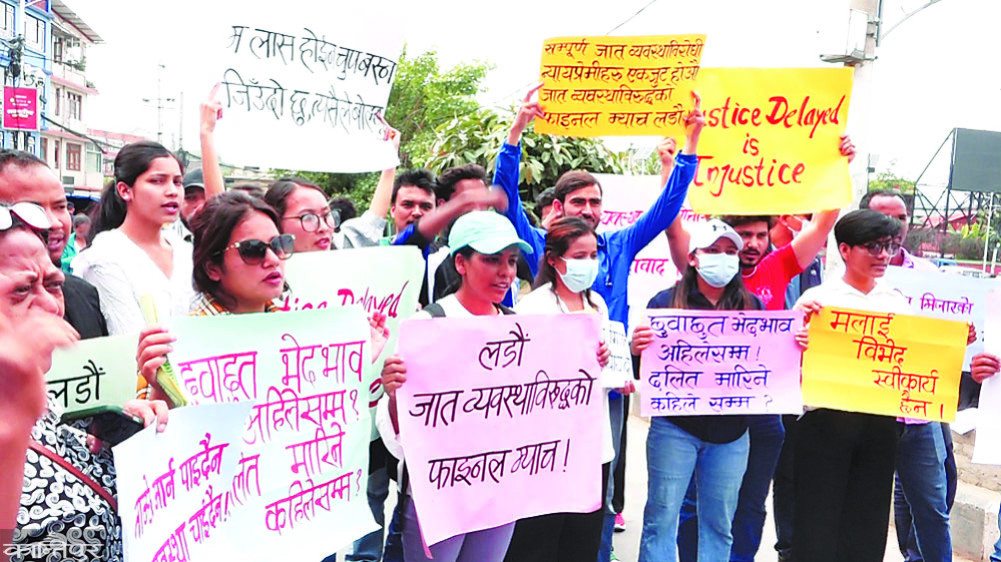
Recently, a Satyagraha has been ongoing under the leadership of rights activist Deepa Nepali against the discrimination being done by landlords in the civilized city of Kathmandu against the Dalit community when they are looking for housing. However, all these are not problems of changing or not changing the surname. The solution to the problem is to transform the thinking. Rather than experiencing discrimination, it is necessary to clean the dirty mentality of those who discriminate. And, it should start from the state. The government had promised to apologize and apologize for the discrimination that has been done against Dalits for centuries. Which is yet to be formally seen in the parliament. The pain of directly experiencing untouchable behavior from friends and teachers in schools, temples, and in Dhara-Pandhera during childhood still haunts me. I thought that I would not have to suffer that wound after coming to the city. When I came to study in Kathmandu, I found even higher and more civilized discrimination here.
Even after two decades since the government declared the country untouchable, caste discrimination has not been eliminated in society. According to Dalit rights activists, discrimination is still rampant even after the political transformation. Even after the political change of 2062/63, heinous crimes of murder and rape against Dalits are increasing due to caste discrimination. The form of discrimination against Dalits is the same from Pandhera to Dera.
Even in Kathmandu, a city of educated and civilized people, the Dalit community has had to face many forms of discrimination. Recently, a satyagraha led by rights activist Deepa Nepali is continuing against the discrimination being committed by landlords in the civilized city of Kathmandu against the Dalit community when they are looking for a house. The satyagraha, which has been going on for over a month, has raised the voice of the government and society to guarantee human rights.
In Maitighar Mandal, youth are questioning the government by saying, ‘Is the room empty, government?’ However, the question of this youth has not yet been answered.
In the 21st century era, let's say in the digital era, what else could be more ironic than wasting one's life's energy searching for an identity as a human being? Youth are the driving force behind learning and development. Nearly 14 percent of the total population of Nepal is Dalit and forced to deal with caste discrimination.
Nine years ago, Deepa of Ghodaghodi Municipality-4, Kailali, came to Kathmandu to pursue higher education, envisioning a bright future. She thought that a civilized city would raise the level of consciousness. However, here she found the exact opposite. How can a city that cannot provide people with a dignified residence produce educated manpower? After knowing caste, her struggle against the discriminatory thinking of not even providing a room began. 'What is the point of being educated if you have no self-respect?' She says, 'The city is not as civilized as you think.' City houseguests know dogs but not people.'
Recently, a frightening scenario of civilized caste discrimination has begun to emerge even through digital means. Not only do houseguests discriminate by asking for surnames while searching for a room, but room finder digital platforms have also openly discriminated against caste.
On Facebook, 'Niwas Solution Private Limited' had posted a notice of a vacant room and wrote 'Room for Chhetri, Bahun Only'. This confirms the digital dimension of discrimination.
The discrimination against the Dalit community is different from others. This is extreme discrimination against humanity. The discrimination suffered by our ancestors is still alive in the present generation. Only the form and style are different. The network of civilized discrimination suffered by the Dalit community is everywhere. The Dalit community is forced to endure humiliation because it is difficult to gather evidence for its legal remedy.
The consciousness of young people like Deepa is now asking this question. With society and with the government. A community that does not know the difference between people and humanity and discriminates is an unconscious community and harmful to society. The government itself should address the cry of humanity that is screaming in the Maitighar Mandal.