Only when the people truly experience good governance will it make sense for Ravi Balen to pass the ball. Otherwise, the series of suicide goals will continue to increase.
We use Google Cloud Translation Services. Google requires we provide the following disclaimer relating to use of this service:
This service may contain translations powered by Google. Google disclaims all warranties related to the translations, expressed or implied, including any warranties of accuracy, reliability, and any implied warranties of merchantability, fitness for a particular purpose, and noninfringement.
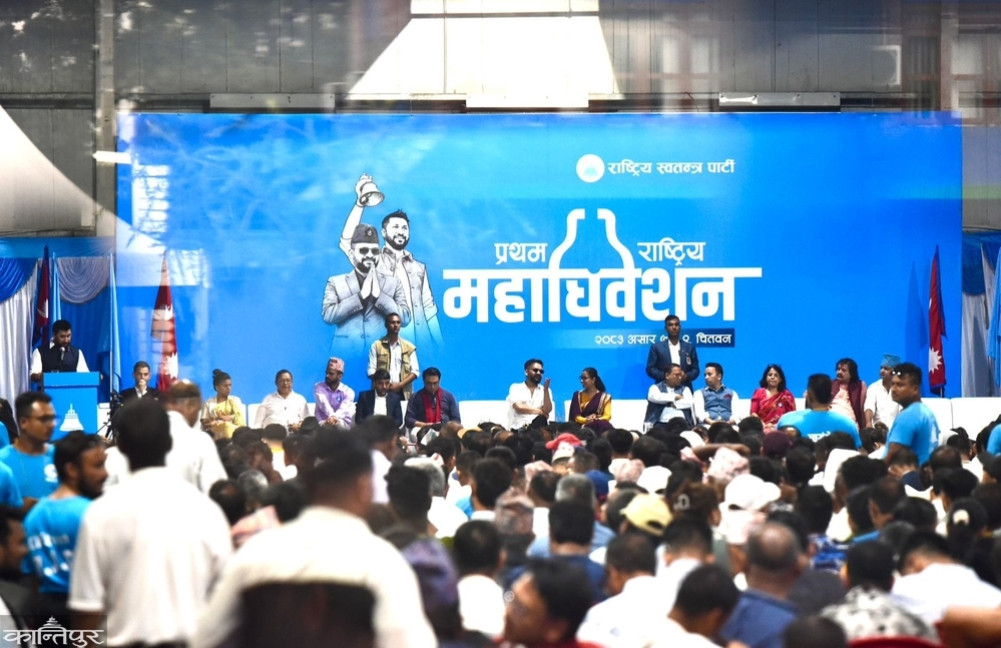
The World Cup 2026 is underway. While football fever is gripping all sports lovers, the National Independent Party (NISP) has completed its first national convention. What is the relationship between football and the politics of the NISP? In fact, there is no direct relationship between politics and football. However, football is frequently used as a 'metaphor' in politics. For example, speaking at the inaugural session of the first convention, NISP President Ravi Lamichhane used 'goal' as a metaphor. He said, 'The NISP has already put the ball in Balen's feet to run the government before the elections. Now it is the responsibility of Prime Minister Balenji to score goals. Even if the ball falls to my feet by mistake, it is my responsibility to pass it to that same foot.'
While football is on the minds of sports fans, Ravi's symbolic expression that 'it is now Balen's responsibility to score goals' has caught the attention of many. By saying this, while the leadership renewal exercise is underway from the general convention, he was probably clarifying that there is no conflict between Balen and himself. It is a pleasant matter that the understanding between the ruling party, and moreover the two main leaders within the country's powerful party, continues to exist. But, how much of that understanding was superficial? How much strategic and how much cosmetic? Was the RSVP leadership able to adopt harmony and new political culture as he claimed? Did the general convention strengthen internal democracy or further weaken it? Is Ravi confident in his heart that Balen will play the role of a dynamic political 'striker'? Or is he waiting for the right opportunity to 'strike' himself? And, does Balen himself consider Ravi a 'playmaker' or does he consider himself a 'playmaker'/'striker'? Many such questions have arisen after the general convention. In this column, an attempt has been made to observe the RSVP through the window of the general convention in the light of these questions. Let's start with a brief review of the general convention.
The well-wishers of the RSVP claim that the first general convention institutionalized this party. The leadership of founding president Ravi has been renewed. The nationwide organizational network has expanded. The central members, of which almost half are women, have been elected through the voting process. Some office bearers have also been elected. However, these insignificant achievements do not confirm the significance of the RSVP general convention. In fact, the first general convention of this new player in the Nepali political arena has been a victim of extreme mismanagement and immaturity. In the language of football, the Rashtriya Swayamsevak Sangh (RSS) has elected a new leadership amidst ‘fouls’.
The RSS played its first ‘foul’ in the inaugural session itself. Where leaders of other parties including the Congress, UML and others were also present. For any party, the general convention is a democratic celebration. It is an old tradition to invite neighboring parties to such celebrations. In the past, parties including the Congress, UML and Maoists also used to invite other parties. The RSS did the right thing by adopting that tradition. However, this party could not be tolerant towards the guest it had invited and resorted to insulting the participating guests, which brought the political culture of the RSS into question.
While participating in the general convention, on the one hand, Congress President Gagan Thapa was showing high political culture and maturity, and he seemed balanced in supporting and criticizing the Rashtriya Swayamsevak Sangh (RSS) based on its merits and demerits. At the same time, the RSSW workers were ‘hooting’ while UML leader Pradeep Gyawali was speaking. Moreover, MP Khagendra Sunar called the guest a ‘criminal and corrupt’. The RSSW made the leaders of the rival parties feel uncomfortable by making them ring their election symbol ‘bell’ during the inauguration. After handing over the bells to the leaders of other parties during the inauguration, ringing them was not such a big issue. However, these activities of the RSSW to intentionally make the leaders of the rival parties uncomfortable were ‘foul play’.
The second ‘foul’ was found to have been committed during the expansion of the organization. The report presented by the General Secretary at the general convention showed that 35,000 children under the age of 18 are members of the Rashtriya Swayamsevak Sangh (RSS). This is not the first incident of child abuse in politics. In the past, other parties have also been criticized for using children in armed rebellions, street protests, and rallies. The RSSS, which has emerged as an alternative force by calling for a new political culture, also appeared insensitive to child rights. Moreover, the party, which is advocating the abolition of student organizations, has questioned its intentions by organizing children as party members in violation of existing laws and international conventions on child rights. The RSSS failed here too.
The third ‘foul’ was found in many places during the internal democracy exercise. Before the start of the general convention, ‘fouls’ began to be played from the issue of preparing the final list of delegates. Extreme chaos was seen in the management of various groups and campaigns within the RSSS. There was also no consensus on the number of delegates to the general convention. Initially, it was said that there would be around 3,000 delegates. Later, it was said that it had reached around 4,400. The list of delegates was not made public. On what basis and how were they selected? It is not clear, it has not happened yet. The series of
irregularities was not limited to the selection of delegates and the publication of the final list. It was also seen in the publication of the list of candidates. The voices of claims, protests and dissatisfaction had disheartened the cadres who had gathered in Chitwan. The repeated revision of the election schedule and the absence of closed sessions at the scheduled time made the cadres even more angry. Some returned without taking part in the voting after the general convention was extended. About 1,500 had left Chitwan without taking part in the voting process for the central members. That number increased further when it came to the election of office bearers. According to the news, only about thirty percent of the delegates voted. Even though the elected representatives celebrated happily, the legitimacy of the general convention, where seventy percent of the delegates did not participate in the voting, automatically raises questions. More importantly, the RSP repeatedly promised not to form factions. However, in practice, the president himself got involved in factions. Even though the panel was not formed and the election was not contested, influential leaders, including the president, openly stood in favor of candidates close to them in the office bearer elections.
The domestic situation of the RSP, which emerged as an alternative force by protesting that ‘other parties destroyed internal democracy,’ was even more difficult. There was no discussion on the reports submitted by President Ravi Lamichhane, Vice President Swarnim Wagle, General Secretary Kavindra Burlakoti, and the Treasurer. Instead of a deep and meaningful discussion, the reports were announced to have been passed in a haphazard manner. The circle that criticized the RSP for being ideologically ambiguous has proven to be right here.
It is true that the leaders of the Rashtriya Swayamsevak Sangh (RSS) have said that they have made mistakes and will continue to correct them. However, these 'fouls' seen in this party at this time are not ordinary mistakes, they will affect the party's democratization and institutionalization campaign, and may also be 'suicidal' for its future destiny.
Even more worrying is the 'position' taken by this party on some issues of constitutional amendment from the general convention. Comments have started to be made that Ravi's political report and Swarnim's economic and political proposal approved by the general convention are contrary to the essence of federalism. There has been a superficial commentary in Nepali society that federalism and provincial assemblies have become financially burdensome. The RSS has taken note of this and put forward the agenda of abolishing the assembly and restructuring federalism. Similarly, he has stood in favor of the arrangement of a directly elected executive, reforming the electoral system to a fully proportional one, transforming the National Assembly into an assembly of non-party experts chaired by the Vice President, and reducing the number of local levels and non-party elections.
In fact, none of these issues are new in terms of discussion. These issues have been debated from different angles for the past ten years. However, now that a strong party with almost two-thirds of the votes in parliament has taken a position and put forward these issues, interest has increased everywhere.
In fact, leaders including Ravi have repeatedly expressed their commitment to the federal democratic system. However, is the position he has taken on the issue of amending the constitution just a lip service? Doubts have arisen.
Federalism, inclusiveness, secularism, etc. are progressive political achievements institutionalized by the Constitution of Nepal. The Rashtriya Swayamsevak Sangh (RSS) and its leadership are not able to 'turn on' them from the heart. The Constitution and the current political system were formed by the Constituent Assembly on the basis of many ethnic and regional identity movements including the People's Movement and the Madhesh Movement. This constitution is a conceptual document that includes the marginalized classes and excluded communities in the mainstream. It has made progressive arrangements with important elements such as republicanism, secularism, federalism and many fundamental rights. It is not without weaknesses or scope for improvement. Since its inception, the issue of including those dissatisfied with the constitution and amending it has been raised. However, due to the tendency to make the constitution a medium for power politics and power exercises, this is limited to the subject of debate. The constitution, which has been targeted by foreign powers and interests, has also been neglected by domestic political forces. In this context, can we bear the consequences of trying to manipulate it based on superficial commentary without a thorough and in-depth review of its contents? It will not only cause unwanted political polarization, but will also plunge the country into another conflict.
In the past, the post of Prime Minister became a playground for a few limited leaders. Moreover, after the three top leaders created a 'musical chair', the advocacy of a strong executive head was in the media discussions. It has also created a strong public opinion in favor of a direct executive. However, it has not been possible to make a Prime Minister accountable to the Parliament, can we afford a directly elected executive? Our practice has shown that the practice of individuals being stronger than institutions increases the risk of fostering authoritarian tendencies. Whether it is the current Prime Minister or the previous ones, everyone has a desire to exercise unlimited power. Moreover, the opaque and irresponsible working style of the current Prime Minister Balen is enough to shock. This context raises the question, doesn't the intention of the RSP to use so many provisions of the constitution attack the essence and soul of the constitution?
Certainly, the 'performance' of the province is not satisfactory. However, the abolition of its provincial assembly will not only prevent the effective implementation of federalism, but also attacks the provincial, political autonomy and rights guaranteed by the constitution. The RSP has taken a 'position' on the above issue of constitutional amendment without deep discussion both within and outside the party, which could be 'suicide' for its politics.
After seeing the plight of the RSP in the general convention and the poverty of political consciousness among its workers and MPs, it must be said that it will have to spend its main energy and time strengthening and institutionalizing its internal life. It has immense public opinion, at this time. However, it does not have the appropriate software required for the party and the operation of power. Ravi has the responsibility to make his MPs, workers and leaders, who do not have even the minimum political awareness, politically/constitutionally 'literate'.
Ravi is now not only the captain of the RSVP team, but also in the role of 'midfielder'. 'Midfielder' is also called 'playmaker' in the language of football. In politics, 'playmaker' is a strategist. It also plays a coordinating, coordinating and leading role. Ravi is in that role. Perhaps that is why he talked about passing the ball to Balen's feet. But, is Balen a 'striker' capable of scoring goals? Has the RSVP's 'playmaker' now been able to keep the 'striker' in check? Balen is neither accountable to the parliament nor to the party. महाधिवेशनमा बालेनलाई खुसी राख्न आन्तरिक लोकतन्त्रको अभ्यासमा रविले कति धेरै सम्झौता गरे, त्यो अनुभूत गर्न सकिने खालकै थियो । बल्ल–बल्ल उद्घाटन सत्रमा बोल्न राजी भएका बालेनले खुलेआम संवैधानिक निकायका प्रमुखलाई प्रधानमन्त्री कार्यालय ल्याएर अघोषित बन्धक बनाएको स्विकारे अनि पाँचै वर्ष त्यस्तै गर्ने चेतावनी दिए । नेतृत्वले यसमा प्रश्न गर्नुको साटो ताली बजाएर अनुमोदन गर्यो । सुकुमवासीको उठीबास लगाउने बालेन–निर्णयलाई रास्वपाले निरीह भएर हेरिबस्यो । राजनीतिक रूपमा पछिसम्म पिर्न सक्ने यस्ता र अरू थुप्रै अराजनीतिक कार्यशैली सुधार्ने र प्रधानमन्त्रीलाई दल र संसद्प्रति जवाफदेही बनाउने विषयमा महाधिवेशनले केही दिशानिर्देश गर्न सकेन ।
राजनीतिमा ‘स्ट्राइकर’ले त्यो बेला गोल गरेको मानिन्छ, जब उसले लिएका नीति विधिसम्मत हुन्छन्, निर्णयहरूको जनस्तरमा व्यापक रूपमा सकारात्मक प्रभाव पर्छ । स्टन्टमा होइन, साँच्चिकै सुशासनको अनुभूति जनताले गर्छन्, तब मात्रै रविले बालेनलाई बल पास गर्नुको सार्थकता हुन्छ । होइन, बेलगाम र मैमत्त ‘स्ट्राइकर’लाई निरीह भएर रविले बल पास गरिरहने हो भने ती आत्मघाती गोलहरूको शृंखला थपिँदै जानेछ । महाधिवेशनपछिको रास्वपा नेतृत्वले अझ बढी गम्भीर हुनुफर्ने बेला आएको छ ।
@Rajaramgautam