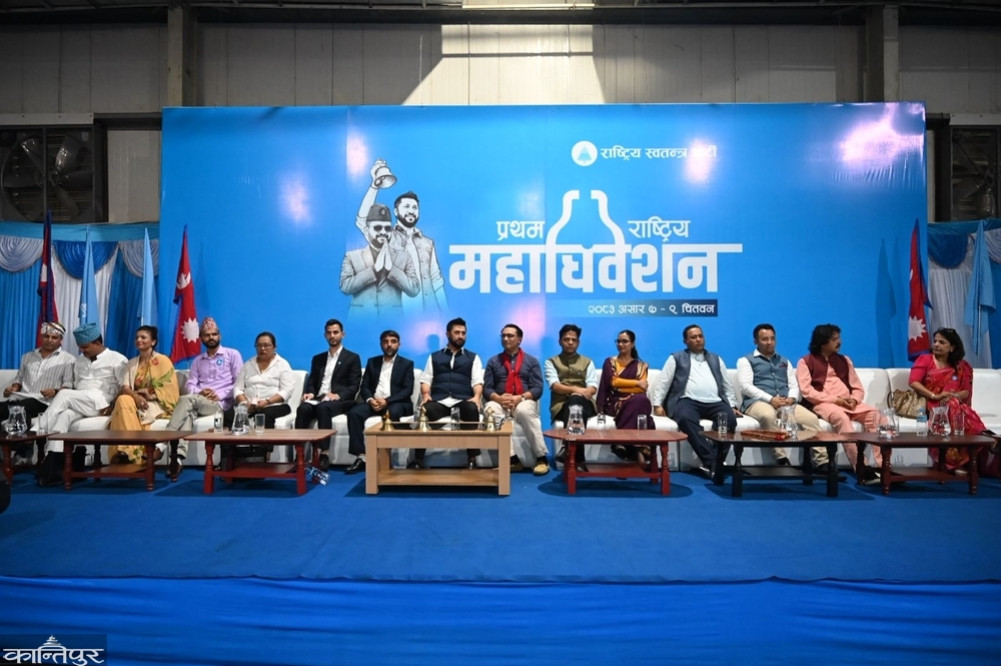
It is unfortunate that the country's largest party is not sensitive to inclusion and has not been able to implement a strong system for inclusive leadership.
We use Google Cloud Translation Services. Google requires we provide the following disclaimer relating to use of this service:
This service may contain translations powered by Google. Google disclaims all warranties related to the translations, expressed or implied, including any warranties of accuracy, reliability, and any implied warranties of merchantability, fitness for a particular purpose, and noninfringement.
The first general convention of the National Independent Party has elected a new leadership. Out of 158 members of the central committee, 100 have been elected from the general convention held from 21-23 Ashar. Since the presidents of the seven provinces are automatically ex-officio members, the remaining 51 will be nominated by party president Ravi Lamichhane. The general convention has elected the president (1 person), vice president (2 people), general secretary (1 person), and joint general secretary (3 people). Out of the 19 office bearers, senior leaders will be nominated for the remaining 12 positions.
The party, which has been operating through an ad hoc committee for four years since its establishment, has received elected leadership from the general convention. The elected leadership of the Rashtriya Swatantra Party, which became the largest party in the House of Representatives elections on 21 Falgun and is also leading the government, was awaited. Because, a leadership elected from the general convention is necessary to run a strong party in an orderly manner and provide proper support to the government. The energy gained from the general convention should now be reflected in the operation of the party and the government.
Now its positive effects should also be seen in the operation of the party and the operation of the government. In particular, the RSSS should make internal democratic practices more lively and move forward in unity. The general convention is the highest place of internal democracy of any party. For the Rashtriya Swayamsevak Sangh (RSS), the general convention has additional meaning. Because, after the RSSS was announced on 7 Ashad 2079, many parties, groups and individuals had joined this party. The process of joining this party from parties and campaigns with different beliefs had gained momentum. Therefore, even though the party was strong, it could not be united organizationally and ideologically.
In such a situation, the general convention was the only option to establish the party in a single organizational and ideological structure. There was some instability between the fact that there was a new party, the interests of leaders from different backgrounds, and mainly the lack of experience in managing the general convention. Many parties have a tendency to want to reach office and the leadership also tries to bring a specific person to office. In the RSVP, there were voices of dissatisfaction in the election process when similar interests clashed. However, with the conclusion of the general convention, the RSVP has completed a celebration of democracy.
The representation of women in the central committee of the RSVP is encouraging. Two of the six elected office bearers are women. At present, many people are focused on the weak inclusive representation. In the 21 Falgun House of Representatives elections, Madhesh became part of the RSVP. However, there is little Madheshi presence in its central committee, and there are no Madheshi presences among the elected office bearers. Madheshi representation is just a reference, the rainbow society of Nepal is not reflected in the leadership of the RSVP as a whole.
It is a sad fact that the largest party in the country is not sensitive to inclusion and has not been able to implement a strong system for inclusive leadership. It should have been able to establish that people from different communities can be elected to the leadership of the Rashtriya Swayamsevak Sangh (RSS). However, 51 central members and 12 office bearers are yet to be nominated. There is a debate about how democratic this ratio of the number that can be nominated is, but it is expected that the RSS will reflect the diversity of Nepali society in the leadership of the party, even through nominations.
Being a strong party means that the RSS has the trust and expectations of a large section of the people. The people expect this party to remain united, remain steadfast in its objectives, and continue to communicate with the people. The wish that the RSS does not fall into a similar fate is not otherwise, given the many examples of major party divisions and shattered dreams in the past. This situation will be possible only when this party becomes more institutionalized, becomes more liberal in democratic practices, and collectivism is practiced in the decision-making process.
Such collectivism is not just a matter of the involvement of those in the central committee or office bearers, but rather a matter of the diversity of Nepali society. It is the responsibility of the Rashtriya Swayamsevak Sangh (RSS) to ensure this. The RSSS General Convention has expressed its commitment to internal democratic practices. Now, the party should be able to run on a common ideology through an elected and empowered organization. Some of the issues in the document presented during the general convention have created intense debate. The RSSS leadership should move forward by clarifying this in the coming days.
The purpose of running a party in a democracy is to carry the people's agenda, be approved by elections, and work for the people's welfare. The people have already approved the agenda carried by the RSSS. That is why the RSSS is leading the government. Now it is the responsibility of the RSP government to create an environment in which the government can minimize the problems of the people and unleash their potential. Citizens are especially interested in various issues such as service delivery, job creation, internal and external investment, geopolitical balance and diplomatic ingenuity, development.
Such issues are not only the regular responsibility of the government, but also the election commitment of the RSP. It is also an expectation towards it. It is also an indicator of its legitimacy. Therefore, it is the responsibility of the RSP to make the government successful. It can become a bridge between the government and the citizens through regular reviews and suggestions of the government. The party, which has been 'refreshed' after the general convention, is expected to work harder to make the government successful.
The journey of a political party moves forward from various experiences. Parties that take it as a lesson and improve themselves succeed. They win more trust from the people. The first general convention of a strong RSP is special for this reason. However, the general convention has been concluded. Now its positive effects should be seen in the party's operation and the government's operation. In particular, the RSVP should further revitalize internal democratic practices and move forward in unity. The RSVP's own government should be able to address the issues of the people.