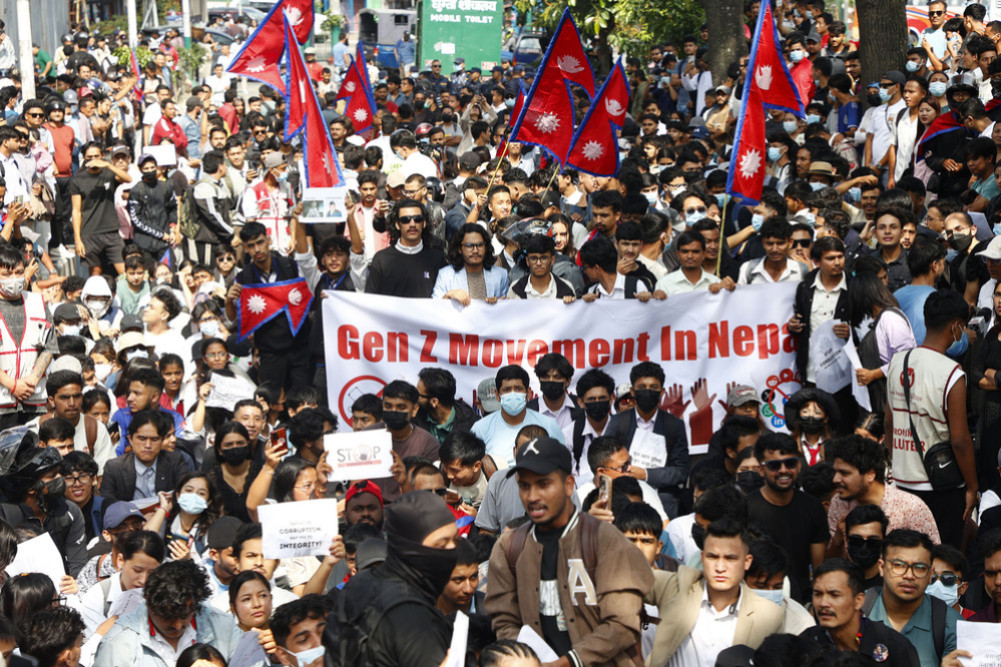
Not only the old political parties, but also their supporters and well-wishers are now in a state of great ideological turmoil. Because the thinking 'tools' that the parties provided them are now rusty.
We use Google Cloud Translation Services. Google requires we provide the following disclaimer relating to use of this service:
This service may contain translations powered by Google. Google disclaims all warranties related to the translations, expressed or implied, including any warranties of accuracy, reliability, and any implied warranties of merchantability, fitness for a particular purpose, and noninfringement.
The Gen-G rebellion was not led by the Rashtriya Swayamsevak Sangh (RSS), but when it came to the elections, the party took the place of the political organization formed on the basis of the rebellion. It seems that everyone who can think independently has accepted that the ‘ground’ of Nepali politics has profoundly ‘shifted’ in the few short months between the Gen-G rebellion and the general election. On the one hand, a party that came into existence just four years ago has become a representative of that big ‘shift’ and is present in parliament with almost two-thirds of the seats. On the other hand, the old parties, which for 35 years have considered one or the other of them as the founder of a state without any choice, saying ‘No, what happened?’, have not been able to find the grammar to accept what has happened. Groups of supporters outside the parties, who are forming their social views around the ideology of the Congress, UML, Maoists and Madhesh parties, are now in a situation where they have not found new ‘tools’ to think about how to think in the new scenario. We will discuss this in more detail later, but let us say this right now as we enter the topic – without a ‘tool’, many people cannot think and form their own opinions on a wide range of social and political issues. In that sense, Marxism is a readily available ‘tool’ for many people of the older generation of Nepal to think, democratic socialism is another, and identityism is another.
Even when the Maoists, who had emerged as a large party in the Constituent Assembly (more than the combined seats of the Congress and the UML), suddenly rose to the position of leading the government in 2065, it was a kind of ‘shock’ to the old state institution of Nepal. The current context is not the same, because the Rashtriya Swayamsevak Sangh (RSS) has been a party in parliament and government before, and Prime Minister Balendra Shah is a former mayor of Kathmandu. Yet, the kind of ‘cultural war’ that is being witnessed in public discourse, with supporters of the ‘old’ and the ‘new’ reacting to every ‘small’ incident, has implications that go beyond the immediate and everyday context of criticizing one government decision or supporting another. In today’s column, I am proposing a ‘thesis’ rather than a ‘hypothesis’ about the possible reasons why this might be happening.
The topic of today’s article is completely new, but to proceed without even ‘acknowledge’ the scale of the discussion that the columnist’s last column titled ‘Departure’ invited may seem like public indecency, which is not in the nature of the columnist. Writing on the opinion page means presenting a point of view on a subject, towards which the readers will react according to their social association over the years and the outlook on life formed from the books they have read and their current mood. But what was different this time was that some scholars reacted not by reading the article, but only by reading the reactions to it, and yet it seemed as if the writer himself had become the subject, losing the ‘intent’ of the writer. If it were not for the little knowledge of ‘cognitive science’ about the history of philosophy and the system and structure of what people think, one could have sat there in a daze thinking that one’s importance in society had grown. But since there is not much confusion about one’s presence and importance on this earth, it seemed appropriate to express a collective respect for all those comments written and unwritten through a story of a thinker that has been in my mind since I read it fourteen months ago. Please note now that the last sentence of this story will be written, and the topic of today's article will have already begun.
This story was published in the famous American newspaper 'The New York Times' in April 2025, but the incident occurred a year before, i.e. in March 2024. And, the story is about Nobel laureate Daniel Kahneman, whose famous book 'Thinking, Fast and Slow' was written about by the columnist in 'Kantipur Koseli' a few years ago. What happened is that in March 2024, the New York Times emailed this Princeton professor asking if he could be available for a podcast in April. Kahneman said that he would never be available again, let alone in April. As the story progressed, it became known that despite being 90 years old and in good physical and mental health, Kahneman was heading to Switzerland to take a philosophical leave of absence, thinking that it would be better to live a few more years and that even if life ended beautifully, it would be over.
A few days later, the world read the news of his death, but the condition was that how it happened would be revealed only after a year. That is why the interview that the New York Times conducted at that time was published only after a year. Kahneman, who has made such a great intellectual contribution to humanity, who has presented new science on the systems through which humans think and how we make decisions on major issues in life, is asked towards the end of the interview how his magnificent life and intellectual contributions can be remembered. His answer to that question admitted that the interviewers were surprised. Kahneman's point was, 'If you think about this universe, its depth and complexity, the 'contribution' I have made in my life is objectively irrelevant.' And, he concluded, 'If others say that my work has contributed to humanity (or, some call me an intellectual), that is their own opinion. I have only done what I enjoy doing every morning.' Anyone (whether they think that they are living to change others, or one day they write an article on some subject, or one who goes to the Maitighar Mandala for the cause they want to stand for as an activist) doing something here is just doing whatever they feel is good for them every day.
All the revolutions, movements and rebellions that have taken place in Nepal's history, their objectives and interpretations were already defined. Whether many members of society agreed or not, the political views of the individuals and groups leading it were already known. The theoretical explanation for what those rebellions were for was already available. The Gen-G rebellion was the only such event in Nepal's history, which was an internal resistance that occurred within a democracy because democracy was lacking, which there were some to call for but no one to lead. There are those who now, but not then, who predicted that that resistance would reach such a large explosion and change the landscape of Nepali politics on such a large scale in a few months. The rebellion was not led by the National Independent Party, but when it reached the elections, that party replaced the political organization that represented public opinion formed on its basis.
Since the Gen-G rebellion itself had no political leader, there was no political organization to 'theorize' it and provide social commentary to explain what the aspirations of society were expressed through that rebellion. Its theorization could have come from outside the political establishment, from academia or from a civil society with the legitimacy of 2062-63. The Gen-G movement had given birth to some promising new civil activists, some of whom were integrated into the Rashtriya Swayamsevak Sangh (RSS) while others are playing a good role independently. Although the previous generation of civil activists are still somewhat active, they have long lost the legitimacy to change the course of public discourse. Among them, a determined group of civil society, unable to digest the displacement of the UML, Congress and Maoists, is trying to earn its remaining social acceptance without getting out of the mindset that everything from the Gen-G rebellion to the Falgun elections was part of some conspiracy. In the academic field, sociologist Chaitanya Mishra's series of three articles in 'Online Khabar' in the first week of Baisakh has attempted to theorize this ideological transition of Nepali society to some extent. Apart from that, it has not come to the attention of the columnist that others have shown interest in it.
Not only for the established parties who thought 'No matter what we do, we are the same', but also for the large reformist outsiders who believed that 'This is democracy, change does not happen overnight, we have to be patient', 'These parties will improve, new leadership will come from within and it will gradually get better', the post-election scenario was a 'shock'. From which they have not been able to come out yet. This irregular contingency has changed the mainstream of the political establishment of the state of Nepal for three and a half decades. In the past, when the political establishment changed, there was no situation like a ‘cultural war’ in the larger ideological society, because the commentary on the new establishment that was to come had already been formed.
When we look at all these contexts together, it becomes clear that the ideological confusion is now seen in society because the Gen-G rebellion was not theorized in time. It is because of this slowness that voices are sometimes heard that it was just a conspiracy. Because, as discussed at the beginning of the article, people generally need a ‘tool’ to think about social issues. Theorizing means providing that ‘tool’. When new ‘tools’ are not available for thinking generally, people are in a state of ideological confusion. In a situation where nothing new is found, some people return to the ‘tools’ that they have already used and become obsolete. When Pushpa Kamal Dahal used words like reactionary and imperialist, which he had stopped using for a long time, again in public a few days ago, it was an example of that. Because, he does not have any new 'tools' to understand and explain the new situation. In such a situation of ideological emptiness and sluggishness, when some of the new ones from the old parties including the UML are heard saying in a way that they cannot believe, 'Now our party will be reorganized', it is not even laughable. Because when the main problem of a party is existential, that is, the question of why this organization needs to be present in society. At such a time, it is obvious from afar that the speaker who speaks with cheap words like reorganization does not appeal to himself.
Not only the old political parties, but also their supporters and well-wishers are now in a state of great ideological confusion. Because, the thinking 'tools' provided to them by the parties have now rusted. The situation of the Nepali Congress under the leadership of Gagan Thapa is even more painful but interesting. Listening to the general public, it seems that Gagan has a vague sense of how angry the people are with the old parties, including himself, and why that is. He has a vague idea of how much the ground of society has changed. But the groups within and outside the party that he has been listening to and associating with for years have not yet 'recognized' the 'ground shift'. They do not realize that the language they think, speak, and write in and the language spoken by society have changed. The 'echo chamber' of thought can exist not only on social media, but also in the company they have had for years. They do not have the academic training to look at themselves and others critically.
If a person affiliated with the Congress had the ability to see theoretically, how many important issues are there that need to be discussed in detail now? How did his project of democracy come to be on the one hand and the party's leadership, structure and thinking to be Sher Bahadur Deuba's for years? Isn't there a reason behind it? How did the leadership that rebelled at the special general convention even ask good questions and the people don't listen to it? Shouldn't we find an answer to that? Looking at the leftist camp, why did the organizations that were formed to implement Marxist ideas end up in the hands of Oli 'Ba' and dissolve? Why did the people, by bringing references to dialectical materialism from history to every small question and not believing so many 'dedicated' politicians who believe that they are living for the salvation of others, reach a newly established party to pin their hopes on it? Shouldn't we find a reason for that? Shouldn't the discussion start from these places?
भदौमा सुरु भएको लोकतान्त्रिक संक्रमणको नयाँ संस्करणलाई सैद्धान्तिकीकरण गरेर एउटा राष्ट्रिय आख्यानमा बदल्नका लागि सुरुवात गर्ने बिन्दु हुनुपर्छ– नेपाली राजनीतिको संरचना र सामाजिक मनोविज्ञान पछिल्ला नौ महिनामा आधारभूत रूपमै फरक भइसकेको छ । यो संक्रमणले पुराना स्थापित दलहरूलाई बढारेको मात्र होइन, तिनीहरूले दशकौंदेखि बोल्ने ‘करेन्सी’ गुमाएका वाद, वैचारिकी र तौरतरिकालाई पनि हो । नयाँ उदाएको शक्ति र सरकारका बारे आवश्यक ठाउँमा प्रश्न गर्ने, जवाफदेहिता खोज्ने र कमजोरी गरेको ठाउँमा आलोचना हुने गरेको छ, त्यो लोकतन्त्रमा हुनैपर्ने अभ्यास हो । रास्वपा पनि एउटा तत्कालको माध्यम हो । भर्खर आफ्नो पहिलो महाअधिवेशन सम्पन्न गरेको उसले आफूलाई प्राप्त व्यापक जनादेशको कति सम्मान गर्न सक्छ र दीर्घकालीन लोकतान्त्रिक शक्तिका रूपमा कति दह्रोसँग संस्थागत हुन सक्छ, त्यो भने हेर्नै बाँकी छ ।
अब अगाडिका लागि के स्विकार्नुपर्यो भने, वर्षौंदेखि कांग्रेस, एमाले र माओवादीको नेतृत्व तहमा कब्जा जमाएर बसेका केही पात्रहरूले देशमा जुन मनलाग्दी गरेका थिए, त्यसको प्रतिक्रियामा नेपाली समाजमा एक वा अर्को प्रकारको ‘लोकतान्त्रिक’ झट्का अवश्यम्भावी थियो । परिणामतः नेपालको राजनीतिमा युवाको सहभागिता ह्वात्तै बढेको छ, नेतृत्वको सोझै पुस्तान्तरण भएको छ र पुराना पार्टीले पनि आफूलाई सान्दर्भिक, अभ्रष्ट र ‘कम्पिटेन्ट’ बनाउने हो भने, त्यसका लागि जबर्जस्त मौका पाएका छन् । नागरिक अभियन्ताका रूपमा नयाँ आशालाग्दा अनुहारहरू ताजा वैधताका साथ समाजमा उपस्थित भएका छन् । यिनै परिवर्तनलाई आधार बनाएर भदौको विद्रोह र त्यसपछिको राजनीतिक परिदृश्यलाई हेर्ने दृष्टिकोणको सैद्धान्तिकीकरण हुनुपर्छ । होइन भने, अगाडि बढ्दाभन्दा पछाडि फर्कंदा आफ्नो स्वार्थ पूरा हुने तत्त्व नेपाली समाजमा जति पनि छन् । हौसिने तिनीहरू नै होलान् ।