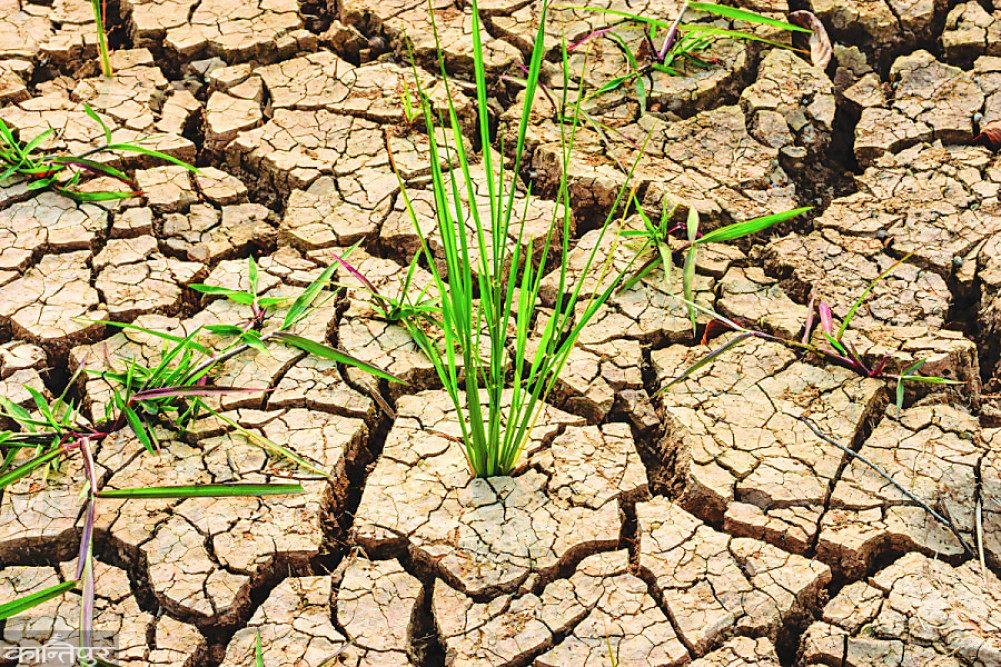
The natural and climatic weather system 'El Nino', which is active from time to time in the Pacific Ocean, disrupts the atmospheric flow and air pressure of the entire world. As a direct result, there is less rainfall in Nepal. And, our living conditions, agricultural systems and lifestyles based on the monsoon system of Nepal have a serious impact.
We use Google Cloud Translation Services. Google requires we provide the following disclaimer relating to use of this service:
This service may contain translations powered by Google. Google disclaims all warranties related to the translations, expressed or implied, including any warranties of accuracy, reliability, and any implied warranties of merchantability, fitness for a particular purpose, and noninfringement.
Every year, the monsoon arrives in Nepal on June 13. However, this year it arrived a little later than the scheduled time. According to the bulletin of the Department of Hydrology and Meteorology, this year the monsoon arrived in Nepal a few days later than the scheduled time. Last year, the monsoon arrived 15 days earlier than the scheduled time. At the time of preparing this article, the monsoon has not reached all parts of Nepal.
The most discussed topic in the department's bulletin was - 'El Nino'. El Nino is a natural and climatic weather system that is active from time to time in the Pacific Ocean. The department has projected that the arrival of the monsoon will also be delayed this year and there will be less than average rainfall due to El Nino. While this article was being prepared, the monsoon has arrived in Nepal. It is raining in various parts of the country.
Due to the effect of El Nino, the monsoon arrived in Nepal later than scheduled in the years 2023, 2019, 2016, 2009, 2002 . In those years, droughts reduced the production of crops including rice, corn, and other crops .
When the trade winds in the Pacific Ocean weaken, warm water moves to the eastern United States and the weather system changes. Trade winds flow throughout the year in the equatorial region . This wind continuously flows from east to west . Trade winds control the world's weather system by pushing warm water from the ocean .
The Pacific Ocean is geographically very far from us . However, from the perspective of climate science, this is no different . Climate does not understand geographical distance . When the surface of the equatorial Pacific Ocean heats up abnormally, El Nino becomes active . This disrupts the flow and air pressure of the entire world's atmosphere. This effect reduces the speed of the monsoon winds flowing in South Asia. Its direct impact is seen in our country. That is, both the amount of rainfall and the occurrence of rainfall decrease. Its effect affects the entire country and our lifestyle and lifestyle based on the monsoon system.
When the monsoon system that normally brings rain to Asia changes, the monsoon weakens in South Asian countries like Nepal and India. When the monsoon weakens, drought occurs and heat increases. Although the climate is likely to remain neutral in the middle of this year, the World Meteorological Organization has predicted that El Nino will develop from July to September. The organization has projected that El Nino may fully develop in these months and even become Super El Nino. When El Nino develops strongly, it is projected to affect the agriculture and animal husbandry sectors.
The organization has projected that El Nino will fully develop in these months and may even become a Super El Nino. When El Nino develops strongly, it is projected to affect the agriculture and animal husbandry sectors. According to a report by the United Nations World Food Program and the Food and Agriculture Organization, more than 266 million people in the world are facing food insecurity due to El Nino. Whenever El Nino is active in Nepal, it affects our agricultural system. In a report released this year, the department mentioned that El Nino will affect agricultural crops.
When rainfall is reduced, the crop production cycle is disrupted. Due to the increase in temperature, heat stress occurs in crops, which leads to reduced production and drying up of irrigation sources. This has a parallel effect on animal husbandry. Excessive heat increases stress on animals, which reduces milk and egg production. Disease immunity is weakened. Lack of green grass and water increases farmers' investment when there are problems in nutrition and health. In this way, when agricultural production decreases, the income of farmers decreases due to weak animal feed and animal husbandry. This has a double blow to the rural economy.
The impact of El Nino is not only felt in South Asia, but also in Western countries. Due to the El Nino cycle, it is predicted that sea temperatures will increase by up to 3 degrees Celsius. Due to less rainfall, it is certain to affect our food crops. Production decreases due to less water. The price of fuel has increased due to the war in the Middle East. The export of chemical fertilizers has also decreased. This has directly affected the agricultural sector. The price of fertilizers such as urea and DAP, which are important for food crops, has also skyrocketed. There is a shortage of fertilizers in the market. There may also be a compulsion to operate diesel pumps and extract groundwater for agricultural work. Therefore, it is certain to have a direct impact on the economy of the agricultural sector.
First of all, we need to understand social science, and it is even more important to understand the sociological and anthropological perspectives. From the perspective of social science, a different environment is seen. From the perspective of sociological and anthropological perspectives, a different environment is seen. Especially, the rural economy of our country is linked to the agricultural sector. When the monsoon cycle is weak, production also weakens. This directly affects the disadvantaged groups. When there is no rain on time, rice production also decreases. Decreased production means increased dependence. When dependence increases, the imported market gains ground. In that case, prices rise. Although this is easy for the 'eat what you have' class, it greatly affects the 'eat what you have' class, resulting in various problems including health problems.
There is another problem in a society like ours. We still call changes in weather or droughts a divine ‘catastrophe or disaster’. It shakes our system. Its impact is not limited to the fields. It should also be seen from a gender perspective. Droughts dry up water in streams, wells, and springs. The responsibility to address this crisis lies with family members. In Nepal, women still have the responsibility of cooking and storing water. They have to go elsewhere to collect water, which means hours of time have to be spent storing water. This completely deprives women of economic activities and income-generating opportunities.
In Nepal, every government talks about agriculture and farmers. The budget also includes addressing the problems of farmers as much as possible. However, we are still not able to fully embrace modernization in agriculture . Due to the lack of timely construction of infrastructure for various irrigation projects, our agricultural economy is affected by such sudden climate-related events .
Even now, we tend to address the issue only after the crops are destroyed . The issue of preparedness is still not taken seriously . Early warning systems have been increasing in recent years . However, problems arise when these issues are not taken seriously in the villages . Farmers should be taught alternative methods while taking preparedness seriously . For that, the state should invest heavily in climate resilience . Along with rainwater, irrigation infrastructure should be made effective at the local level .
Similarly, it seems that rainwater harvesting system should be addressed at the policy level by making it effective .
Timely scientific irrigation management is necessary to minimize potential risks like El Nino in the future. Similarly, the government should select heat-tolerant crop varieties. It is also necessary to make a preparedness plan with special care for animals at this time.