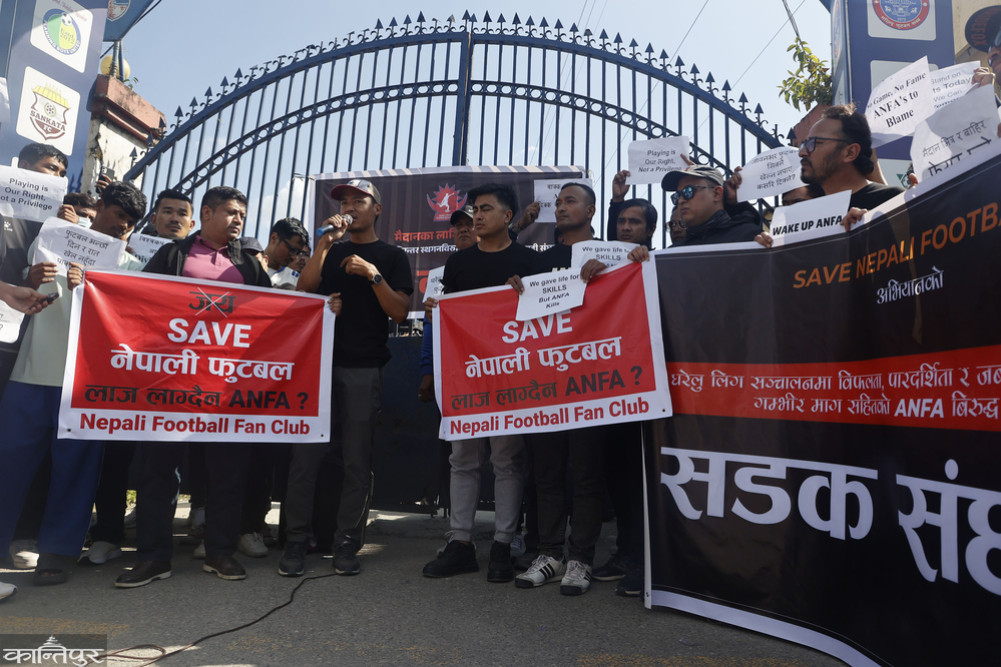
Nepali football will have to bear many short-term and long-term losses from this. The main goal at this time is to review and improve the activities carried out in Nepal that forced FIFA to take such drastic measures.
We use Google Cloud Translation Services. Google requires we provide the following disclaimer relating to use of this service:
This service may contain translations powered by Google. Google disclaims all warranties related to the translations, expressed or implied, including any warranties of accuracy, reliability, and any implied warranties of merchantability, fitness for a particular purpose, and noninfringement.
Football fans around the world are currently watching the World Cup. They are supporting different countries and uniting themselves with the competition. While football is creating excitement all over the world, Nepali football is facing a sad situation. Because, the International Federation of Football Associations (FIFA) has decided to impose a ban on Nepal on Thursday. Nepali football, which has been going through controversy, power struggles and confusion for some time, has been pushed into further difficulties with the FIFA ban.
Nepali football will have to bear many short-term and long-term losses. The main goal at this time is to review and improve the activities carried out in Nepal that forced FIFA to take such drastic steps. In the context of various countries, the ban has been found to have ended by ending the interference of third parties such as the government and the court and finding a way out with the agreement or involvement of FIFA itself. Nepal also needs to learn from the experience of such countries.
The latest controversy is believed to have started after the All Nepal Football Association (ANFA) prepared to go directly to the central election without holding district and provincial level elections. One side of ANFA had scheduled an 'early election' for Chaitra 13 and the regulatory body, the National Sports Council (NSC), had directed it to postpone it. But after the ANFA leadership refused, the NSC suspended it on Chaitra 11. The election was then postponed.
Without football activity, it is difficult for clubs here to survive. There can be no 'exposure' of players who represent the national team, but rather players may flee. The process of players joining clubs in different countries individually can also be affected. In the meantime, virtual talks were held between FIFA, the Asian Football Confederation (AFC), ANFA and NSC. During that, FIFA and the AFC had asked them to withdraw the suspension and return to the old election schedule. FIFA and the AFC had written a letter to NSC, setting a deadline of Baisakh 21 to withdraw the decision to suspend ANFA. On Jestha 1, the NSC lifted the suspension on ANFA. Meanwhile, the term of office of the executive committee led by ANFA President Pankaj Bikram Nembang ended on Asad 6. FIFA's ban was made public five days later.
A recent incident is famous to understand the extent of the dispute between NSCEP and ANFA. ANFA President Pankaj Bikram Nembang and General Secretary Kiran Rai were turned back from the airport while going to watch the World Cup. This happened because the Immigration Department blacklisted all ANFA officials and employees on the recommendation of NSCEP. This incident may have also irritated FIFA. The main point to understand in all this is that FIFA and AFC do not accept external interference in ANFA.
They mean interference in ANFA's autonomy. But in various countries, such restrictions have been imposed when government bodies or courts dominate the football organizations there. The restrictions and lifting of restrictions on neighboring countries India and Pakistan illustrate a similar context. FIFA has cited 'third-party interference' as the reason for imposing the ban on Nepal. There is no doubt that there was a problem within ANFA. However, a prudent resolution of the power struggle and dispute was essential. Failure to do so has pushed Nepali football into darkness.
FIFA's ban means that the football activity of the country concerned will come to a standstill. That is, Nepal will no longer be allowed to participate in any international or regional competition. It will not be allowed to compete with any FIFA member country. The grants provided by FIFA for the development of football here may be stopped. Participation in the skill development programs organized by FIFA for the development of football may also be prohibited. Some of these effects are immediately visible.
However, the long-term effects are even more fatal. For example, due to the lack of football activity, it is difficult for clubs here to survive. Players cannot get 'exposure' when representing the national team, but instead players may flee. The process of players individually joining clubs in different countries may also be affected. The break in continuity gradually weakens football activities.
There is a lot of talk about the presence of countries such as Cape Verde, Curacao, Uzbekistan and others in the World Cup. It inspires the possibility of countries that have not received much attention in football before to participate in the World Cup and create a sensation. Nepal can also learn from it. It can produce football talents. One of the main conditions for that is to cultivate and spread the football environment here.
But the current situation does not make the environment here any better, it even worsens the existing environment. Therefore, the government, Nakhep and ANFA should all learn a lesson from the current ban. Such bans are also an opportunity to solve long-term problems and make a commitment to improve the working style. Many countries have been banned. However, the ban is lifted after there is assurance that there will be no third-party interference and that the election will return to normalcy. Nepal should also take the initiative for that. After the ban, which was said not to be applied, efforts to shorten this period should be the priority now.