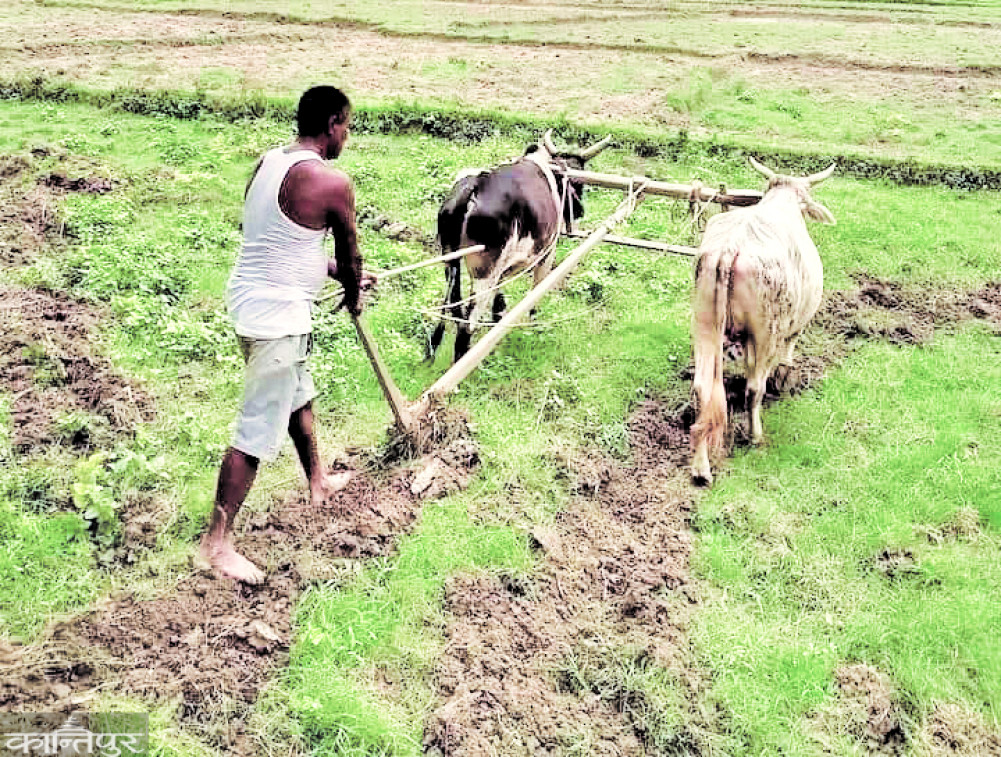
Tractors removed bullocks from the fields. But, not only bullocks were removed. The traditional economy based on animal husbandry also weakened. The availability of cow dung decreased. The cycle of organic fertilizer was broken. Dependence on chemical fertilizers increased.
We use Google Cloud Translation Services. Google requires we provide the following disclaimer relating to use of this service:
This service may contain translations powered by Google. Google disclaims all warranties related to the translations, expressed or implied, including any warranties of accuracy, reliability, and any implied warranties of merchantability, fitness for a particular purpose, and noninfringement.
While visiting the village of Zabdi in Sarlahi Balra, I came to know that Dinesh Sahni (56) is now the last harwah (ploughman) of the village. I thought that an old saying still remains in the village. Dinesh has two bulls – one white, the other saffron. Looking at the bulls, it seems that they are tied with the same rope in the morning and evening. Does Dinesh call the bulls by name or not? I did not ask. But, it was obvious that the bulls recognize his voice.
Dinesh's father was also a harwah. He also ploughed other people's fields. The color of the soil may have changed, the weather may have changed. However, the line drawn by the ploughshare remained the same. Poverty also remained largely the same. The role of the harwah in the agricultural structure of the village was very difficult but important. However, its economic returns were limited. Labor has been passed down from generation to generation, not wealth. Dinesh also learned to plow from his father, but he did not repeat his father's fate.
A tractor has arrived in the village. The sound of a tractor can be heard far away. The footsteps of an ox cannot be heard that far. But some things are lived not by sound, but by presence. Dinesh's oxen still reach the fields. He plows in the morning. He drives a tire truck in the afternoon. Two oxen pull the soil in the morning, life in the afternoon. The same capital has created two jobs. Sometimes it seems that Dinesh did not raise the oxen, but the oxen are raising Dinesh.
The general understanding is that with the arrival of a tractor, the need for a plow will end. However, the village economy is not that simple. After the arrival of a tractor in the village, the number of people who can plow the land has decreased even more rapidly. Young people went abroad for employment, looking for new opportunities for wages. The skill of plowing became rare. This rarity gave Dinesh a new value.
Dinesh says, ‘I am not an educated person. I know how to work hard.’ He said this as if the sun had declared that he was bright. There was no pride, no complaint. Time had made his profession old, but that same oldness also made him necessary. I kept thinking, what will happen after Dinesh? This sentence is a small summary of the changing labor relations in rural Nepal. As skills are lost, their value may increase. But, with that, a question also arises – what will happen after Dinesh? His sons have not learned to plow. There is little chance that other youth in the village will return to this profession. Therefore, Dinesh is not just a person, he is the last representative of an era.
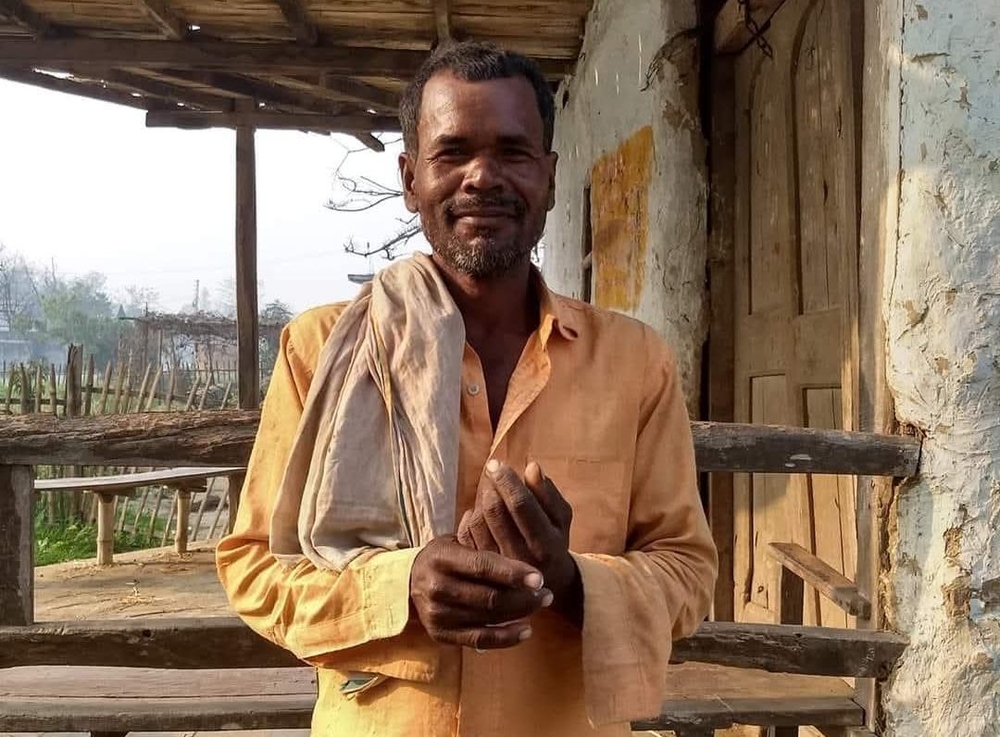
Development statistics can count the number of tractors but cannot count the number of people like Dinesh Sahni. Whereas the real change in the village is written there. Where a profession is disappearing, a skill is becoming rare and a person is fighting the changes of time to save his place. Dinesh Sahni is not just the last survivor of the village. He is reminding us that the story of development is not written only by machines. The other side of it is also written by the hands of workers, the footsteps of bulls and the smell of soil.
Perhaps the tractor will increase further. The fields will be plowed. The crops will grow. However, one scene of the village will be lost - two bulls moving forward through the soil and a man holding a plow behind the bull. When many things are lost from the village, we do not know. However, sometimes when one person remains, we know - a time is not completely lost. Dinesh Sahni is that remaining time.
The village has its own way of measuring change. City people look for it in GDP, production growth, productivity and growth rate figures. But, villagers recognize change by sound. Once upon a time, the jingling of bells was heard in the morning and evening, today the wheezing of diesel engines is heard. The question is not whether moving from bullock carts to tractors is progress or not? The question is – who moved forward on this journey and who was left behind?
The transition from bullock carts to tractors in agriculture is not just a technical change. It is a deep story of economics, politics, sociology and power relations. A tractor running in the field does not just till the soil, it also tills the structure of rural society. The bullock was the farmer's property, it was also a friend. When the bullock died, the farmer would mourn. When the tractor broke down, the farmer would look for a mechanic. The nature of the relationship has changed. Tractors increased production, plowed fields faster, and saved time. There is no dispute about this. However, every technological change also brings about a redistribution of power and resources.
Who was the first to buy a tractor in the village? Usually, those who already had a lot of land, a lot of capital, and a lot of political access. Before the tractor came to the fields, it came to the courtyard of power. It was not just a machine, it was a symbol of prestige. Whoever had a tractor standing in front of his house changed his status in the village. Gradually, along with plowing the fields, the tractor began to reorganize the rural economy. Small farmers, who previously farmed with bullocks, now started renting tractors. The cost of farming increased. A new cycle of diesel, maintenance, tax payments, and bank loans began. Earlier, the farmer had a relationship with nature. Now his relationship with the market has also become intertwined. This is where economics begins to become politics.
Because tractors not only bring machines, they also bring loans . And, loans not only bring interest, they also bring dependence and uncertainty . For farmers with little land, tractor facilities can become less, more of a compulsion . In many villages, the increasing use of agricultural machinery has been seen to reduce the demand for farm labor . The need for labor in plowing, transportation and other work has decreased . This change has not always been pleasant for landless families dependent on farm labor . Technology is not neutral . Its benefits and losses are not shared equally . Therefore, every story of development also has a hidden story of displacement .
Tractors removed bullocks from the fields . But, not only bullocks were removed . The traditional economy based on animal husbandry also weakened . The availability of cow dung decreased . The cycle of organic fertilizer was broken . Dependence on chemical fertilizers increased . The symbiotic relationship between agriculture and animal husbandry, which had sustained rural life for centuries, gradually weakened. The political aspect of this change is even more interesting.
Governments consider tractors a symbol of development. Tractor distribution is announced in election rallies. Subsidies are distributed in the name of agricultural modernization. Photos of ministers handing over the keys to tractors are made public. But, rarely does anyone ask – how many small farmers have reached such subsidies? How many farmers went into debt to buy tractors and were later forced to sell them? The picture of development shows the machine, not the debt-ridden farmer. The benefits and costs of development are due to the different classes bearing the brunt – benefits have gone up, costs have gone down. The story of the tractor is similar.
Farming requires modern technology. It is neither possible nor necessary to return to the era of the plough and bullocks. However, technology is democratic only when its benefits are widely shared. Otherwise, it deepens inequality. Today, there are fewer bullock carts and more tractors on the village roads. Many call this a picture of development. However, if you look closely, this is not just a change in machines - it is also a story of rural power balance, labor relations, debt structure, environmental sustainability and social justice.
The development of a village should not be measured by how many tractors there are, but by how many farmers can cultivate with dignity, how many workers get jobs and how many families can live without the burden of debt. The journey from plow-oxen to tractor may be a necessity of history. However, its evaluation should not be based on the 'horsepower' of the engine, but on the living conditions of the people. Because the machines running in the fields do not always witness development. Sometimes they also drown out the voices that are asking - for whom is development?
Is the tractor good or bad? This is not the main question. The main question is, who owns the tractor? Who benefits from it? And who bears its cost? The story is not about the tractor, but about the farmer who bought the tractor. It is about the worker, whose need for labor has decreased. And it is about the village, where the map of power has also changed along with the machine. From here, the journey from plow-oxen to tractor is no longer just a story of agricultural change - it becomes a story of rural economic and political change.
My experience says that those farmers who already have financial resources, access to credit, training and institutional support are more likely to adopt tractors and other agricultural machines. That is, machines often reach relatively wealthy farmers. The biggest challenge of mechanization in Madhesh is not just buying machines, but also having access to machine services. Small farmers often do not own machines, they depend on services available on rent. This has given rise to a new type of ‘service provider class’ in the rural areas, in whose hands economic power has begun to be concentrated. Thus, a new class has been born in the villages – the masindar. That is, the tractor owner, harvester owner or excavator owner! This is the birth of a new rural power structure.
A job that used to take 10 people can now be done by one tractor. The fields are plowed faster. However, the story of the nine people who did not reach the fields that day is not recorded anywhere in government statistics. Mechanization increases productivity but reduces the demand for labor in some jobs. It has reduced the need for labor in areas such as plowing, transportation and harvesting. On the other hand, new employment opportunities have been created in the machine repair and service sectors. Another, this is also a ground reality – the tractor was not the result of technological innovation, but was also a response to the labor crisis. The exodus of agricultural workers, the search for other enterprises in agriculture, and agricultural mechanization should be studied together.
Perhaps in a few years, there will not be a single plow left in the villages of Nepal like my village. The fields will be plowed, the crops will grow, the production figures will go up even higher, the government report will call it the success of agricultural modernization. But, no one will remember this at that time – there was a farmer named Dinesh Sahni in his village, who plowed the fields with bullocks or oxen every morning and afternoon. The history of development often writes about the arrival of machines, but it forgets the names of those people, who lived their lives as a bridge from one era to another.
The story of the Dinesh Sahni is actually not just the story of a farmer. The question is – whose labor value increases when the village changes? Whose is lost? Whose voice is heard? And, whose is suppressed? The tractor may plow the soil faster, but it does not answer these questions. To find the answer, we still have to go to the farmyard, where the footprints of two oxen, along with the last signature of an ancient time, remain. When that signature is erased, we will not only have lost a profession, we will have also lost a chapter in the social memory of rural Nepal.