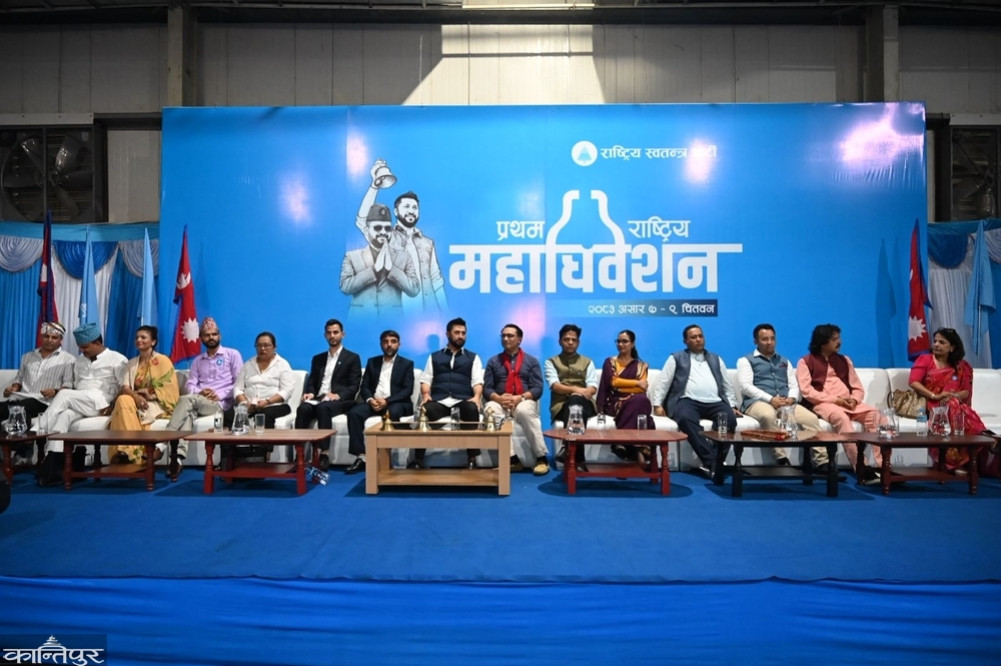
Political parties should have a clear ideological vision for the liberation of women, Dalits, oppressed classes and communities. However, the document of the RSVP convention has not been able to present any ideology that ensures the rights of these classes, genders and communities.
We use Google Cloud Translation Services. Google requires we provide the following disclaimer relating to use of this service:
This service may contain translations powered by Google. Google disclaims all warranties related to the translations, expressed or implied, including any warranties of accuracy, reliability, and any implied warranties of merchantability, fitness for a particular purpose, and noninfringement.
The Rashtriya Swayamsevak Sangh (RSS) emerged as the largest political party in the country within four years of its formation. There is no history of becoming the largest party in the parliament in such a short period of time in the political history of Nepal. Political parties are basically the product of the country's politics, socio-economic conditions and needs. Most of the parties in Nepal were established through revolutions, struggles and movements for the end of autocracy and anti-people rule and socio-economic transformation. However, after coming to power, those parties could not address the needs, desires and aspirations of the people. On the other hand, extreme dissatisfaction and anger among the people increased due to rampant corruption, irregularities and unrest. It is on the basis of that anger and dissatisfaction that the RSS has become the largest political party in the country.
The RSS has been defining others as old and its own party as a new force. Theoretically, a new force demands not only a new face or leadership, but also new political principles, perspectives and ideologies. But the RSP general convention failed to develop any new political vision or ideology to solve the country's economic and political crisis and bring about a radical social transformation of the country. The document presented by RSP President Ravi Lamichhane and Vice President Swarnim Wagle has not been able to show any theoretical and ideological new direction of the party. Instead, the general convention has given legitimacy to the ideology that strengthens the traditional neoliberal capitalist system.
Zero ideological innovation
In the political report and resolution presented by RSP at the convention, Ravi Lamichhane has mentioned that the RSP is not a traditional 'leftist' or 'rightist' party. He has also said that the party will not be bound by any ideological framework. He has also mentioned that it will prioritize a perspective based on practicality, prudence and reality. This theoretical ambiguity is a mixed view of status quo and opportunism. A political party should have a clear vision of building a state system, social system, economy, culture, etc. Only that provides a roadmap to resolve the country's immediate and long-term socio-economic contradictions and take the country forward. If the situational necessity is considered as a principle, the Rashtriya Swayamsevak Sangh (RSS) can also define autocracy as a necessity, which is fatal for the country and the people. Therefore, it does not seem that the RSS has been able to create any new ideology from this general convention.
The RSS, which once interpreted constitutional socialism as an idea, has considered 'social democracy' as the party's idea from this convention. From the perspective of political ideology, this is not a new idea. Social democracy, which has been practiced in the world since the 19th century, seems to have been brought up for debate and discussion by the Nepali Congress from the past. An open market-based capitalist economy and a welfare state are the basis of social democracy. While the convention is declaring social democracy as an ideology, what is the theoretical basis of social democracy? Why is Nepali society in need of this ideology? It has not explained in detail how it will transform Nepal's socio-economic situation and take the country forward. It seems that this idea, brought without analyzing the socio-economic situation, is presented only as a slogan. The Rashtriya Swayamsevak Sangh (RSS) that has emerged as a new force does not seem to have been able to interpret and analyze social democracy in a new way.
The statement made by senior leader and Prime Minister Balendra Shah of the RSS in Parliament on the Nepal-India border dispute is a serious issue related to national independence. With the Prime Minister's statement, common Nepalis had increased interest in what the RSS's ideological perspective on national independence and international relations was. Naturally, it was expected that the RSS general convention would hold a serious debate on these issues and present the party's clear point of view. However, none of the documents presented at the NCP convention could present any concrete and clear vision on Nepal's sovereignty, national independence and international relations. The NCP could not bring any new ideas and perspectives on such serious issues from the convention.
Theoretically, the economic policy adopted by the political party determines the economic development of the country and the living standards of the people. Nepal has transformed from feudal production relations and economy to a capitalist system. However, Nepal has not been able to develop progressive capitalism. Instead, it has become an integral part of the crony capitalist system. In such a system, the country can neither develop an independent economy nor end crony capitalism. In this environment where the country's economy is running on foreign employment, foreign loans and taxes on the basic class, the NCP has adopted a neoliberal economy that makes the rich richer and the poor weaker. Such a market-controlled economy destroys the economic lives of workers, laborers, farmers, and marginalized communities, while increasing the dominance of the limited rich and the capitalist class. If we look at the political environment around the world, such capitalist classes are capturing not only the economy, but also political power. Such an economic policy in which the capitalist class captures the economy and the political system is certain to cause a serious crisis in the economic lives of the majority of the poor, workers, farmers, and oppressed classes and communities in Nepal. The neoliberal economy adopted for the benefit of the capitalists without analyzing the historical series of Nepal's economic and political environment is against the interests of the majority of Nepalis. On the other hand, Nepal had constitutionally set a goal of moving towards a socialist economic and political system, but the economic policy of the Rashtriya Swayamsevak Sangh (RSS) has tried to go back on this theoretical basis.
There is great inequality and discrimination in Nepali society on the basis of gender, caste, language, religion, culture, geography, etc. The oppressed classes and communities including women, Dalits, indigenous peoples, Madhesis, Tharus, Muslims and others are forced to live a miserable life due to the discrimination and exclusion they have been subjected to by the past discriminatory state and social regimes. The political, economic, social, cultural, educational and other basic rights of the majority of oppressed classes and communities must be ensured. Until these communities, which have been subjected to historical oppression, exclusion and discrimination, are liberated, the country cannot truly develop. Therefore, political parties must have a clear ideological vision for the liberation of women, Dalits, oppressed classes and communities. However, the documents of the RSVP convention have not been able to present any ideology to ensure the rights of these classes, genders and communities. Despite being said to adopt the principle of inclusion, the party's high leadership or policy-making level has not been able to develop the idea and method of mandatory representation. There is no basis for calling the RSVP new in terms of its perspective and ideas on social diversity.
Political party conventions are basically important for reviewing the country's environment and formulating necessary ideas, perspectives and action plans. The general convention is a place where representatives from all over the country hold extensive debates on the party's principles, ideas, perspectives and action plans. However, theoretical ideological debates, discussions and deliberations have ceased to take place in the general conventions of most parties in Nepal. The Rashtriya Swayamsevak Sangh (RSS) has also continued this trend. The RSSS did not discuss and revise the political ideological documents presented by the party. If it is believed that the ideas of the main leadership are paramount and other leaders and cadres are merely approvers and implementers, then ideological churning cannot take place in such a party. In another sense, not discussing the party's ideas is not a democratic practice. In this way, it is not seen that the RSSS has been able to provide any innovation in terms of idea formation. This raises the question again – is the RSVP really a new party or a party with old ideas and tendencies under a new name?
Attack on achievements
The Nepali people have made great sacrifices against the autocratic, centralized and intransigent state power in Nepal. Nepal has been transformed into a federal democratic republic after a long struggle by the people for the fundamental restructuring of the state to ensure basic democratic rights and to get rid of class, caste, gender and regional discrimination. Nepal's democratic and leftist political parties, civil society, indigenous peoples, Madhesis, Dalits and marginalized communities have fought for decades to establish this system. However, after this system was established, the proposal put forward by the RSVP, which became the largest party in the country through this system, in the context of federalism through the concept of provincial assemblies, is anti-people and regressive. Why was there a demand for federalism in Nepal? Why was there a need for federalism? What are the social reasons for this? The proposal to abolish the Provincial Assembly without reviewing, studying and consulting on such serious issues is an insult to the struggle and sacrifice of the oppressed community. The RSVP, which claims to make the country prosperous, should identify the weaknesses in the practice of federalism in the Provincial Assembly or in general, understand the expectations and desires of the community, and practice effective and strong federal governance. On the contrary, bringing a proposal to abolish the Provincial Assembly without reasonable thought and logic is a ploy to take away the limited rights obtained by the oppressed community.
The RSVP does not seem committed to proportional inclusion either. If we look at the RSVP secretariat, parliamentary committee chairpersons, convention representatives, district and provincial chairpersons, and all the appointments made by the Balendra-led government, the RSVP does not seem to be committed to proportional inclusion. The RSVP also has the responsibility to practically implement the constitutionally and politically achieved proportional inclusion principle, but the RSVP has been ignoring even the constitutional achievements. This is also the deprivation of the rights of the oppressed gender, class and community.
The poor, squatters and landless people expected state support. The old political parties only made land reform a slogan. They expected the Rashtriya Swayamsevak Sangh (RSS) to solve this problem, but instead the first blow has been struck against the landless squatters. In this process, not only was the dozer terror used, but the daily life of the landless squatters has been made even more difficult.
In the past, the people were aggrieved when political parties occupied and hollowed out the state structure. The people fought against that occupation and irregularities. The Gen-G movement is the product of that. However, the new government seems to be moving forward with a strategy to systematically occupy the state structure. It has started to cripple the freedom of expression of the citizens, while efforts are being made to suppress the opposition voice in the parliament. In this way, the danger of the country moving towards another legal dictatorship is increasing. However, such issues were not found to be on the agenda of the discussions of the general convention of the Nepali People's Party. If the achievements gained through the struggle of the Nepali people are threatened, the people will naturally rebel. If the hope for rapid transformation awakened in the youth is not translated into practice, it will not be easy for the Nepali People's Party to cope with the anger it will bring. The government should have a forward-looking, progressive and transformative plan to prevent another storm that 'mass frustration' may bring. However, the contradiction between thought and practice is leading the country towards the possibility of having to struggle again for freedom of expression, social justice and basic democratic rights.