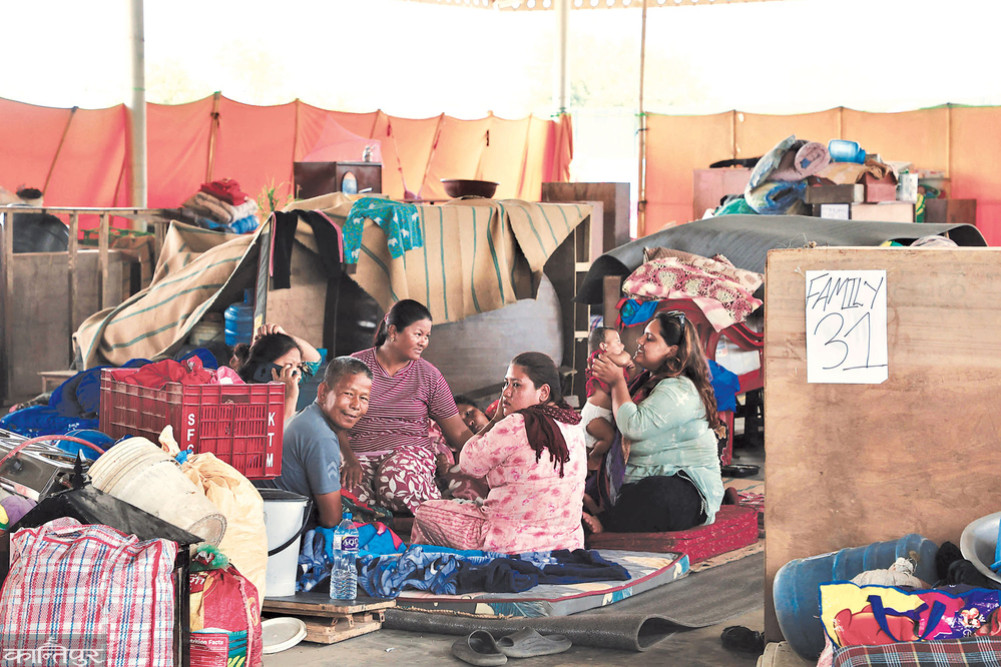
The government, which has been unable to arrange permanent residence for two months, has tried to remove them from the holding center by issuing an 'ultimatum' instead of issuing a public apology.
We use Google Cloud Translation Services. Google requires we provide the following disclaimer relating to use of this service:
This service may contain translations powered by Google. Google disclaims all warranties related to the translations, expressed or implied, including any warranties of accuracy, reliability, and any implied warranties of merchantability, fitness for a particular purpose, and noninfringement.
The notice posted by the government in the holding centers where squatters are kept has created panic and confusion. The empowered Bagmati Civilization Integrated Development Committee issued a notice on Tuesday asking the squatters to vacate the holding center by Asad 12, increasing the possibility of their displacement. This notice is a step contrary to the assurance given by the government on April 12 that proper management would be made in the near future before sending dozers and security personnel to the settlements along the riverbanks.
Instead of publicly apologizing for not being able to arrange permanent residence for two months, the government has tried to evict them from the holding center by giving an 'ultimatum'. However, it is almost clear that they are real squatters and the government has a responsibility towards them. But the government, which was criticized for being excessive when it was hastily removed from the settlements on April 12, has not learned from its weaknesses. Instead, it is repeating the same mistakes in different ways. This reveals the government's hypocritical view of the lower classes of society.
The government has decided to provide a relief amount of 25 thousand rupees, so instructions have been given to vacate the holding center by 12 Ashar. The notice states that the amount specified for three months for house rent will be provided in monthly installments to the bank account. If the government's notice remains unchanged, the families of the squatters will now have to find a room with 25 thousand and will have to live on 15 thousand per month. When they were removed from the river bank and taken to the holding center, many squatters were not able to take care of their belongings.
They were forced to live under the government's surveillance and the government's 'schedule' of food and drink, separated from their regular residence for years. In the beginning, even the women in labor and those in need of additional care had to spend a difficult daily life. Nevertheless, they were forced to endure the situation. Because, they had no choice. On the other hand, there was also hope that the government would provide permanent management. Tuesday's announcement has shattered this situation. The possibility of the slum dwellers falling into another misery has increased.
The 25,000 that the government is offering cannot be used to manage a room in Kathmandu. In addition, 15,000 cannot even cover the monthly expenses. While the slum dwellers were living in the slum, many families had jobs that provided them with a small income. Accordingly, everything from the treatment of patients to the education of their children was managed. But after the holding center was moved, employment was disrupted. Many children also missed out on their education. They were mentally disturbed. One patient living in the holding center in Kirtipur died.
Another weakness of the government is also seen in its nature of not clearly explaining the process or not communicating properly. Before removing the squatters from the riverbank settlement, there was no communication with them. Such references highlight the weaknesses of the government's plans. Learning from this, the government could have done things like connecting adults with employment, continuing the education of children, and arranging permanent residence as soon as possible. They could have been given financial concessions for a certain period of time. All these issues are essential conditions for the guardianship and physical-economic-psychological security that the state should show to the lower class people. However, the government has prioritized creating fear and confusion on the basis of short notice.
Another weakness of the government is also seen in its nature of not clearly explaining the process or not communicating properly. Before removing the squatters from the riverbank settlement, there was no communication with them. They were not told what the government was going to do, what would happen in that process, what the issues of the squatters were. Sufficient time was not given for proper management. Prime Minister Balendra Shah had said on social media that the settlements had to be moved in a hurry to save them from the monsoon.
Speaking in the House of Representatives on 17 Jestha, he had said that the government should and would manage the land of those who do not have even a single dhur or an aana of land anywhere in the country. The expectation of those living in the holding centers was the same, they would be permanently managed from there. But as the monsoon season approaches, they are being removed from the holding centers. However, is it a coincidence or a plan to stick an 'ultimatum' to the holding centers including Kathmandu when 'social democracy' was being advocated at the general convention of the Prime Minister's party, the Nepali Congress, in Chitwan? Does the issue of adding more hardship to the miserable life of the lower class fall within the definition of 'social democracy'? The ruling party's response is expected.
The issue of squatters was wrong from the beginning. The government should have adopted a model for the certification and management of squatters. But the strategy of removing them from the settlement under the guise of dozers and security personnel was adopted. Even then, they were not treated humanely. Their reputation was not taken care of. The same process is still ongoing. Problems have been seen everywhere in the plan that was started without a mature plan and practical preparation. But the government has not improved its style.
Whereas, the Sukum residents needed additional guardianship from the state before, they still need it now. They need trust. They need information. The state should communicate with them. They should give them confidence. But government officials are saying that ‘the budget freeze is coming in mid-Asar, so we have to give a short time.’ Let’s say that the scope of the financial year is bigger than the safety and reputation of human life, the budget that can be frozen is bigger. Overall, the government style from 12 Baisakh to 12 Asar is plagued with many weaknesses. The government itself needs to review and improve them. Results should be achieved through persuasion, not force.