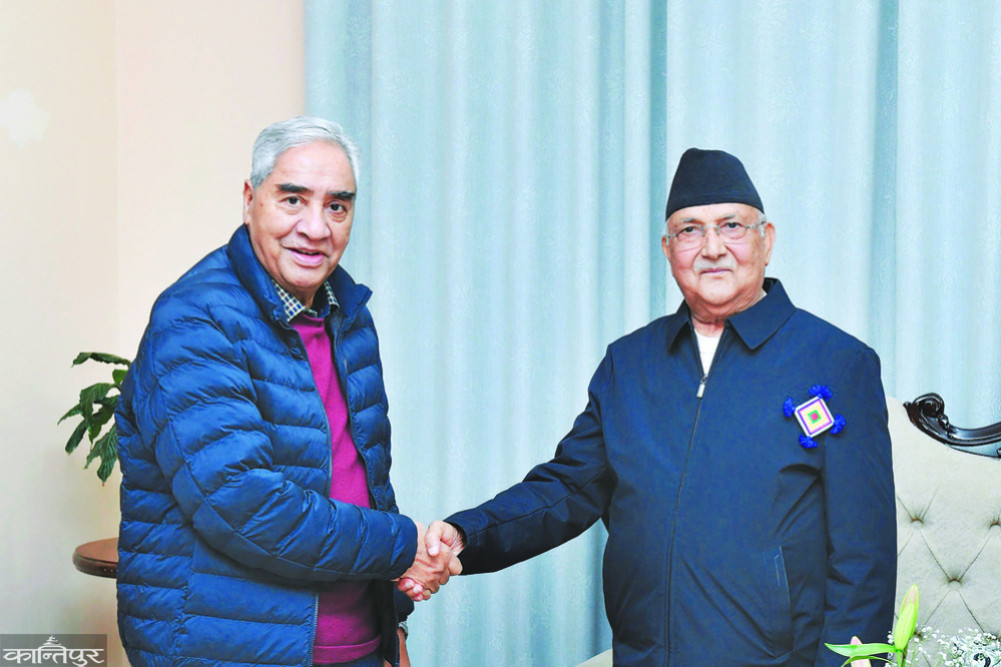
A significant portion of the Nepali people were disgusted by the artless drama of ‘Tin Tikdambaaz’. Among them, Sharma Oli seemed to be the biggest villain, having transformed from the measured politician of two decades ago into a scheming and self-serving tribal leader.
We use Google Cloud Translation Services. Google requires we provide the following disclaimer relating to use of this service:
This service may contain translations powered by Google. Google disclaims all warranties related to the translations, expressed or implied, including any warranties of accuracy, reliability, and any implied warranties of merchantability, fitness for a particular purpose, and noninfringement.
There is nothing new in the pomp, pageantry and cheering seen at the three-day first general convention of the Rashtriya Swayamsevak Sangh (RSS), which came to power with a nearly two-thirds majority after riding the wave of green revolution and destruction on September 8 and 9, 2025. In fact, this is an old drama of Nepali power politics, which has only found a new stage and new characters. The trend of being the first to reach the palace of those who succeeded in becoming the 'new king' by destroying the lineage of their in-laws, killing their clans or deporting their brothers, bowing to the rising sun and warming themselves with a burning fire, saying 'Long live the Maharaj', has been a 'great and glorious' tradition of Nepal since the Shah-Rana reign and has been going on for generations.
In 1990, the so-called 'Chaite Congressmen' could not bear the burden, and even the great heroes of the democratic struggle like Ganeshman Singh, Krishna Prasad Bhattarai and Girija Prasad Koirala had to be crushed for some time. The fact that the 'Iron Man' Singh, who had not been subdued by any ruler among the Rana and Shahs for more than half a century, was reduced to 'iron ashes' in the latter half of his life due to internal strife within his own party and drowned in the Bishnumati River is recorded as a cursed wound in the history of the Nepali Congress. After the 'Mandales' dominated the then UML, the fortunes of the 'Mashales' shone in the incarnation of the Maoists. When King Gyanendra tried to resurrect the political ghost of King Mahendra through tantra and mantra, the Nepali voters consigned the Shah regime to the pages of history after 2008. The victory mania of the Maoists that arose after that could not last even two years.
Far from learning from history, Sushil Koirala, who did not even trust his own experience, uprooted his party's election symbol tree from the Terai-Madhesh region and used its wood to build a strong 'ethnic throne' for UML's Khadga Prasad Sharma Oli to come to power. The potential political downfall of the same Sharma Oli, who emerged as the community leader of Khas-Arya after the brutal suppression of the third Madhesh uprising in 2015 and the failure of the blockade, once again reaffirms the established belief of Nepal's power politics - power does not last forever. A ruler who succeeds to the throne by any means must immediately begin at least two tasks - institutionalization of structures and selection, training, testing and socialization of a worthy successor. Why is that necessary? When ascending the throne, flatterers cheer amid the swastikas of the Batuks, watching the clock, but when descending from the throne, any ruler is ultimately left alone. If there is a strong institution and a capable successor, the legacy remains alive, otherwise it will not take long for the contribution of a lifetime to be erased. It is not unnatural for those seeking an authentic copy of the Sugauli Treaty to be impartial to contemporary history, but to determine the trend of power and governance, one must remember the events of the recent past.
David Armitage, a professor of history at Harvard University, gives a very poignant explanation of the importance of reading history. History is not just the hymns and chants of the ruler, as British politician Michael Gove tried to create a false myth of a single ‘national past’. Nor is it just a means of ‘entertainment’, which people read in their leisure time as a pleasure for their taste. In fact, history is a critical science that questions short-term and narrow perspectives, makes simple stories of cause and effect complex and multifaceted, and searches for ‘paths left untrodden’ in the past. History can overturn established narratives or agreements, broaden the horizons of narrow perspectives, and, in the words of historian Simon Shama, ‘keep the rulers or the powerful awake all night.’ It is within this resistant consciousness of history that the public future of the past is safe.
Withered Tree
A ruler who succeeds to the throne by any means must immediately begin at least two tasks – institutionalizing structures and selecting, training, testing and socializing a worthy successor. Despite some internal and external ups and downs, the Nepali Congress has been synonymous with democratic struggle and institutionalization at least since the unification of the Nepali National Congress and the Nepal Prajatantra Congress in 1950. The moral ejaculation of the Congress, which came to the conclusion that its political ambition was only to rule, also began from that point after the restoration of the multi-party system in 1990. Sher Bahadur Deuba's emergence as a pragmatic politician who would gladly accept minor deviations for the sake of continuing the status quo rather than constant change should be considered a significant political phenomenon after 1991. He had humiliated the UML and forced the hard-line Stalinists of that reformist communist party to become close to the Maoists and eventually to embrace them.
For a while after the Narayanhiti Royal Palace massacre of June 1, 2001, Nepal's history may have seemed like a thrilling spectacle of a man running wild on stimulants. In July of that year, Prime Minister Girija Prasad Koirala resigned and Sher Bahadur Deuba became Prime Minister for the second time. The five-year term of local body officials elected in 1997 was ending in July 2002. Deuba's government, despite having the option of extending its term by one year as per the law, vacates the political arena for the Maoists by allowing elected officials at the village and district levels to resign.
The Maoists break the ceasefire and launch a coordinated attack on various security agencies, including the Royal Nepal Army barracks in Ghorahi, Dang, in November 2001. The Deuba cabinet decides to declare a nationwide state of emergency, accepting the Royal Nepal Army's condition that there should be no legal or practical obstacles to its deployment. After a dispute arises within the party over the extension of the state of emergency, Deuba dissolves the House of Representatives, splits the party, and begins the royal-military rule of King Gyanendra through a phased coup. King Gyanendra's gradual seizure of power begins with his coup on 4 October 2002, declaring Deuba "incapable", and culminates in direct royal rule on 1 February 2005.
After losing his way in the dense jungle, Congress President Koirala, who was adamant that it would be appropriate to return to the starting point and chart the next course of action, was not ready to back down from his stance that the democratic process could not move forward without the restoration of parliament, despite the disagreement and hesitation of some senior party colleagues in his own party. After the start of direct royal-military rule in 2005, even telephones were shut down for a while, army 'super editors' were deployed in the editing rooms, and freedom of expression was restricted. The Maoists, isolated by the crisis, had started to label critics of the royal-military regime as 'forgivable bourgeois', even if they were not friendly forces. The regime used to ignore valid criticism to a certain extent. It was during this period that the essence of this columnist's presentations on public platforms would be - the later the restoration of parliament, the stronger the possibility of the Constituent Assembly elections becomes. In the same vein, I had the opportunity to debate with Sharma Oli, a senior politician who was somewhat obscure in the then UML party, in a discussion program on Nepal Television.
It is said that Sharma Oli still has an elephantine memory. He probably remembers dates and details of the conversation. The columnist only remembers the contradiction between his polite behavior and his strange political beliefs that he experienced after leaving the Nepal Television studio. Nepal Television used to provide transportation facilities to pick up and drop off guests participating in the conversation. Sharma Oli probably had his own means of transportation. Since the Nepal Television motor had gone to deliver someone, the columnist had no choice but to wait in the courtyard. Sharma Oli could have easily gone on his way, but he also stood in the doorway for a moment. I remember that he walked away holding hands only after the Nepal Television vehicle arrived a little late. In the course of standing up and talking, he said something surprising – ‘I cut everything you said on the television screen earlier. In fact, I completely agree with you. But you are a commentator, you speak for the present. I do politics. I speak for history. Tomorrow, I will take over the government. That is why I have to speak with consideration.’ Since the incident happened almost a quarter of a century ago, there may have been a language difference in the conversation I remembered, but it is difficult to forget the commitment made in a gentle tone with an innocent feeling.
Perhaps it was then that the columnist began to carefully watch Sharma Oli’s every political step. It is a different matter to make history by doing your work honestly, but politicians who have ambitions like ‘making history’ or ‘showing history’ often do not respect values, norms or institutional bonds, and personal decency is not reflected in their political behavior. Deuba abandoned principles and loyalty to be a pragmatist, while Sharma Oli was completely dedicated to the goal of making history by becoming a ruler through the application of his principles and loyalty. That made him the most powerful prime minister since Girija among the prime ministers since 2006, but he has not only failed to preserve his legacy during his own lifetime, but has also reached a point of erasing his own history.
Oscar Wilde, a writer famous for his sharp satire, extraordinary wit, and eloquent expressions, has a saying – ‘There are two great sorrows in life.’ The first is not getting what you want. The second is getting what you want.’ Sharma Oli’s ‘series of sorrows’, which he got after he wanted, probably began in March 2018, when he became a powerful prime minister trusted by not only two-thirds but almost three-quarters of the parliamentarians in the 275-member House of Representatives by securing 208 votes out of 268. By limiting Pushpa Kamal Dahal to the letterhead chairman of the Nepal Communist Party, which came into existence after the merger of the Maoists with the UML, he obstructed the process of slowly making alternative communist leadership acceptable. Then perhaps he forgot that with unlimited power comes great responsibility. His light expressions like ‘a rhino is not a rhino’, ‘Mount Everest should not be called Everest’ and ‘Lord Ram must have been born in Thori in terms of kilometers’ were simply ridiculous. Having to dissolve the parliament twice was a sign of political immaturity and mocking the respected president by saying ‘that is not the case’ during the oath-taking ceremony was indecent behavior. Insulting the ‘Indian virus’ and the symbols of a friendly country was not only undiplomatic but also bitter. His ‘map nationalism’ is sure to plague Nepal-India relations for a long time. However, his biggest political mistake was perhaps starting a one-man rule by weakening his own party and the opposition.
His party split and the organization fell apart. Politicians in his own party were unable to take a single step without self-interest. The web of institutional corruption that began with the Covid pandemic was getting tighter and tighter. A significant portion of the Nepali people were fed up with the artless drama of the 'three tycoons' that began to be staged in national politics after the 2022 general election. Among them, Sharma Oli seemed to be the biggest villain, because from the politician who spoke with weight two decades ago, he had transformed into an ethnic mukhtiyar who spoke arbitrarily and indulged in whims. After succeeding in limiting the Congress to a supporting role, his feet were no longer on the ground. त्यसपछि सहरिया मध्यमवर्गीय परिवारहरूमा ‘कंसबाट मुक्त गराउने कृष्णको प्रतीक्षा’ जस्तो तीतो वितृष्णा फैलिन थालेको कुरा चाकडीदारहरूबाट घेरिएका मुख्तियारलाई सुनाउन सक्ने आँट भएको उनको दलभित्र कोही देखिएन । उनका भूल, गल्ती र राजनीतिक अपराधहरूको फेहरिस्त लामै होला तर ‘अहम् ब्रह्मास्मी’ पछि ‘तत् त्वम् असि’ भन्ने वाक्यको मर्म बुझेर वैकल्पिक नेतृत्व विकसित गर्नुको साटो ‘मपछि प्रलय’ को धारणामा उनी अन्तिम समयसम्म अडिग रहे । अन्ततः ९ सेप्टेम्बर २०२५ मा नेपाली सेनाले ‘सुरक्षा’ का नाममा उनलाई राजीनामा गराएर हेलिकोप्टरबाट उद्धार गर्दै प्रकारान्तरले बन्दी बनाउनुपर्ने अवस्था कसरी आयो होला भनेर सोध्ने हिम्मतसमेत आज उनको राजनीतिक चाकडीबाजहरूको जमातमा कसैले गर्न सकेको देखिँदैन ।
अस्ताचल सूर्य
पूर्वी पहाडको सामान्य परिवारबाट झापा हुँदै सत्ताको शीर्षसम्म पुग्न सफल राजनीतिकर्मी शर्मा ओलीको सम्भाव्य राजनीतिक बहिर्गमनमा सामान्यजन त के, उनकै पार्टीका समर्थकहरूले समेत दुःखमनाउ गर्नुपर्ने कुनै कारण छैन । उनले ‘माका फुइँ’ र ‘झरेको आँप’ भन्दै खिल्ली उडाएका समुदायहरूमा खुसियालीसमेत देखिन सक्छ । डडेलधुरा र कञ्चनपुर हुँदै तीन दशकभन्दा बढी समयसम्म राष्ट्रिय सत्तावृत्तको प्रमुख पात्र रहेका देउवाका व्यक्तिगत एवं सार्वजनिक जीवनका उपलब्धिहरूको लेखाजोखा पनि कम प्रभावशाली छैन । तर, ती दुई राजनीतिकर्मी मिलेर ध्वस्त पारेका राजनीतिक संरचना र छिन्नभिन्न बनाएका दलहरूले भने तिनका विरासतलाई कलंकित गरिरहने सम्भावना प्रबल छ ।
सुकेको रुख एउटा रूपक हो । सुशील कोइरालाले काटेको रुखमा पात पलाउनुअगावै आफन्तवाद, स्वार्थवाद र अवसरवादको विष हालेर सुकाउने काम गरेका देउवाले कुनै बेला शक्तिशाली रहेको दललाई जीवन शक्ति, नवीनता वा जनसमर्थन गुमाइसकेको राजनीतिक धारमा झारिदिएका छन् । कतिसम्म भने, नेका विभाजित हुन्छ वा सग्लै रहन्छ भन्ने कुरामा समेत सामान्यजनको खासै रुचि छैन । एमालेको हालत त्यसभन्दा पनि खराब छ । आफ्नो प्रभाव, शक्ति र लोकप्रियताको अन्त्यतिर पुगेको नेतृत्व पंक्ति, पतनोन्मुख संगठन, निरीह राजनीतिक शक्ति, एक युगको समाप्तितिर लागेको समर्थन–आधार र अस्ताउँदै गएको विचारधाराका लागि ‘अस्ताचल सूर्य’ भन्दा उपयुक्त बिम्ब अरू केही हुन सक्दैन ।
यसलाई ‘सुनौलो उदासी’ किन भनिनुपर्छ भने– बूढो र खोक्रो रुख सुक्नु थियो, सुक्यो । भोलि फेरि त्यसकै बीजबाट अर्को बिरुवा हुर्किनेछ । थकित र क्लान्त सूर्य अस्तायो, केही छैन– भोलि बिहान उदाउने सूर्य त्यही रहे पनि नयाँ ऊर्जा लिएर आउनेछ । चिन्ता के मात्र हो भने, देशको वर्तमान व्यवस्था इतिहासको साटो ‘अल्गोरिदम’ पढ्नेहरूको हातमा छ । तिनले पनि सक्षम विकल्पको महत्त्व ठम्याउन सकेको देखिँदैन । सायद जंगलमा जहाँबाट बाटो बिराएको हो– २८ मे २०१२, जुन बेला पहिलो संविधानसभाको अवसान भएको थियो– त्यहीँ फर्केर भविष्यका लागि नयाँ गोरेटो कोर्ने जिम्मेवारी ‘जेन अल्फा’ भनिने र अन्तर्जालको आकर्षणबाट सुस्तरी विरक्त हुँदै जाने ‘जागरुक पुस्ता’ ले निर्वाह गर्नेछ ।