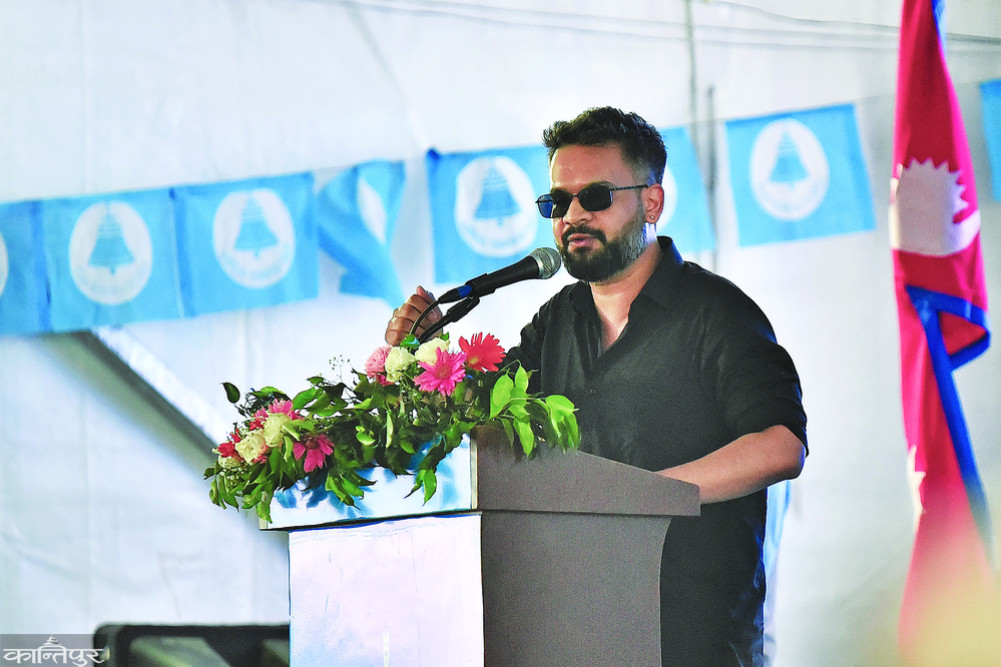
The government's actions so far show that 'dictatorship style' is beginning to emerge in Nepal. Prime Minister Balendra Shah needs to be alert to political risk-taking in a timely manner.
We use Google Cloud Translation Services. Google requires we provide the following disclaimer relating to use of this service:
This service may contain translations powered by Google. Google disclaims all warranties related to the translations, expressed or implied, including any warranties of accuracy, reliability, and any implied warranties of merchantability, fitness for a particular purpose, and noninfringement.
Prime Minister Balendra Shah's determination to control corruption is welcome. This step has the support of the Nepalis. In fact, the Nepali economy is crippled by corruption. A crippled person cannot walk properly, nor can he think from a long-term perspective.
Corruption wastes physical capital and destroys the capital structure that has been built. And, it also destroys the country's social capital by creating an environment of distrust between different levels of society. Therefore, Nepal is not a country with a shortage of capital, but a country with a shortage of honesty. In such an environment, the efforts of anyone who says, "I will create an environment of honesty in the country" are commendable.
Strict action should be taken against the corrupt. In this context, the passport scandal is currently in the news in the country. The public will gradually come to know the reality of this, but one unpleasant fact is that the government warehouse of passports is emptying. What to do if a country that dreams of sending young people abroad and developing them runs out of passports? How did this situation arise? Why did it happen? And, how did it happen? It is natural to ask questions.
Innocent Authority
Perhaps the Authority came to the center of attention while searching for answers and solutions to the above questions. According to the press, it was seen that ‘a complaint was filed with the Authority regarding the passport scandal, but it has been confused so far’. Suspicious about this, the Prime Minister’s Office started an express search and investigation. According to the national press, the head of the Authority, Prem Rai, was called, pressured and even made to write a letter of arrest warrant.
Now the question arises, what is the constitutional status of the Commission for the Investigation of Abuse of Authority? What is the status of the Constitution that makes it clear that this institution is independent and does not have to take instructions from anyone to fulfill the responsibilities given to it by the Constitution? Under the principle of constitutionalism, the Prime Minister's advisor summoned the high-ranking officials and even the head of an independent unit of checks and balances to his office. According to the published news, he was 'interrogated' and 'detained for hours' and forced to take some decisions. Again, the question arises, where did the advisory group get the right to attack the constitutional level of the authority? What is even more sad is the helplessness of the authority. It seems surprising that the head of an independent constitutional unit accepted the pressure and insult on his organization without even a single retort. It is not a good sign for the country to sit idly by while attacking the constitutional existence of his organization.
Personally, I do not know Prem Rai and I do not know the Prime Minister's advisors either. However, both of them (one by resorting to power and drugs and the other by showing a pathetic face of helplessness) have created a situation of serious doubts about the further continuation of Nepal's democratic journey. If there is truly no trust in the leadership of the authority, then Prime Minister Balendra Shah should dare to impeach Prem Rai in the parliament and remove him. That is the way, otherwise the Prime Minister's Office should accept the institutional dignity of the institutions established in accordance with the spirit of the constitution.
Express Highway
According to the published news, they were 'interrogated' and 'detained for hours' and forced to take some decisions. Again, the question arises, where did the advisory group get the right to attack the constitutional level of authority? The Prime Minister's statement that 'you have to run when going on the express highway' is attractive in itself. In this era of rapid development, it is natural to say that everything should be fast. Even today, the growth rate of Nepal's national income is only about four percent. To take it at a faster pace, investment should be increased, and to increase investment, it is not impossible to argue that the debt burden should be increased from 44 to 54 in the ratio of national income. However, no one would call this readiness shown by a finance minister natural and 'express development', but rather a model of exciting risk-taking. In the twentieth century, even big leaders have fallen into the pit of a similar 'express highway' model.
In our friendly country, China, the revolutionary leader Mao set a goal of 'bringing the country to the level of a prosperous country in 15 years'. And, for that, he completely abolished private ownership. He dreamed of rapid development based on concepts like production brigades and production divisions and built agricultural organizations in a military style. In order to develop the industry at a rapid pace, he adopted a policy of opening iron factories in every village. The Cultural Revolution campaign was launched to get rid of the old capitalist mindset. However, the vehicle of that speed led to the death of millions of Chinese people in the largest famine in the twentieth century and the country reaching a state of collapse.
Pragmatists like Zhou Enlai tried to stop Mao's 'Development Express' and saved the Chinese economy from collapse. However, the real development revolution began only after the rise of Deng Xiaoping and the halting of the 'Revolutionary Express' in the name of development. In 1980, China's economy, which had a per capita income equal to that of Nepal and India, has undergone radical changes today through institutional construction, encouragement of the private sector from production, and the expansion of foreign investment. What would have happened in China if it had continued to run on Mao's express route? Therefore, the methods and processes associated with this cannot be ignored in the name of maintaining peace and security in the country or ending corruption. If we continue to boast that ‘my intentions are good’, but ignore or do not pay attention to the organs connected to the implementation of that intention, ‘democratic dictatorship’ will become institutionalized. And, the political crisis will only worsen. If this context is ‘put aside’, won’t ‘democratic dictatorship’ flourish in the name of democracy? And is this our goal? It would be appropriate for the Prime Minister to consider.
The political system as explained by the Constitution of Nepal is constitutional, welfare liberalism. Its success depends on the intention of the government. When it comes to ‘democracy’, from North Korea to Cuba or Venezuela – everyone calls themselves ‘democratic’. However, the reality is that elections alone do not determine the success of democracy, it is the intention of the rulers.
The government's activities so far give a glimpse of the beginning of the 'authoritarian style' in Nepal. Prime Minister Balendra Shah needs to be alert to political risk-taking in a timely manner. Indeed, such attempts were made by those in government before him and they failed miserably. May the history of this political risk-taking not be repeated in the country by the new generation.