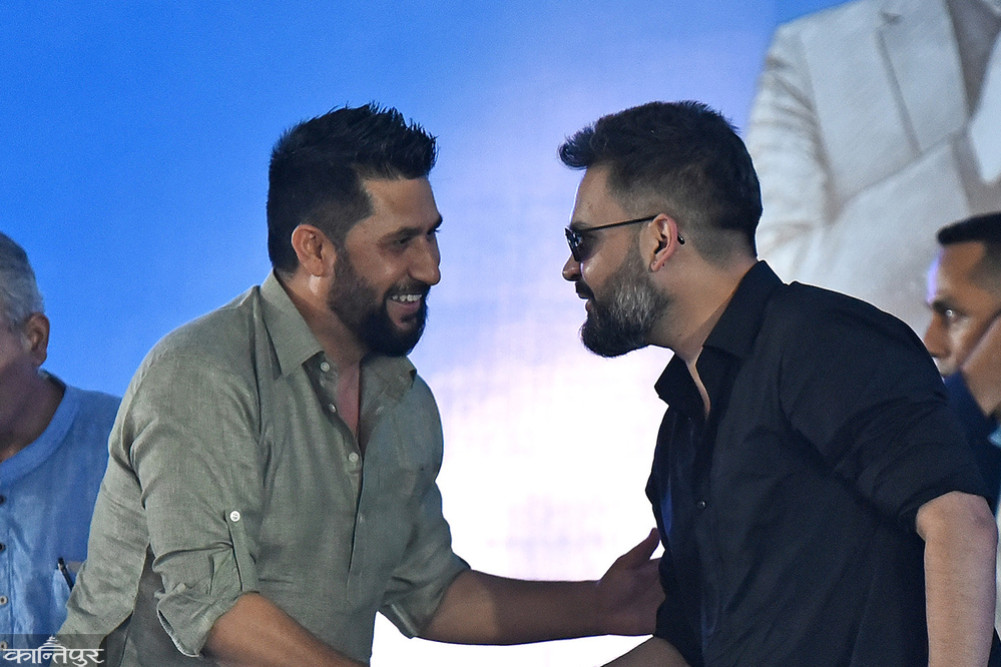
Leaders are competing to prove themselves taller by building 'towers' on the peaks of gentle and peaceful mountains. The so-called top leaders of political parties have won the votes of the people, but have not been able to win their hearts.
We use Google Cloud Translation Services. Google requires we provide the following disclaimer relating to use of this service:
This service may contain translations powered by Google. Google disclaims all warranties related to the translations, expressed or implied, including any warranties of accuracy, reliability, and any implied warranties of merchantability, fitness for a particular purpose, and noninfringement.
The National Independent Party, which succeeded in forming the government by securing a majority in the elections held as a result of the Gen-G rebellion, has organized its first general convention in Chitwan in a grand manner. For this, party chairman Ravi Lamichhane should be congratulated. No matter what anyone says, Lamichhane is the person who conceived and built the Rashtriya Swatantra Party, raised it and brought it to power. For this, whether you agree with him or not, you must congratulate him. He must have done many good and bad things during the party building process. However, he succeeded in building the party despite being embroiled in many disputes. For that, he must have made some right and wrong compromises. That issue is in its own place. He was not disturbed by the events and accidents of the recent past. The learned leader of the Nepali Congress, CK Prasai, used to say – ‘In politics, there is no permanent friend or enemy.’ Ravi embraced this reality. He did a lot to raise ‘necessary’ financial resources for the mobilization of contemporary politics. He endured a lot of hardship. He also became the Deputy Prime Minister. Finally, the National Independent Party came into existence as an organized political party. Ravi’s ambition was realized.
In the elections held as a result of the Gen-G rebellion, the country’s leading political analysts want to give the credit for the current victory of the National Independent Party to Walendra Shah. If it were not for the presence of Walendra’s miraculous personality, such a ‘large’ public opinion would not have been seen in favor of the Rashtriya Swatantra Party. However, this is a symbolic issue. If there were no Rashtriya Swatantra Party, there would be no question of Walendra winning the elections alone. There are a large number of election experts who have closely watched the Nepali elections and reached conclusions. They have seen the coordination between RSVP Chairman Ravi and senior leader Walendra in this way.
It is true that Walendra Shah was at the center of the election. His personality was highlighted by RSVP workers and supporters. Chairman Ravi Lamichhane was not very active in the election campaign. He was confident that Walendra Shah's 'name is enough' to win the election. Ravi and his allies were confident about the growing resentment of the people against the Nepali Congress and the communist parties. This was the meaning of the RSVP fielding Walendra as the prime ministerial candidate. The RSVP's decision to advance Walendra as the prime ministerial candidate was strategic. This strategy was not only the result of the diplomatic skills of the RSVP leaders. Discussions about the successful election are still ongoing.
A clear and proper explanation of the successful election that was caused by the destruction of Bhadra 24 last year in the name of the Gen-G movement has not yet been given. The suspicion that the election that came as a result of the Gen-G movement was manipulated by the security forces still remains. The Nepali people are more interested in good governance than in democratic practices.
Balendra Shah's performance as Prime Minister has also not been in line with the dignity of the Constitution of Nepal. The Prime Minister has not even maintained the dignity and respect of the newly elected Parliament. He has been seen as very restless in Parliament, and he has also started to be seen as limited to a small group in the government. There should be a discussion in Parliament about Balendra's behavior as Prime Minister. That has not happened. This cannot be considered a good sign for the Rashtriya Swayamsevak Sangh (RSS) itself.
Violating constitutional and parliamentary norms by political parties as soon as they get a majority in the elections is a disorderly behavior. The Rashtriya Swayamsevak Sangh (RSS) is not a party that came to power through a revolution. The Rashtriya Swayamsevak Sangh (RSS) Chairman and the Prime Minister have not yet thought about this matter.
Prime Minister Balendra's distaste for the country's constitution is becoming clear. People on the streets are starting to say - this constitution seemed good. However, it is no longer a dynamic constitution for us. It developed a leader-dominated system. However, it did not do credible work for the people. Corruption increased under the patronage of politicians. Development projects running in the country were not transparent. Farmers were not encouraged to increase agricultural production and industrial activities. In a country known to be rich in water resources, commercial development of water power did not occur. Dependence on all aspects of Nepali people's lives was increasing. A very unfavorable situation was created for the country and the people. The trend of going abroad in search of work started increasing. The main leaders of our parties turned out to be the ones who shamelessly exported their human resources abroad. They were not responsible for the country and the people. People who do politics started to enjoy the pride that they are not servants of the people, but rulers. Unfortunately, this pride is also seen in the behavior of Prime Minister Balendra. His character is also not different.
The imaginative style of building the country has never been reflected in the faces and behavior of the leaders who came to Nepali politics after the change. Even though the voices of development echo in the voices of the leaders, the people have not been able to see those voices moving towards the goal. Now the country has been transformed into a federal republic. And also, the desire for change is seen among the leaders, but there is no urgency in that desire. Whoever the Prime Minister is, they have enjoyed the game of power. The country's leaders have been shown to be insensitive to the people. They are neither imaginative nor do they have any practical knowledge. The leaders are in a race to prove themselves tall by building 'towers' on the peaks of gentle and peaceful mountains. The so-called top leaders of political parties have won the votes of the people, but have not been able to win their hearts.
Now, there are reports that the scholars around Prime Minister Balendra are preparing a proposal to review the constitution. Balendra and his associates must have started preparing for the amendment of the constitution, keeping in mind the regular cycle of changes taking place in this country. After the change of 2062, the 'inclusive' constitution of the Federal Republic of Nepal was formed in 2072. However, constitutional scholars had expressed the opinion that the constitution lacks a soul. Constitutional scholars have not stopped discussing the constitution even now. However, the writing of the constitution alone is not enough. How is it used? Many issues depend on that.
If the spirit of the constitution is to be revived in the coming days, the top leaders of the party must first be trained in practical politics. However, many leaders have crossed the age limit. While reviewing the constitution, the age of the leaders must also be taken into account. Whatever struggle our leaders had for the country during the post-2007 revolution, they have already recovered the cost with interest. Change in the country will not come by making mistakes in the constitution alone. For change, the first thing to do is to understand the desire of the society. Leaders who are currently active in politics and those who will enter politics in the coming days should pay special attention to the exercise of constitutional rights by the Nepali society. If that happens, we can hope that the country will reach a somewhat comfortable state.
At the convention of the Rashtriya Swayamsevak Sangh (RSS), Nepali Congress leader Gagan Thapa has said that the Congress is not an enemy of the RSSS, but a competitor. If the Congress remains divided in its current state, this statement by leader Thapa does not make much sense. It does not take long for competition in politics to turn into hostility. Leader Thapa must have known this. The practice of taking politics as a profession destroys the organization. It may be easy to grasp the formulas of the executive and judicial systems for political success. However, that tendency destroys politics.
It is not unusual for a party with a majority in parliament to try to bring a program of radical change for the development of the country. The Rashtriya Swayamsevak Sangh (RSS) has not only got a majority now. This must have badly shaken the Nepali Congress, the Communist Party of Nepal and other parties and their leaders. On the other hand, influential leaders of the Congress do not seem to have paid attention. Congress leader Gagan Thapa, who appeared to be decorating the stage of the special convention on the eve of the elections, must be surprised right now. The Congress party fell far behind in the elections due to its inability to analyze the time and situation. Now, they must have realized this – it is easy to be popular in politics. But, it is difficult to take wise decisions. In today's times, the basis of politics is power. There are not just one example of such power establishing a king as a rank and a rank as a king.
World politics today is not like it was twenty years ago. Small and underdeveloped countries are involved in many troubles whether they want it or not. In our own context, the discussion of various organizations active during the Gen-G movement and the various personalities associated with those organizations gives a profound introduction to our social, political and diplomatic situation. We have reached a point where we are unable to think about our national and internal interests. In addition, the dangers of internal conflicts have also been raised in our minds. Our political parties are mired in internal strife. In this situation, if our national security system and political leadership cannot reach an understanding, the country is sure to be mired in conflict.