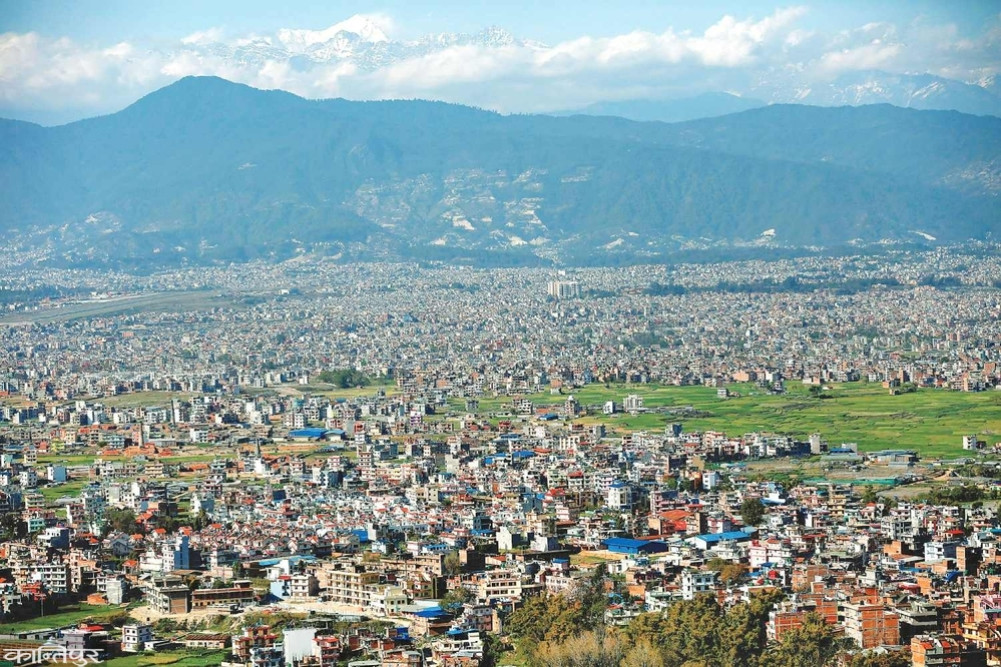
Only if the Kathmandu Valley, which is divided into 18 regions, can be tied into a unified governance rope, will the '3 Cs' of cooperation, coexistence, and coordination envisioned by the Constitution of Nepal be realized from the foundation of Singha Durbar. And federalism will attain a sustainable form.
We use Google Cloud Translation Services. Google requires we provide the following disclaimer relating to use of this service:
This service may contain translations powered by Google. Google disclaims all warranties related to the translations, expressed or implied, including any warranties of accuracy, reliability, and any implied warranties of merchantability, fitness for a particular purpose, and noninfringement.
The natural geography or governance-administrative structure of the Kathmandu Valley has been fragmented into 18 local bodies and 247 wards. On top of that, there is a maze of parallel projects of the Bagmati Province government ministries, budgets and federal ministries.
The Electricity Authority is not allowed to lay underground cables blocking the path of the passers-by, the Telecommunication Authority digs a path to carry its own cables. There is zero coordination between electricity and telecommunications. The next month after the road is built, the water supply starts the sewage work. There is a 'Mayor Forum' registered as an NGO for coordination between municipalities, but due to the disagreements of the metropolitan city, it has not been very effective.
In addition, according to the Kathmandu Valley Development Authority (KVDA) Act, 2045, issued during the Panchayat period, there is great dissatisfaction among local bodies that the established institution is working against the spirit of constitutional autonomy after the current federalism. It is reflected from time to time as a strong evidence of the contradiction between governments.
The matter is not only the duplicity of the three levels of government, but the effective results of coordination between one municipality and another municipality have not yet been achieved. Once, when Lalitpur Metropolitan City wanted to build a tourist-friendly bicycle lane from Budhanilkantha to the southern part of Lalitpur, neither the municipalities agreed nor did any higher body coordinate. We are constantly experiencing the administrative chaos of digging one road within the same valley, while another demolishes it, and neighboring municipalities becoming hostile in sewage and waste management. And, the result is that the valley has not been as organized as it should be.
The debate on constitutional amendment has become a central political agenda in the country. The government of Prime Minister Balendra Shah, who has himself led the Kathmandu Metropolitan City, has formed a task force to prepare a concept paper for constitutional amendment. At this historic juncture, when the Task Force has already begun its work, it is imperative to bring it up as an issue in the debate on constitutional amendment to address the fragmentation of governance in the Kathmandu Valley and restructure it into a unified federal capital region.
We should carefully study the experiences of four countries in the world on this issue and move forward. Looking at these experiences, Nepal can learn from good or empirical practices so far rather than imitating the same model verbatim. When analyzing the forms of governance adopted by these four countries for managing their capitals, they have adopted different systems to maintain a balance between national sovereignty and local autonomy.
America (Washington DC): America established Washington DC as a federal district from other states to keep the capital free from state/provincial politics. There is a system of elected mayors and councils at the local level, but the right to amend laws and budgets or use vetoes is reserved for the federal parliament and Congress. Voters in the area They have been deprived of the right to vote in the Parliament/Senate. For this reason, the citizens here have been continuously protesting for decades, saying that the tax system without representation is invalid. In a democratic country like the United States, the lack of voting rights for the residents in the Senate and complete federal control, although administratively convenient, have stifled the democratic representation of the citizens.
India (New Delhi): The Indian Constitution has given New Delhi a special status as the National Capital Territory. In Delhi, where the elected Chief Minister and the Legislative Assembly are functioning, the Lieutenant Governor appointed by the Central Government has taken control of security, land and public order. As we have heard, the continuous legal-political conflict between the Central Government and the Delhi State Government is not a new issue. Since 2015, this dispute has reached the Supreme Court several times, but it is still pending. The conflict between the State Government and the Central Government has led to delays in the development and service delivery of Delhi.
Indonesia (Jakarta): The mayors of the five cities under the Special Capital Region of Jakarta, which is recognized as a province, are not elected but are civil servants appointed by the governor. Although the coordination and cooperation of the one-door system in the infrastructure development and decision-making process of this system run by employees seems easy, the lack of people's representatives at the local level has weakened the democratic control and accountability of citizens over local governments. Although the Jakarta model seems administratively efficient, it does not exactly match Nepal's federalism principle.
Philippines (Metro Manila): Metro Manila is a group of 16 autonomous municipalities. Although the Metropolitan Manila Development Authority was formed with a head appointed by the President to coordinate among municipalities, it does not seem to be effective due to the lack of legal sovereignty and an independent budget, so the consent of local mayors must be relied upon to provide urban services and facilities to the people. As a result of this, Manila is one of the most unorganized cities in Asia today. The structure of the current Kathmandu Valley Development Authority is largely similar to the Manila model.
A comparative study of the above four practices shows that three aspects (first – clear constitutional basis, second – elected leadership, third – valley-wide strategic authority) are indispensable for a vibrant and organized capital city governance.
The ‘3S’ of the Constitution of Nepal and the Kathmandu Valley
Article 232 of the Constitution of Nepal states that the relationship between the Union, Provinces and local levels shall be based on the ‘3S’ principle of cooperation, coexistence and coordination. Why has the ‘3S’ not been able to work effectively to beautify the Kathmandu Valley? The answer to this root question must be sought in structural reasons. Let us look at it in three issues.
First, lack of coordination. Schedule-8 of the Constitution has given the local level the sole right to urban planning and local roads. On the one hand, federal/provincial ministries directly allocate budget for Kathmandu's roads and sewers by citing the common rights clauses of Schedule-7 and 9 and the old KVDA Act. On the other hand, since no law has been enacted on common rights yet, the problem of encroachment on this area of work will persist as long as there is legal ambiguity.
Second, the crisis of cooperation. The long-standing problem of the Valley is that there is no systematic cooperation system between Kathmandu Metropolitan City and other municipalities in the Valley in waste management. At the current landfill site, 22 municipalities, including 18 in the Valley and 4 outside, dispose of waste, but there is no common institutional mechanism for it yet. The current legal framework does not provide a basis for an integrated waste management plan, common landfill sites, and joint infrastructure investment.
Third, the challenge of coexistence. The federal government of Nepal, which still has a centralized or control-oriented mentality, is continuously eroding the constitutional spirit of coexistence as the municipalities in the valley see interference from the federal government when they claim jurisdiction over historical heritage within their own areas, and the local level sees infringement of their jurisdiction/rights when the union imposes plans. The root cause of this is the fact that the limits of rights are not clarified by law.
Constitutional amendment and policy discussion
Based on all the analysis, discussions at the following 5 policy levels are necessary to move towards the constitutional model of the Kathmandu Valley Capital Region.
First, the constitutional identity of the Special Capital Metropolitan Region is the main issue. In the current situation where the debate on constitutional amendment is going on, it is appropriate to declare 18 municipalities or the valley as a special capital region. The current municipalities should be transformed into administrative and service delivery units and the authority for comprehensive strategic planning and infrastructure should be given to a single integrated umbrella mechanism, thereby guaranteeing the security of tenure of the current people's representatives, continuity of ward-level service delivery, and protection of local identity.
Second, the constitutional provision for the head of the capital region is another important issue. It is not easy to lead the entire valley together. For this, a constitutional provision should be made for the post of head of the capital region. Learning from the Delhi controversy, the jurisdiction of this post should be clearly defined in the constitution. An amendment to the Election Act is necessary to arrange for direct elections across the valley or elections through the electoral college of the people's representatives of the municipality.
Third, the establishment of the Capital Region Development Council is necessary. The formation of the Capital Region Development Council is useful as an alternative to the KVDA Act, 2045, which was introduced in the unified state. From the experience of Metro Manila, we should not be stingy in giving the council an independent revenue source, the right to make laws, and the right to approve infrastructure development without creating a powerless coordination body. If the council includes mandatory representation from the Urban Development Division of the Ministry of Physical Infrastructure of the federal government, the Ministry of Physical Infrastructure of Bagmati Province, and the mayors of the 18 municipalities in the valley, all stakeholders will have ownership.
Fourth, constitutionally guaranteeing revenue is the core of fiscal federalism, which makes federalism sustainable. If a constitutional provision is made that a portion of the property tax, vehicle tax, and commercial tax revenue within the valley is mandatorily deposited in the Capital Region Development Fund, the foundation stone for capital development can be laid.
Fifth, special federal rights should be given to security and heritage. Following the good practice of Washington DC, the special jurisdiction of the federal government in areas where diplomatic missions are located, Singha Durbar, Presidential Palace, important monasteries, religious and cultural areas, and areas sensitive to national security should be clearly mentioned in the schedule of the constitution.
Potential problems
It is not without the possibility of obstacles in this implementation. There needs to be an intensive discussion on how to continue the identity of the main city of the current valley for hundreds of years. The mayors and people's representatives of the 18 municipalities of the valley may voice opposition from political parties due to the fear of weakening their political weight and influence. The Bagmati Province government may not show readiness for this due to the fear of losing both revenue and rights. Since the bureaucracy is traditional by nature, there is a possibility that it may slow down if it does not realize its important role in the new system.
Kathmandu Valley is not the only area of work of 18 local bodies. This is not only the identity of Nepal, but also the identity of the country in the international world. The remnants of the unitary system are still alive and the city is becoming ugly and uninhabitable due to the old laws and the new race of federalism.
We should learn from the Delhi dispute and the current experience of Metro Manila. Prime Minister Balendra Shah has previously experienced local governance firsthand as the mayor of Kathmandu. He should use the political favorability of the parliamentary majority to restructure the Kathmandu Valley as a single capital region in the upcoming constitutional amendment.
Only if the Kathmandu Valley, which is divided into 18 regions, can be tied into a unified governance rope can the principle of the '3Cs' (cooperation, coexistence and coordination) envisioned by the Constitution of Nepal be realized from the foundation of Singha Durbar. And, federalism will achieve a sustainable form.