He should clearly state his acceptances, rejections, and the provisions he wants to change regarding the constitution. He should also clearly state the various policies he wants to establish, from economics to social concerns.
We use Google Cloud Translation Services. Google requires we provide the following disclaimer relating to use of this service:
This service may contain translations powered by Google. Google disclaims all warranties related to the translations, expressed or implied, including any warranties of accuracy, reliability, and any implied warranties of merchantability, fitness for a particular purpose, and noninfringement.
The four-year journey of the Rashtriya Swayamsevak Sangh (RSS) in national politics has been very intense. When the party was announced on 7 Ashad 2079 under the leadership of Ravi Lamichhane, who gained popularity as a television presenter, there were not many politically familiar faces with him. However, under the leadership of the same group, the party has achieved the height of success in the general elections held in Mangsir 2079 and Falgun 2082. In the last election of the House of Representatives, it is leading the government by winning 182 out of 275 seats.
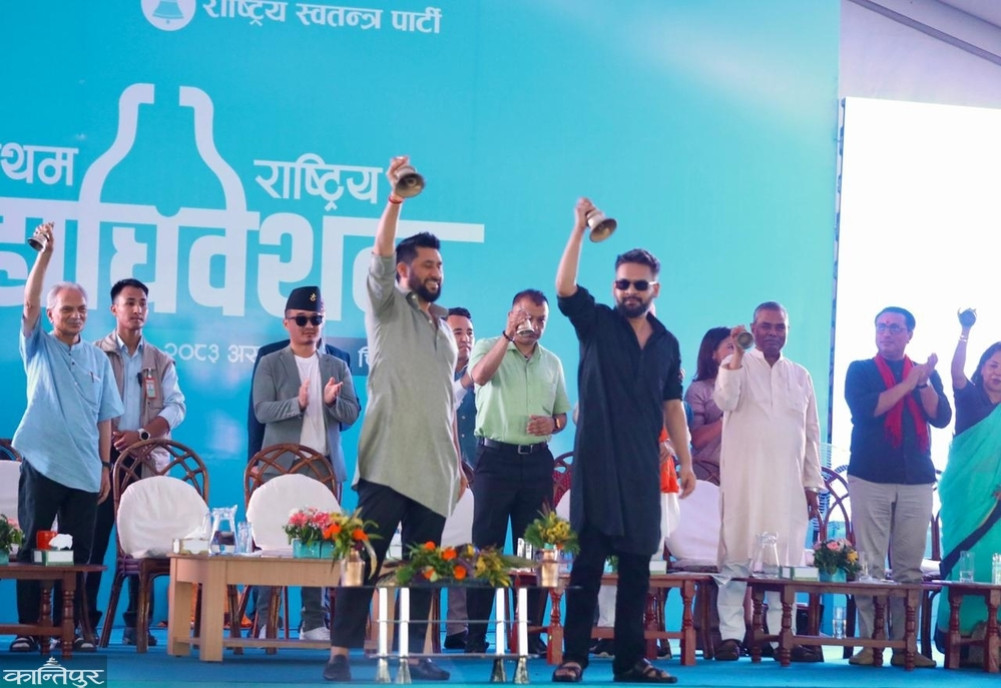
The shape that the party has taken after only four years of its establishment is a new event in the history of Nepal. At this time, this same party is engaged in its first general convention. In the process, it needs to draw energy from the success achieved so far and realize the challenge of future responsibilities. Mainly, it needs to be able to find a way to institutionalize the extraordinary trust of the people and convert it into achievements. For that, the ideological and organizational framework that determines the general convention is awaited.
Some distortions and anomalies that were firmly established in Nepali politics played a role in facilitating the rise of the Rashtriya Swayamsevak Sangh (RSS). Corruption and misrule had increased in particular. At that time, the leaders of the upper levels of the so-called big parties were involved in serious irregularities. However, there was little faith in the public that they would be investigated and action would be taken against them. The lifestyle of the leaders' families or relatives seemed to be improving, but people were skeptical about the financial resources to support it.
With the dominance of families in important institutions and bodies in the state, partisanship was high. They could not establish the belief that they could or were doing impartial work. The frustration created by such a situation led to the Gen-G movement in Bhadra 2082. The Rashtriya Swayamsevak Sangh (RSS) had raised its voice against corruption and inconsistencies since the day of its establishment. It had given the message that it was the only party that could fight against it. At present, this same party is leading the government. The backbone of the government is a strong RSS. The general convention should set a clear framework of concrete commitments and work performance so that it can overcome the disappointment in the citizens and succeed in its own promises.
The democratic practice within the RSS has also been viewed meaningfully. Since four years have passed without a general convention and since they have been uniting with different individuals and parties, they have been operating on an ad hoc basis. Now, the method and process of selecting leadership should be made democratic. This is not just a matter for the party concerned, because parties are public institutions and assets. The methods and processes within them establish standards. They create public interest.
Therefore, the responsible party officials can choose both the path of consensus and democratic practice (election), but they should not deprive themselves of the path of competition in accordance with democratic practice. The main issue is that both processes should not create an uncomfortable situation within the party. That is, the general convention should not create factionalism, bitterness and disappointment in the RSP. Only when a strong party moves forward and is committed to its goals can the general public benefit from the party concerned.
It has been operating on ad hoc basis for four years without a general convention and has been uniting with different individuals and parties. Since its establishment, the RSP has often had ups and downs. Therefore, when discussions were held about the party, the discussion was mainly about the leadership. Its ideological issues were often overlooked. Political analysts expressed doubts about the party's views and commented that they were not clear. Even though the leadership of the Rashtriya Swayamsevak Sangh (RSS) tried to defend itself by citing its documents, the image of the leadership seems to have become more entrenched in the public. There are a few reasons for this. First, the RSS has not spoken with the same firmness on theoretical and ideological issues as clearly and forcefully as it has on other issues.
The clarity sought by society on the fundamental pillars of the constitution, especially federalism and secularism, has not been expressed in its words. Complex language and conditional terminology have created confusion among people. Therefore, it should clearly state its acceptances, rejections, and provisions it wants to change regarding the constitution. It should also clearly state the issues it is trying to establish, from the economy to various policies that concern society. The appropriate platform for this is the first general convention. At the inauguration ceremony of the general convention on Sunday, President Lamichhane has tried to clarify such aspects and show commitment, but in the coming days, trust must be earned by having adequate dialogue with the people.
Another important aspect is the RSP government. Party operation and state operation are separate issues. But if the party can be made a critic and supporter of the government, the government has a greater chance of success. In the past, there have been many examples of problems in both due to lack of coordination between other parties and the government. At present, the RSP has a strong presence in the House of Representatives, but the lawmakers are not able to guide the government in the way it should.
As a result, the sovereign parliament itself has come to look like a supporter of the government. Therefore, the role of the government and the party in the parliament should be reviewed at the RSP general convention. The reason why this issue is important is that the RSP had shown its manifesto in the election and asked for votes. The party has a responsibility towards that. And, the responsibility of fulfilling the promises in the manifesto basically lies with the government. Therefore, the RSP should review the government's progress towards fulfilling the promises presented in the manifesto and show the right path.
The depth of the open discussions among the delegates in a democratic environment and the common path that will be set at the general convention will make the party's journey mature. The people have made the RSP a strong party with great expectations. The same party has formed the government. It is its responsibility to change the face of the country. Therefore, only if it achieves success can the disappointment that has gripped the people earlier be transformed into a positive achievement. If the RSP is also ineffective and the government is also confused, the citizens will fall into another pit of disappointment. Therefore, the RSP needs to objectively review the situation during the general convention, be clear in its ideological approach, and adopt democratic methods in its leadership, and take careful steps forward.