Citizens expect a large portion of the government budget to be spent on development work so that they can benefit from it. In Nepal, the situation is exactly the opposite and has been established as a legacy.
We use Google Cloud Translation Services. Google requires we provide the following disclaimer relating to use of this service:
This service may contain translations powered by Google. Google disclaims all warranties related to the translations, expressed or implied, including any warranties of accuracy, reliability, and any implied warranties of merchantability, fitness for a particular purpose, and noninfringement.
Citizens expect that a large portion of the government budget should be spent on development and construction work, so that they can benefit from it. In Nepal, the situation is exactly the opposite and has been established as a legacy. Out of the budget of Rs 2124.34 billion presented by Finance Minister Swarnim Wagle on 15 Jestha, current expenditure is Rs 1270 billion. Only Rs 431 billion has been allocated for capital expenditure (mainly expenditure on development and construction) and Rs 422 billion for financial management.
Since the past, since the revenue has not been collected as per the target, there has been a compulsion to take loans for regular and development expenditure. Recently, a cycle has been created of taking loans for daily operations and repayment of principal and interest on public debt. This is making the budget structure unbalanced. Therefore, the government should reduce the debt burden by making effective measures to increase economic growth and revenue collection.
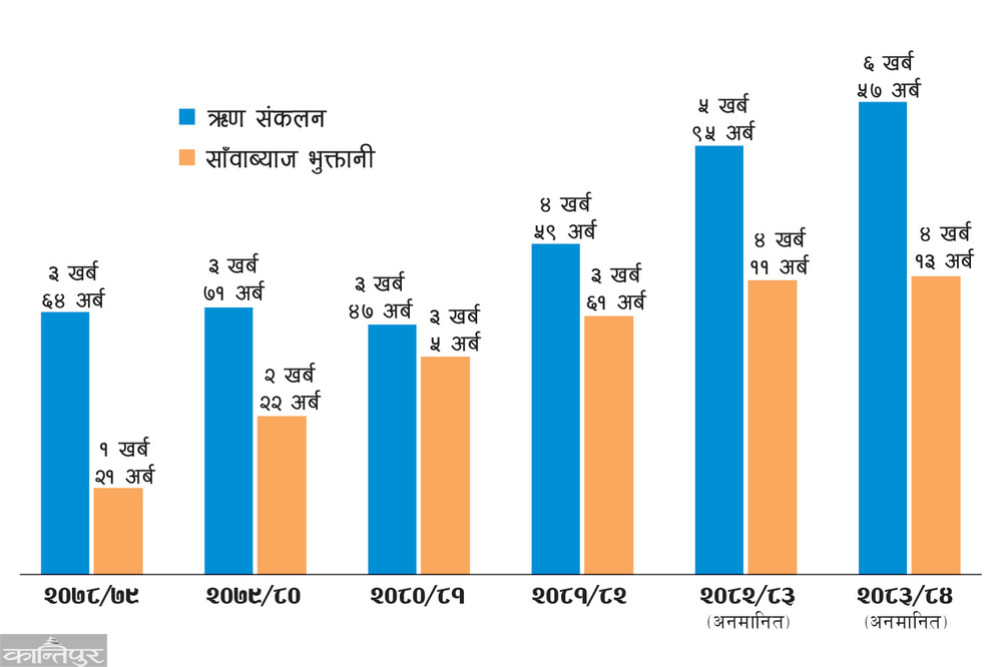
Public debt is on the rise due to borrowing to meet regular, development and financial management expenses. Looking at the data of some financial years, its ‘trend’ becomes clear. For example, in 2078/79, Rs 364 billion of debt was collected, while Rs 121 billion of principal and interest were paid in the same financial year. In 2079/80, debt collection and principal and interest payments were Rs 371 billion and Rs 222 billion, respectively. In 2080/81, they were Rs 347 billion and Rs 355 billion, respectively, and in 2081/82, they were Rs 459 billion and Rs 361 billion, respectively. In the current financial year 2082/83, debt collection and principal and interest payments are estimated at Rs 595 billion and Rs 411 billion. In the coming financial year, the government has prepared to borrow an estimated Rs 657 billion, while Rs 413 billion will be spent on principal and interest payments.
The government should reduce the debt burden by making effective measures to increase economic growth and revenue collection. If the current economy continues to operate regularly, regular expenditure and principal interest on government debt will definitely increase. Both of these are the mandatory responsibilities of the government. As soon as a large portion of the budget is allocated to these two areas, capital expenditure called development expenditure will have to be reduced. In such a situation, the development work, which is already slow, will slow down even more due to lack of financial resources.
If the budget cannot be allocated to the productive sector and infrastructure sectors, the citizens will not be able to enjoy the normal benefits of development, and employment will not be created. There will be no development, no employment, and the possible options for income generation will shrink. The country's economic activity will also slow down. The situation where the government is fed by debt and citizens have to go abroad for employment will become more natural. If a way out of such a cycle is not found, dissatisfaction among the citizens will increase.
An uncomfortable situation has arisen as every government considers it easy to take loans instead of developing the country's economic strength. As of last Jestha, Nepal's outstanding public debt has reached 2961.19 billion rupees. This has also increased the liability for paying principal and interest on the debt. Some measures can be adopted to reduce the pressure of foreign debt. First, the liability for regular expenditure should be reduced. But the government is not very sensitive to this. Second, measures should be found to increase the government's own income.
In particular, revenue collection should be made effective. Revenue leakage should be stopped. The capacity of employees should be increased. Revenue collection centers should be made technologically advanced. Since there is an open border between Nepal and India, there is a high possibility of revenue leakage. Therefore, monitoring should be increased in the border area. Third, private sector investment is indispensable to increase the country's economic strength. The state can also increase investment in infrastructure, encourage the private sector and foreign investors, provide security, announce facilities, and remove legal hassles.
Debt is a natural issue for any country. Even if we look at the debt as of Jestha, it is only 44.87 percent of Nepal's gross domestic product (GDP). Therefore, the government should abandon the tendency to take loans for regular expenses. Instead, if loans are taken for areas that will create capital, create employment, increase production and increase business potential, and have relatively higher profits, it will play a role in increasing the country's economic strength.
The government's ability to invest also increases. In such a situation, the burden and need for debt also decreases. Therefore, the government's sensitivity is essential not only in taking loans, but also in what it is used for. At the same time, the government's strategic success in reducing regular expenses and increasing revenue collection is also essential.