The challenge for the RSVP now is not just to win the next election, but also to transform current trust into institutional strength and a long-term political culture.
We use Google Cloud Translation Services. Google requires we provide the following disclaimer relating to use of this service:
This service may contain translations powered by Google. Google disclaims all warranties related to the translations, expressed or implied, including any warranties of accuracy, reliability, and any implied warranties of merchantability, fitness for a particular purpose, and noninfringement.
Every political organization is born with a historical objective. After that objective is fulfilled, the organization must be able to redefine itself. If it cannot, it gradually becomes irrelevant. The Nepali Congress may have fulfilled its historical goal of establishing democracy, the Communists to institutionalize the republic, and the Madheswadis to bring about federalism, but since they have not been able to set a new national vision and priorities, those parties seem to be heading towards a crisis of relevance today.
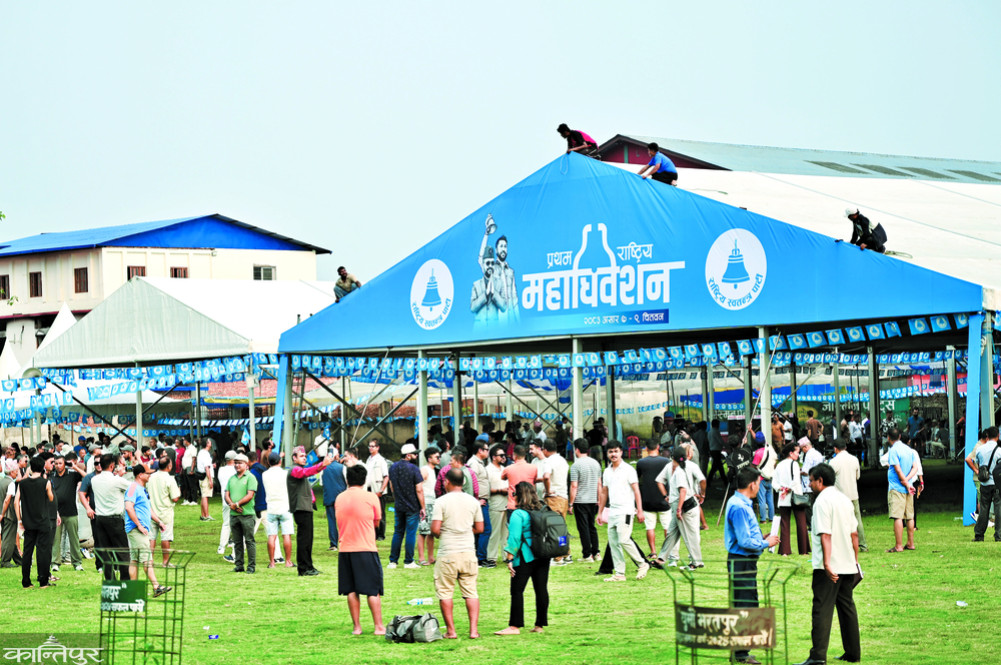
The Rashtriya Swayamsevak Sangh (RSS) party, which has become the main political force in the country without even holding its first general convention, should have a deep discussion about its objectives, current successes, and future path from its ongoing first general convention. The challenge for the RSS is not only to win the next election, but also to transform this belief into institutional strength and a long-term political culture. The success of the RSS will now be evaluated on two levels – institutional development and organizational expansion as a party, and efficient performance as a government. Let us discuss the five priorities to be set in the second chapter of the RSS, which will begin after the first general convention.
1. Government's Result-oriented Performance
The RSP is leading the federal government with almost two-thirds of the House of Representatives. It also aspires to lead the state and local governments in the near future. Therefore, it has the challenge of proving itself in both its ability to run the government and its result-oriented performance. The reason for the failure of past majority governments is the lack of delivery, i.e., the lack of easy and accessible service flow. Whether or not it can provide effective service flow will determine the future of the RSP.
Good governance and economic prosperity are prerequisites for each other. Citizens' trust can be maintained in the long term only if service flow reform, the rule of law, and a dynamic economy can be promoted together. If the economy's 'momentum' is lost, it is difficult to recover. Therefore, the government must adopt a strategy to protect businessmen who make good contributions to the private sector along with bringing wrongdoers under the law.
If we look at the government's result-oriented administration of the past three months, the citizens are enthusiastic. Even when questions arise about specific tasks, the citizens do not doubt the government's intentions. Now, on the foundation of this trust, it is necessary to institutionalize good governance within the rule of law and make the economy dynamic at the same time. But government performance alone is not enough. For long-term political stability, the ideological basis of the RSPB organization must also be equally clear.
2. Party values and ideology
The brain of any organization is ideology and the soul is values. The first general convention of the RSPB needs to bring clarity to ideology and values. There is debate on ideology outside, but values must be internalized by the party and the leadership. The institutional values that the party must adopt are method in decision-making, transparency in the process, integrity and courage in leadership, inclusive excellence in state administration, and empathy in leadership personally. Today, we need an organization based on such moral values. If the organization cannot be based on values, internal conflicts arise in parties, while the adoption of values makes the organization sustainable and acceptable. Values provide organizational culture, restrain members, and create a 'welcoming' for new leadership. The party has been formed as a new one, but to make the political system new, the party must set its values.
The party also needs to take a clear decision from this general convention regarding ideas. The basis of the ideas of the Rashtriya Swayamsevak Sangh (RSS) should be dynamic democracy. That is, in the light of democracy, politics focused on real solutions to the real problems of the citizens should rise above permanent ideological 'labels'. The need of the day is to strengthen the pluralism-based democratic republic that the RSS has currently adopted, and to further clarify the liberal economy with social justice in terms of economic ideas. But if ideas and values are limited to paper, they have no meaning. Organizational capacity is required to transform them into practice.
3. Trained organization
Consistency between theory and practice is the basis of the credibility of the organization. There must be identity in the topics written and spoken in the party and in practice. The organization must be trained for this identity. At least the speech and behavior of the members organized in the party committees must be in line with the philosophy and values of the RSS. Even now, in the villages, trained cadres of the Congress and the Communists are clearly distinguishable by their behavior. Only training can make the ideas and behavior of the members of the Rashtriya Swayamsevak Sangh (RSS) there clear and distinct.
The success of the RSS will also depend mainly on the effective implementation of principles, systems and discipline. Rather than just increasing the number of members, the RSS needs to pay special attention to building quality, responsible and value-oriented members. The party's policy and philosophy should be visible on all three fronts of the RSS's organization, government and parliament.
4. Management of potential conflicts at the leadership level
Conflicts and confrontations within the party are natural. Ideological friction is also good for the party. Differences are a natural aspect of any democratic organization. The challenge lies in the ability to manage them. In this context, the RSS has so far seen a clear division of labor among the leadership. A culture should be created in which such division of labor and clear distribution of responsibilities should take place not only between the chairman and senior leaders, but also between the organizations and leadership at every level. For example, there should be clear criteria for managing the problems that arise when moving to a multi-party system, or the bitterness and dissatisfaction that arise from internal competition. Definition of responsibility and institutional decision-making processes help manage potential conflicts. An institutional system is more effective in the long run than an individual-centered consensus.
5. Balancing expectations and reality
The issue that the Rashtriya Swayamsevak Sangh (RSS) must understand from its first historic general convention is that the strength of today's RSSW is not the strength of its organization or legacy, it is basically the strength of trust. Amidst overwhelming disappointment, voters have given their trust to the RSSW and its leadership, with great expectations. To maintain this trust, it is necessary to balance expectations and reality and communicate clearly with the people. From local level governance to neighborhood policy and diplomatic management, balanced and institutionalized action should be taken on the legitimate expectations of the people. Although the success of the RSSW today seems to be based on the leadership of a few key figures, now institutionalizing it is the main challenge for the party leadership. The expectations of the citizens can only be fulfilled in the light of this reality.
Finally, I remember a story told by a Gen-G activist. While going to the 23 Bhadra movement, another friend standing next to him said to a young man – Oh, cover your mouth, cover your mouth, if a photo of you going to the movement comes out, you won’t be given a visa later. This is not just the fear of a young man, but the psychology of a generation looking for opportunities. The situation of having to cover your mouth even in the movement for change, having to cover your mouth even when you say you will contribute to a party, having to cover your mouth when doing agriculture, having to cover your mouth when doing business, having to cover your mouth when supporting the government, having to cover your mouth when criticizing should end. An open society based on plurality and diversity, where the dream of every youth, every citizen, to work in their own country with self-respect should be fulfilled. The goal of the Rashtriya Swayamsevak Sangh (RSS) should be to raise hope, provide opportunities and show the way.
Synthesizing all these issues, the need of today’s party is to institutionalize civilized politics. And, the responsibility of the government is equitable prosperity, that is, prosperity for all Nepalis, self-respect for all. Therefore, the aim of the Rashtriya Swayamsevak Sangh (RSS) is civilized politics and egalitarian prosperity. When the entire RSSS returns from Chitwan after the general convention, it should carry this responsibility even stronger.
We said we need youth leadership, the citizens voted for the youth we said this time. We said we need a new alternative, the citizens voted with trust in the new power. We asked for a strong mandate, the citizens showed generosity in it. The citizens have fulfilled every issue and expectation we asked for. The citizens have fulfilled their obligations. Now it is the turn of the RSSS to deliver results. If the RSSS can institutionalize civilized politics and egalitarian prosperity, it will not just be a party that won an election, but a force that will lead a new political chapter in Nepal.