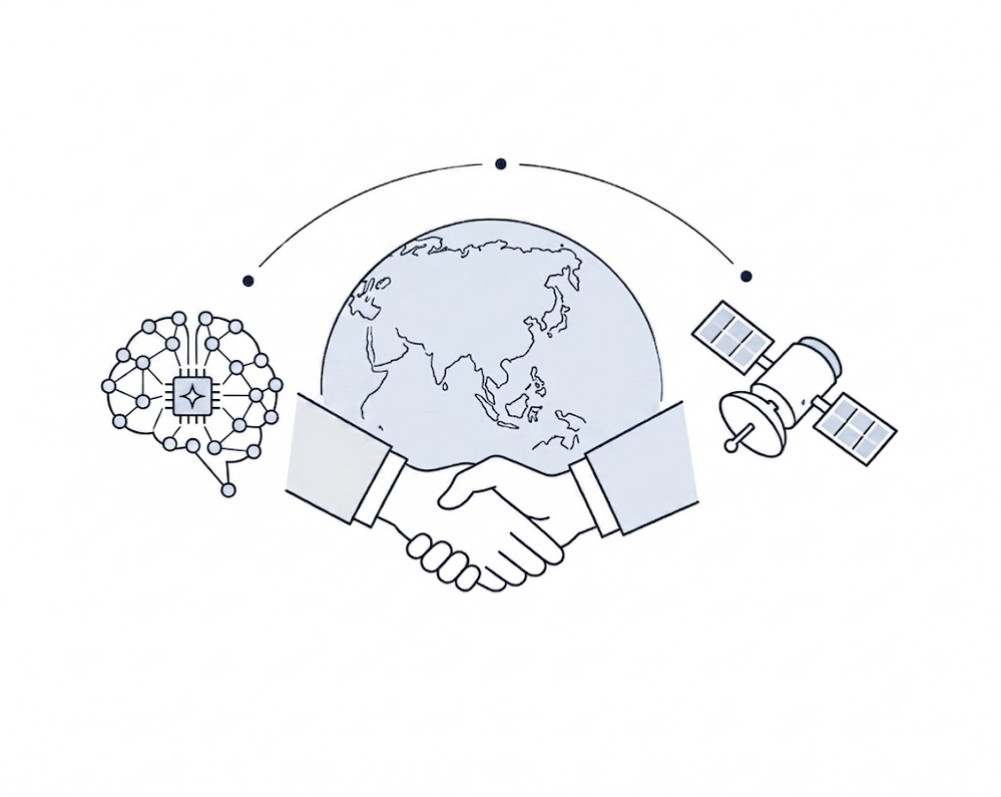
Information technology dominance and science diplomacy are no longer optional issues in today's global order. They have become essential areas in which we must vigilantly embrace, compete, and succeed.
We use Google Cloud Translation Services. Google requires we provide the following disclaimer relating to use of this service:
This service may contain translations powered by Google. Google disclaims all warranties related to the translations, expressed or implied, including any warranties of accuracy, reliability, and any implied warranties of merchantability, fitness for a particular purpose, and noninfringement.
We are on the verge of entering the era of ‘Pax Technica’, i.e. the era of technological dominance. Many say – we have already entered. The word ‘Pax’ generally refers to an international order established under the leadership of a powerful nation and the relative peace or stability created by it. In the history of international relations, such periods are often explained in connection with the name of a specific nation. For example, Pax Britannica or Pax Americana. But today, not the name of any country, but information technology itself has become the main basis of dominance. Again, the winner in this will be the emergence of another Pax Era.
A completely new era has emerged in which the knowledge, capabilities and manpower of information technology play a decisive role in all areas of a country’s economy, society, politics, military power, etc. Countries are competing to rise to the forefront and remain at the top in the adequacy, assurance and mobilization of such strategic technologies (such as memory chips, artificial intelligence, quantum computing, etc.) and manpower. For that, gaining a prominent position or getting high priority through science diplomacy, which is indispensable for overcoming all old forms of diplomacy, has certainly become an indispensable condition for national independence.
Now let's look at its theoretical and practical aspects in detail. Hegemony or 'hegemony' is one of the most used words in foreign affairs and international relations as a whole. But in many places it is used abstractly without any detailed definition. In international relations, which has been established as a separate field of study since the 1950s, the use of hegemony has been focused on three major subgroups. First and certainly, there is realism that considers military power as the decisive currency in relations between states. In this view, which understands international politics as a continuous power struggle and competition between nations trying to gain power to ensure their existence and security, there was a long debate on what is the basis of hegemony. American professor John Mearsheimer's book 'The Tragedy of Great Power Politics' published in 2001 brought this long debate to a logical conclusion. According to him, land power is the decisive form of military power. That is, the most powerful state is the one that has the most capable and strong (land) army.
Second, in the neoliberal view of international relations that emerged in the 1970s, on the basis of the weakness seen in the internal economy and society of the United States and the Soviet Union, which had been leading the two poles of the Cold War, and the successful practice and growing attraction of international and regional mechanisms and institutions, there was a lot of discussion about a world order without the hegemony of any one country. Neoliberal professor Robert Keohane's 1984 book 'After Hegemony: Cooperation and Discord in World Political Economy' is a vivid example of this. According to him, even after the end of a country's dominance, the institutions built by that country remain alive and play a decisive role in the world order. That is, it was claimed that the liberal world order would last for a long time despite the competition between countries.
Third, there is critical thinking. According to neo-Marxist professor Robert Cox, who argues that the theory of international relations should be studied in two parts: problem-solving and critical, the combination of material capabilities, ideas, and institutions creates a historical structure and that determines which country becomes dominant. For almost seven decades, the above three theoretical perspectives, centered on nation-building, dominated the debate on dominance in foreign affairs. The rise of the ‘Pax Technica’ era has shaken the very roots of their basic propositions. The same old pattern, facts, figures and commentary, which was used to discuss foreign relations before 1990, has now become irrelevant. The country and the world have changed, so let us also refine our discussions of foreign affairs.
Technological dominance
It is natural that countries that have developed the latest technology will achieve great economic growth and, on the basis of that, will also be at the forefront of international politics. As Britain, which has achieved success in industrialization, became a country on which the sun never sets, the status or role of countries that have established dominance in new sectors of industry and its supply chain by developing technology has become a formula in international politics. The competition for technological dominance is also a regular series of the same world politics. But there are some specific dimensions to it, without an in-depth discussion of which it is difficult to draw a picture of the world order determined by the 'Pax Technica'.
First, of course, there is the highest competition in the development of new technologies worldwide. For example, even now, there is a global competition to see who will succeed in the use of microtechnology (below 3 nm and 2 nm) and ultraviolet devices in the manufacture of semiconductor chips that serve as the main 'brains' of artificial intelligence, military technology, smartphones and modern vehicles. The number of competing countries and the strategy of competition are as widespread and widespread as a world war.
The reasons are clear. On the one hand, success in the development of strategic information technology can bring about radical changes in major industrial sectors, the entire national economy and even military technology at once, so the development of technology has become a matter directly linked to national identity and independence. On the other hand, once a competing country advances in such technologies, it takes a long time for any powerful country to catch up with or surpass the leading country, and the multifaceted risk of falling behind in the development of strategic technologies is high.
The second and most important issue is that a country or group that is successful in developing the latest technology can create a global standard based on the technology it has developed and force all other countries to use the same technology or develop similar technology. This has also become a major tool for dominating world politics. In July 2025, the US announced the ‘Full-Stack AI Package’ as an integrated system of artificial intelligence. This is an integrated solution model from hardware, software, platforms to services required for developing AI. The expansion of the US model to its allies reflects its clear intention to establish its dominance in the digital world order. In order to create its own special role from this situation, in July 2025, Chinese Premier Li Keqiang proposed the establishment of the ‘World Artificial Intelligence Cooperation Organization’ (WAICO), a United Nations-like organization of common AI for all countries in the world, arguing that the development of artificial intelligence should be for the common good of humanity. Chinese officials have been talking about the fact that a lot of progress has been made in this regard from time to time. In particular, there is widespread competition in the world today in information technology, which does not seem to be the right standard.
Third, new ‘techno-blocks’ are being formed based on the supply chain of technology development cooperation, raw material trade, and strategic technology distribution. Just as political ‘blocks’ were formed on the basis of military alliances in yesterday’s world politics, the supply chain of strategic information technology is now determining it. This has become a major basis when discussing the transformation of the world order. Therefore, the issue of which countries Nvidia founder and CEO Jensen Huang visits and with whom he talks is more important than the visit of any head of state in the world. Because, he is at the center of the supply chain of artificial intelligence development.
Fourth, they are also emphasizing the development of ‘platforms’ that can increase their influence in each other’s countries. The long-running dispute between the US and China over the purchase and sale of TikTok is a vivid example of this.
Fifth, the competition to ensure the human resources required to develop technology is also an important aspect of technology dominance. There is a global competition for strategies to develop and sustainably sustain high-level human resources in the field of strategic technology development. There has been much discussion that the fourth and fifth dimensions are both opportunities and challenges for Nepal.
Science Diplomacy
The topic of information technology is discussed not only in relation to national economy and security, but also in relation to the rapid climate change, especially the green transformation that is currently being discussed worldwide. In this sense, the issue of cooperation (and, competition) in the information technology sector in the formal and informal relations that every country has with other countries has now become a difficult issue to distinguish. As a result, the importance of science diplomacy has increased incomparably.
There is no single prevailing definition of science diplomacy, which has been in widespread use since 2010. Generally, the use of science diplomacy is understood as an international activity focused on the joint development of science and technology, human resource exchange, and treaties and agreements related to science and technology through cooperation between countries. Improving diplomatic relations through cooperation in the field of science and technology or developing the field of science and technology by mobilizing diplomatic relations is called science diplomacy.
But as mentioned above, as the development of science and technology has become an issue directly linked to national independence, every country has been broadening the definition or practice of science diplomacy and giving it more importance . Today, science diplomacy has become a comprehensive strategy to protect its country from the constant information technology dominance game and to keep the country at the forefront of that competition from the creation process to the use of major strategic technologies . For that, countries seem to be giving a special place in national politics to the ministry or office that handles science diplomacy, spending maximum energy on the development of areas where their country has competitive capabilities, making necessary laws, appointing science attachés or coordinators in countries that need cooperation, and preparing/operating ‘platforms’ for regional and global cooperation for scientists in their country, all under the same umbrella of science diplomacy .
The realization we need to make
As mentioned above, information technology dominance and science diplomacy are no longer optional issues in today's world order. These have been established as essential areas in which we must carefully assimilate, compete, and achieve success. We have become mere spectators of this global transformation. If we do not have a place in the development and use of information technology in strategic areas, our identity as a small but natural, cultural, and historically middle power country will be at risk. In addition, if we start 'collaborating with whoever comes first' without considering the flow and competition of world politics, Nepal may be further affected by the competition between power countries.
When Nepal has formally announced its intention to become a regional tech hub and benefit from the development of global information technology, a strategy and action plan for 'national science diplomacy' are necessary to transform our vision into reality. Even on very sensitive issues, there is a lack of cooperation due to the walls between the stakeholders. जसले गर्दा, हामीले असफलताको तीतो अनुभव भोगेका छौं । तर अहिलेको ऐतिहासिक अवसरलाई सदुपयोग गर्दै देशको मुहार फेर्न राष्ट्रिय संकल्प गर्ने बेला आएको छ । देशभित्र अधिकारसम्पन्न कानुनी निकायको तर्जुमा, स्रोत सुनिश्चितता, प्रमुख शक्तिराष्ट्रमा रहेका हाम्रा दूतावासहरूमा विज्ञान सहचारी वा संयोजक नियुक्ति, विज्ञान कूटनीति केन्द्रित शैक्षिक कार्यक्रम एवं जनशक्ति विकास र देशबाहिर विश्वका कुना–कुनामा विज्ञान र प्रविधिको क्षेत्रमा अपरिकल्पनीय सफलताहरू हासिल गरिरहेका नेपालीमार्फत ‘नेपाल विज्ञान सौम्य शक्ति पब्लिक डिप्लोम्यासी परियोजना’ सञ्चालनको एक नयाँ अध्यायको सुरुवातमा सिंगो देश व्यग्र प्रतीक्षारत छ ।