Will Nepal now move on to another major ‘system change’ debate or focus on changing ‘capacity within the system’? For Nepal, which is located in the sub-regional structure of South Asia, the second option is the long-term solution.
We use Google Cloud Translation Services. Google requires we provide the following disclaimer relating to use of this service:
This service may contain translations powered by Google. Google disclaims all warranties related to the translations, expressed or implied, including any warranties of accuracy, reliability, and any implied warranties of merchantability, fitness for a particular purpose, and noninfringement.
I am writing this article from Dhaka, Bangladesh. From here, what is happening in Kathmandu seems surprising. Not because Bangladesh is a prosperous economy and a developed country. It is because the gap between similarities and differences between Nepal and Bangladesh is narrowing. These two countries are geographically close but not neighbors with shared borders. In the recent past, both these countries have seen major political changes. Both have decided not to leave the list of least developed countries for a few years now. Geographically, they are almost equal. But Bangladesh's population is almost 6 times that of Nepal, and its economy is about 11 times larger than Nepal's. Socially, both are different. Disappointment is widespread in both countries.
Due to the disappointment seen in both countries, a major political upheaval occurred in both countries some time ago. Now there is a need for political, economic and social renaissance. But political leaders who can lead it have not emerged in both countries. The leadership that is currently in power has not shown signs of being able to lead a renaissance with political principles. Therefore, what needs to be seen is whether a new political leadership can be born from this campaign. In this article, I will discuss this topic.
The main reason for the astonishment of looking at Kathmandu from Dhaka is not only the drama of the political event, but also the structural reality that the event revealed. Nepal has gone through many stages of system change in recent decades. The form of the state, the distribution of power, the language of representation, and the formal structure of governance have changed extensively. But the basic structure of the economy, especially the capacity to produce, the nature of employment, and the culture of policy stability, have not changed at the expected pace. As a result, political competition has become more focused on ‘what to distribute today?’ than on ‘what to build tomorrow?’. When the power of the state is weak, politics becomes a mere performance art. When such performance increases, institutional discipline weakens. This vicious cycle is perpetuating today’s despair. And, not only Nepal, but also Bangladesh seems to be struggling with this vicious cycle in its own way.
The main reason for the astonishment when looking at Kathmandu from Dhaka is not only the drama of the political event, but the structural reality that the event has revealed. One of the realities of Nepal’s economy is that production within the country is low and the population is leaving the country to work abroad for employment. Remittances have made household consumption possible. Which has increased imports and made it easier for the government to collect revenue in the industrial and agricultural sectors. But it has also blocked the path of reform in the industrial and agricultural sectors. It has also facilitated those who do politics and are involved in policy-making to avoid this issue. When consumption and imports increase, revenue comes from customs and consumption taxes. Once the revenue comes, the state can prioritize short-term distribution over long-term productive reforms. Prioritizing distribution again reduces the pressure on investment and reform towards production. The biggest cost in this cycle is borne by the youth. They decide to go abroad when they do not see an adequate ‘platform’ to use their energy, skills and ambitions within the country. This makes every youth make foreign employment a way of personal balance. But it increases the risk of long-term ‘brain drain’ and ‘demographic vacuum’ for the nation, which also affects social cohesion and the future of the domestic market.
This difference becomes even clearer when compared to Bangladesh. Bangladesh also suffered from poverty, inequality and political polarization. But it expanded its labor-based production structure linked to the global market. After entering the export-oriented industry, policy-making is automatically tied to the discipline of ‘competition’ and ‘just-in-time delivery’. Availability of raw materials, port operations and continuity of energy are required. This does not mean that Bangladesh is successful. There are challenges in labor rights, security, banking discipline and political inclusion. But the economic structure has forced the state to perform some minimum functions. Such a compulsion is weak in Nepal. Because remittances have largely met the immediate needs of foreign exchange and consumption. Therefore, the social basis of discontent in Nepal is not only poverty, but also the question of ‘why work hard?’. Here the relationship between hard work and opportunity is blurred.
This is where the psychology of political crisis begins. The formalities of democracy such as periodic elections to the parliament, federalism, and the language of rights have given hope to citizens. But when the experiences of daily life such as service delivery, justice, employment, and price stability do not improve, that hope is turning into despair. In our country, this experience is even more pronounced among the common people. Because even after many stages of transition, basic state capacities such as transparency in public procurement, impartiality of regulatory institutions, credibility of tax administration, and accountability of public services have not been established at the expected level. Federalism means service close to the citizen. But in practice, service delivery is felt to be more complicated in many places due to ambiguity of responsibilities, dual structures, and resource-capacity imbalance. When institutional clarity is reduced, governance depends on individual decisions and interpersonal relationships. When there is reliance on interpersonal relationships, there is policy opacity and no stability. In an opaque situation, when policy stability decreases, the private sector is afraid to invest. When the private sector is afraid to invest, employment decreases. Which leads to a lack of employment and increases frustration. In this way, economy and politics are tied into one knot.
This knot is further complicated by the sub-regional geo-economics of South Asia. The fact that Nepal is a landlocked country is not just geography. It is a strategic condition of the economy. Nepal's main import and export, from petroleum to fertilizers, from raw materials to medicines, all pass through India. India is not just a neighbor for Nepal, but a kind of 'logistics and transit platform'. When relations with such a platform are good, the market opens up, costs decrease, and supplies become easier. When relations cool or procedural friction increases, costs can suddenly increase through customs, standards, inspections, border capacity, and permit processes. These frictions are often not clearly visible in diplomatic statements. They appear in the form of 'delays', 'strictness', 'informal restrictions', or 'technical standards'. Such subtle pressures can cause big waves in price increases, industry costs, and public anger towards the government within the country. This is why Nepal's relationship with India continues to be a sensitive tug-of-war between economic reality and national sentiment.
Bangladesh is also in a similar but different nature with India. It has a long border with India, and 'connectivity' is important with northeastern India. There are issues of energy and water management. There are multilateral agreements on trade-transit. But Bangladesh has access to seaports, and export-oriented industries have opened the door to alternative world markets. Geography has provided some space for ‘multiple options’. In Nepal, the space for multiple options is inherently small. Even if there are attempts to open alternative routes, they are not immediately replaceable on a large scale. Therefore, the domestic political cost of any tension in Nepal’s relations with India is high. And, when domestic politics are weak, the risk of confidence in talks with India also increases. A kind of ‘weak domestic governance, weak bilateral negotiations, and weak domestic economy’ cycle runs. Which has to bear the economic cost of political instability.
Another reality of South Asia is that regional integration is weak. Due to SAARC’s inertia, obstacles to cross-border trade, and political mistrust, the region has not been able to develop a common value chain, energy market, and formal mobility of labor skills sufficiently. This has a direct impact on small economies like Nepal. If sub-regional markets were easier, Nepal could have scaled up rapidly in hydropower, tourism, agricultural production and services. But as the market access is politically and procedurally narrow, Nepal has had little or is losing the opportunity to ‘prove’ its potential competitiveness. This is why sub-regional platforms such as BIMSTEC or BBIN have become mere papers.
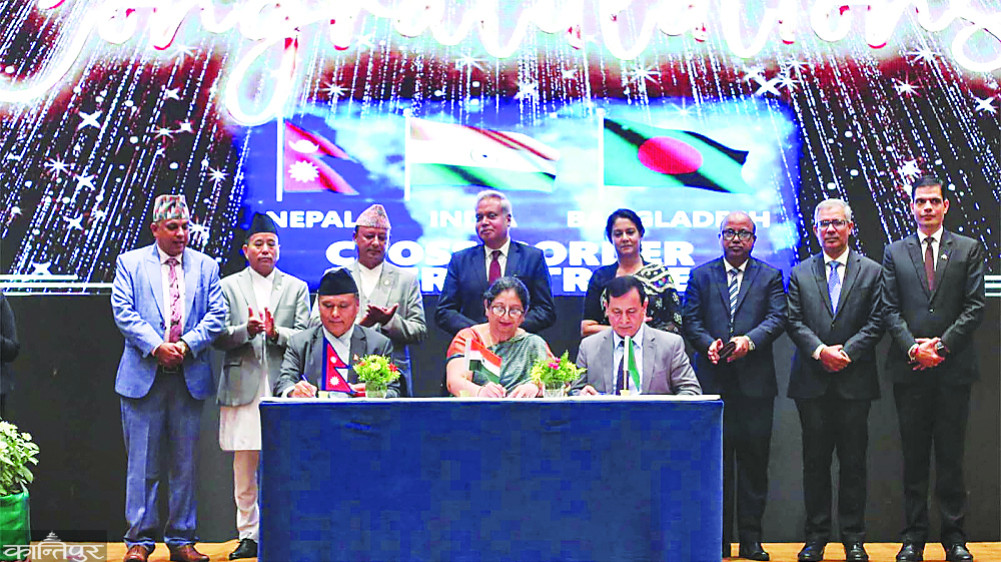
In this context, although the potential of Nepal-Bangladesh relations is great, the path to implementation seems complicated. Nepal and Bangladesh do not share a direct border, so trade, tourism or energy cooperation inevitably depends on India’s geography and grid/transit agreements. This dependence has made the relationship tripartite. It is not possible with the will of Nepal and Bangladesh alone. India’s cooperation is essential. This is especially crucial in energy trade. Nepal has hydropower potential. Bangladesh needs energy. India has grid and transit capacity. But energy is not just a trade commodity. It is a strategic issue linked to long-term agreements, national security, pricing and regional influence. So there is a lot of friction going on ‘behind the scenes’. Issues such as delays in technical approvals, transmission line priorities, price structure debates and domestic political signals come to the fore. If Nepal wants to make energy cooperation with Bangladesh a reality, it must strengthen its project preparation, regulatory clarity and credibility in implementing agreements. Because when working based on a tripartite structure, the weak side is always in question.
Another reality emerges when we connect the political discontent within Nepal with the sub-regional reality. Many decisions are determined by the ‘long-term capacity of the state’. Tax administration, public procurement, education reform, labor market reform, competition policy, banking discipline, etc. are all subject to political risk. This makes not only investors but also long-term agreements with neighbors uncertain. When policy credibility is weak, bilateral and trilateral negotiations are also limited. This pushes Nepal back from a place where it can gain strategic leverage. This is why the political landscape in Kathmandu looks like a structural risk, not just ‘news’ from Dhaka. Because the impact of this risk extends beyond Nepal's borders, to sub-regional connectivity and the energy/trade equation.
A bitter truth of history is that new leadership is often not born simply as a 'new face'. For new leadership to emerge, the rules and incentive structures must change. A bitter truth of history is that new leadership is often not born simply as a 'new face'. For new leadership to emerge, the rules and incentive structures must change. In Nepal, the structure of leadership selection is often affected by factional agreements, unequal access to financial resources, and closed competition within organizations. Such a structure makes it difficult for individuals with policy expertise, economic discipline, and an agenda of institutional reform to rise to the top. On the other hand, in Bangladesh, political polarization and excessive centralization of power seem to be narrowing the space for alternative leadership. The problem is even more complex in Nepal. Because the very foundation of the economy rests on external labor and import-consumption.
The economic model adopted by Nepal must be in line with sub-regional realities. First, energy. Hydropower is a potential backbone of Nepal's long-term comparative advantage. But to benefit from it, domestic transmission, project implementation capacity, environmental/social management and the credibility of long-term purchasing agreements are needed. When it comes to energy exports, one must not only rely on national sentiment but also on the practicalities of price, time and risk sharing. Because market and grid politics are also politics. Second, tourism. Tourism provides foreign exchange, employment and drives local economies. But for this, city management, security-trust, airport/airline access and experience-based service quality are essential. Third, high-value agriculture and agro-processing. This can increase both rural employment and income, but it requires irrigation, storage, quality standards and market access. Fourth, the service sector and the digital economy. Here, Nepal can export small but result-oriented products to regional markets if given skills and a stable policy environment. But there is a common condition in all these areas – policy stability and institutional trust.
The relationship with India is also a test of this trust. Nepal can have an emotional goal of reducing its dependence on India. तर व्यावहारिक रूपमा हेर्ने हो भने त्यस्तो लक्ष्य ‘निर्भरताको गुणस्तर सुधार’ मा हुनुपर्छ । ट्रान्जिटलाई नियममा आधारित अनुमानयोग्य बनाउने, सीमामा हुने प्रक्रियागत घर्षण घटाउने, व्यापार मापदण्डमा सहकार्य गर्ने र ऊर्जा व्यापारलाई पारदर्शी दीर्घकालीन ढाँचामा राख्ने । यस्तो सुधारले राष्ट्रिय हितलाई कमजोर पार्दैन । उल्टो, नेपालको शक्ति बढाउँछ । किनकि जब घरेलु प्रणाली व्यवस्थित हुन्छ, बाह्य पक्षसँगको सम्झौता पनि स्पष्ट हुन्छ । यही सन्दर्भमा बंगलादेशसँगको सम्बन्धलाई पनि ‘कूटनीतिक निकटता’ भन्दा ‘आर्थिक परियोजना निकटता’ मा रूपान्तरण गर्न सकिन्छ । ऊर्जा, पर्यटन र व्यापारका साना तर ठोस उपलब्धिहरूबाट भरोसा बनाउँदै जाने, जसले त्रिपक्षीय संरचनामा पनि व्यावहारिक गति दिन्छ ।
अन्ततः ढाकाबाट काठमाडौं उदेकलाग्दो देखिनुको कारण राजनीतिक हल्ला मात्र होइन, त्यो हल्लाले संकेत गरेको प्रश्न हो । नेपाल अब अर्को ठूलो ‘व्यवस्था परिवर्तन’ को बहसमा जान्छ कि ‘व्यवस्थाभित्रको क्षमता’ परिवर्तनमा केन्द्रित हुन्छ ? दक्षिण एसियाको उपक्षेत्रीय संरचनामा बसेको नेपालका लागि दोस्रो विकल्प नै दीर्घकालीन समाधान हो । संस्थागत क्षमता बढाउनु भनेको परियोजना निर्माण मात्र होइन, बरु न्याय, सेवा, कर निष्पक्षता, सही नियमन र सार्वजनिक खर्च उत्तरदायी बनाउनु हो । यही आधारबिना न नयाँ नेतृत्व टिक्छ, न बाह्य साझेदारीबाट लाभ उठ्छ, न युवालाई देशमै भविष्य देखाउन सकिन्छ । तर यही आधार बनेपछि मात्र नेपालले भारतसँगको संवेदनशील सम्बन्धलाई कम भावनात्मक, बढी नियम–आधारित बनाउन सक्छ । बंगलादेशसँगको सम्भावित सहकार्यलाई कागजबाट व्यवहारमा उतार्न सक्छ । र, दक्षिण एसियामा उपक्षेत्रीय एकीकरणको थोरै भए पनि फाइदा आफ्नो पक्षमा मोड्न सक्छ ।
त्यसैले, ‘अभियानले नयाँ नेतृत्व जन्माउँछ कि सक्दैन’ भन्ने प्रश्नको जवाफ संस्थागत क्षमता अभिवृद्धिमा छ । यदि नागरिकको दबाबले पार्टीभित्र आन्तरिक लोकतन्त्र, चुनावी खर्चको पारदर्शिता, नियामक स्वायत्तता, सार्वजनिक खरिदको शुद्धता र आर्थिक नीतिमा न्यूनतम सहमतिको बाध्यता सिर्जना गर्यो भने नयाँ नेतृत्व जन्मिन सक्छ । नियम नबदल्ने हो भने अहिलेका नयाँ अनुहार पनि पुरानै संरचनाका कैदी हुनेछन् । ढाकाबाट हेर्दा काठमाडौंमा देखिएको उदेक यही द्वन्द्वको दृश्य हो । मुलुक र आममानिस परिवर्तन चाहन्छन् । तर परिवर्तनको वास्तविक ठाउँ संविधानको धारा होइन, दैनिकी र अर्थतन्त्रको संरचना हो । यो तथ्य स्विकारेर अघि बढ्न सके नेपालले निराशालाई पुनर्जागरणको इन्धन बनाउन सक्छ । सकेन भने यो उपलब्धि खेर जान्छ र अर्को उथलपुथलको चक्र सुरु हुन्छ । र, दक्षिण एसियाको उपक्षेत्रीय राजनीतिले त्यो चक्रलाई अझ जटिल बनाइदिन्छ ।