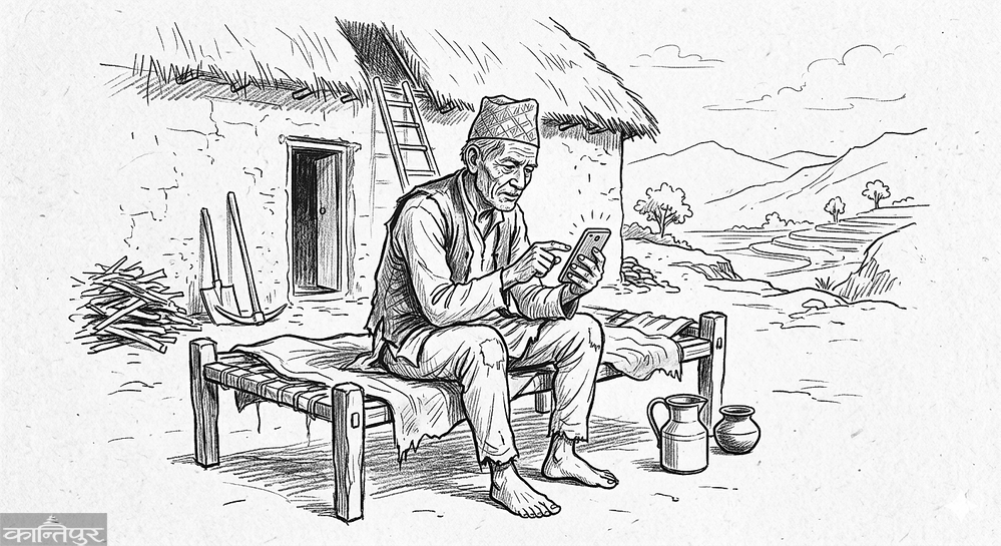
The true assessment of a digital state is determined by how easily even vulnerable citizens can exercise their basic rights. Therefore, the ‘Digital Nepal Center’ must be expanded rapidly.
We use Google Cloud Translation Services. Google requires we provide the following disclaimer relating to use of this service:
This service may contain translations powered by Google. Google disclaims all warranties related to the translations, expressed or implied, including any warranties of accuracy, reliability, and any implied warranties of merchantability, fitness for a particular purpose, and noninfringement.
Imagine a farmer in a remote part of Karnali. He has a relatively cheap smartphone, which represents the miracle of ‘connectivity’. His device has a ‘4G signal’. But, when he tries to apply for agricultural subsidies or register his land, he runs into difficulties. Because, the formats of our government portals are so complex, which are incomprehensible to a farmer.
Digital transformation is also at the heart of the 100-point roadmap for effective governance put forward by the Nepal government. We are at a crucial juncture in this regard. ‘Digital Nepal’ has great potential. It has the potential to streamline public services, curb corruption and accelerate economic growth. However, if we only import ‘text-heavy’ digital models from Western countries, we will end up digitizing our existing inequalities. This will be an unintended consequence.
Nepal’s adult literacy rate is around 70 percent. The rate is very low among marginalized communities, women and the elderly. In this context, a digital strategy that assumes universal literacy is not a national development strategy. It will leave one-third of the population behind. Let me add my experience here, it took my illiterate mother just three months to teach me how to call by pressing the button on an iPhone. Therefore, to fulfill the true promise of e-governance, our complex websites need to be made usable by ordinary citizens. For that, we need to use the concept of the ‘Trident of Inclusion’.
Inclusive Trident
The trident is a traditional three-pointed figure. It can be used as a powerful ‘metaphor’. Before launching any new digital public service, it should be evaluated on the basis of three pillars –
Voice-based architecture
The Internet is built globally for reading and typing. However, an inclusive Internet must be built for speaking and listening. For those who cannot read rigid digital forms, voice is the most convenient medium. Key public services should be accessible through ‘Interactive Voice Response’ systems and ‘Voice Commands’ available in major Nepali languages.
Furthermore, our basic digital infrastructures, such as the National Data Exchange Layer, should be designed to support secure, voice-based queries. So that citizens can avail services through a simple phone call.
Visually intuitive interfaces
Symbols, color-coding and simple visual cues that are understandable to all should be prioritized. Along with this, the concept of authentication should also be reconsidered. Remembering complex passwords is inconvenient for many. Digital identity systems should be based primarily on biometric authentications such as fingerprints or facial recognition. This makes the physical presence of the citizen the ultimate and never-to-be-forgotten weapon to exercise their rights.
Agent-assisted ‘human bridge’
The third and most important aspect of Trishul is the recognition that the best interface for complex digital systems is often a trained human. This requires a wide expansion of assisted digital models. For this, ‘Supportive Digital Services’ should be expanded widely.
Need for Digital Nepal Center
This is where the concept of Digital Nepal Center comes in as the most practical and cost-effective way of inclusion.
Taking inspiration from Bangladesh’s highly successful A2I (Aspire to Innovate), Nepal should establish and franchise a network of locally operated Digital Service Centers nationwide. A Digital Nepal Center is not an office run by a government employee. It is a micro-enterprise.
Imagine—there is a small service center in a rural municipality, where computers, biometric scanners, printers, and reliable internet connection are available. This center is run by local entrepreneurs, especially young people or women from the community who are interested in technology. When that farmer in Karnali needs an agricultural subsidy, he does not have to struggle with his smartphone or travel long distances to reach the district headquarters. He goes to the Digital Nepal Center in his own village. He meets a local agent there whom he knows and trusts. And, through him, he completes the application process as per his work. In this way, citizens get services easily and agents receive a small commission regulated by the government for their services.
Investment in human capital and economic strength
Establishing and expanding such centers is not just an investment in information technology, it is an investment in human capital and local economic strength.
First, it immediately resolves service delivery barriers. There is no need to wait for 100 percent digital literacy to use 100 percent digital services. The ‘human bridge’ overcomes the literacy barrier.
Second, it creates thousands of sustainable micro-enterprises across the country. When the government franchises this model, local youth can become digital leaders of their own communities. This can reduce rural-urban migration. Because, jobs are created in the villages. It encourages a new generation of local technology entrepreneurs.
Third, it builds an indispensable foundation for digital transformation—trust.
In a society where digital fraud is on the rise and data privacy is still in its infancy, citizens can feel confident about e-governance when trusted local people act as digital intermediaries.
The way forward
The Government of Nepal’s 100-point action plan is a bold commitment. But the true measure of a digital state is not how complex its code is or how fast its servers are. Its true measure is how easily the most vulnerable and deprived citizens can exercise their basic rights.
To make Digital Nepal a reality for all, policymakers, international development partners and the private sector must unite around the aforementioned inclusive vision. Investment in the development of voice-based public digital tools must be increased and Digital Nepal Centers must be rapidly expanded.
By embracing the trident of inclusion and investing in human bridges that connect communities, we can make Nepal’s digital transformation not just about technological improvements but also a powerful tool for equality, empowerment and economic opportunity.
(The views expressed are the author’s own)